Teatro Real de Madrid 2025-26 Review: Roméo et Juliette (Cast B)
Thomas Jolly’s Production & How Shakespeare’s Tragedy Emerged from the Ruins of the Belle Époque
By Galina AltmanAt the heart of “Romeo and Juliet” lies an archetypal story rooted in antiquity, Ovid’s tale of Pyramus and Thisbe from the “Metamorphoses.” A fatal misunderstanding, a false report of death, and a double suicide beside a tomb: Shakespeare transferred this ancient mechanism of tragedy onto the stage, making youth itself hostage to the feuds of an older world.
When Charles Gounod turned to the story in 1867, Europe was living through a very different age. Paris, transformed by the Exposition Universelle, became a showcase for a new world and for the cultural foundations of what would later come to be known as the Belle Époque. Luxurious hotels opened their doors, new theaters and boulevards were built, culture became an essential part of urban life, and beauty and elegance were elevated almost to the level of civic duty. It was an era of confidence in progress, refinement, and faith in the arts.
Gounod’s opera absorbed this atmosphere completely, and Shakespeare’s tragedy acquired a new style and tone. Renaissance severity gave way to French melodic sophistication, the cult of sentiment, and exquisite lyricism. Even death became surrounded by beauty.
Production Details
Thomas Jolly’s production at Teatro Real rejects neither Shakespeare nor Gounod, existing precisely at the intersection of these two worlds. Jolly preserves the musical beauty of the French score while restoring the story’s primal brutality. The production thrives on the constant friction and sparks generated between Gounod’s elegance and Shakespeare’s sense of inexorable fate.
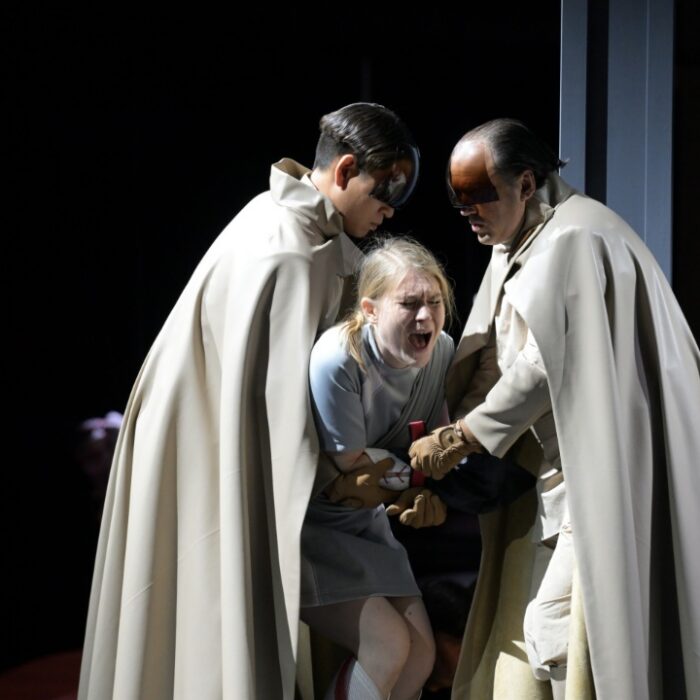
The director takes as his point of departure Mercutio’s famous curse: “A plague on both your houses!” Verona becomes a landscape of disease, decay, and collective madness. The central image of the production is a gigantic revolving double staircase, simultaneously evoking the grand ceremonial spaces of the Palais Garnier and the ruins of a civilization no longer capable of saving its own children. The crowd scenes resemble a panicked infected mob, while the protagonists inhabit a world where death is present from the very first moments.
The principal intrigue of the Madrid run lay in the opportunity to experience radically different casts within the same directorial framework. The result was a fascinating experiment: how differently can the same production reveal itself depending on the artists inhabiting it?
Julia Muzychenko as Juliette
Muzychenko’s Juliette felt like a living human being. Her heroine did not merely portray emotions; she lived through them all, from the exhilaration of her first ball to the devastating grief of losing her beloved and the fatal conclusion of the story. Suddenly, the opera ceased to feel like another nineteenth-century masterpiece and became the real tragedy of two teenagers denied a future. Remarkably, it remained aesthetically and vocally beautiful throughout.
A laureate of the Queen Elisabeth Competition in Brussels and a former soloist of Dresden’s Semperoper, Muzychenko demonstrated the rare ability to unite vocal excellence with contemporary dramatic truth. In the first act, her waltz sounded light, transparent, and completely natural. As the drama unfolded, her voice gradually acquired greater emotional depth. Particularly striking were the potion scene and the final duet in the tomb, moments that left many audience members visibly moved. Yet Muzychenko never forced the sound or substituted emotion with vocal effect. Her French cantilena retained its flexibility and beauty while remaining profoundly human. She proved to be the artist most organically integrated into Jolly’s physical theatre aesthetic.
While Ismael Jordi occasionally struggled against Carlo Rizzi’s dense orchestral textures in the largest dramatic passages, Muzychenko seemed to inhabit the chaos itself. She flew up the towering staircases toward the balcony scene while executing demanding choreography and maintaining complete control of her vocal line. In Juliette’s feigned death scene, she hurled herself downward and tumbled to the foot of the stage with the sudden violence of a bird struck down in mid-flight.
More Cast Highlights
The supporting cast also shifted the dramatic balance. Particular attention must be paid to Mercutio in the second cast, delivered by Carles Pachon, whose musical line remained remarkably fluid despite the role’s rhythmic density and textual fragmentation. Stéphano, sung by Carmen Artaza, offered a sharply defined stage presence, while bass David Lagares made a strong impression as the Duke of Verona, his noble timbre adding weight to the ensemble. Jean-Fernand Setti’s Capulet, with his resonant voice and commanding paternal presence, likewise contributed significantly to the cohesion of the stage world.
It would also be impossible not to mention Josépha Madoki’s dynamic choreography, which allowed Shakespeare’s classic drama to breathe in an entirely new rhythm. A leading figure of the French dance scene, Madoki incorporated elements of street dance and vogue into the production, decisively breaking with traditional operatic rigidity. The audience simply had no opportunity to look away; the spectacle carried the energy of carnival and the intensity of collective ritual.
Costume designer Sylvette Dequest reinforced this visual atmosphere through a striking monochrome fusion of high fashion and streetwear, creating a world that felt suspended between elegance and collapse.
The orchestral foundation of the production, led by Carlo Rizzi, sustained this unstable balance between French lyricism and theatrical violence, shaping a soundscape that continuously shifted between clarity and density.
Thomas Jolly’s production exists at the collision point of two aesthetics: Gounod’s French lyricism and Shakespearean brutality.
Yet it was the performances led by Julia Muzychenko that revealed the production as it was most likely intended. Free of conventional operatic pathos and decorative beauty for its own sake, they exposed the emotional truth at the heart of the drama. Muzychenko did not merely coexist with Jolly’s concept; she became an essential part of it.
In the end, the greatest revelation of Teatro Real’s “Roméo et Juliette” was neither the monumental staircase, nor the Gothic imagery, nor even the star names on the poster. It was an artist who demonstrated that contemporary opera begins where vocal technique and dramatic truth cease to exist separately and become one.