Teatro Real de Madrid 2025-26 Review: Roméo et Juliette
By Mauricio VillaTeatro Real presented a new production of Gounod’s “Roméo et Juliette,” with Nadine Sierra and Javier Camarena as the “star-cross’d lovers” under the expert baton of Carlo Rizzi.
It is a coproduction with Paris Opera and that helps make sense of the sets, which include the famous marble staircase of Garnier’s temple to Parisian opera. After plague doctors, wearing the infamous bird-beaked masks, had collected dead bodies from the street, the chorus appeared for the first time, descending this staircase in carnival attire. This reminded me maybe a bit too much of Harold Prince’s production of the Guinness World Records-holding musical theater play “The Phantom of the Opera.” Was this an homage to the famous musical production or simply coincidence?
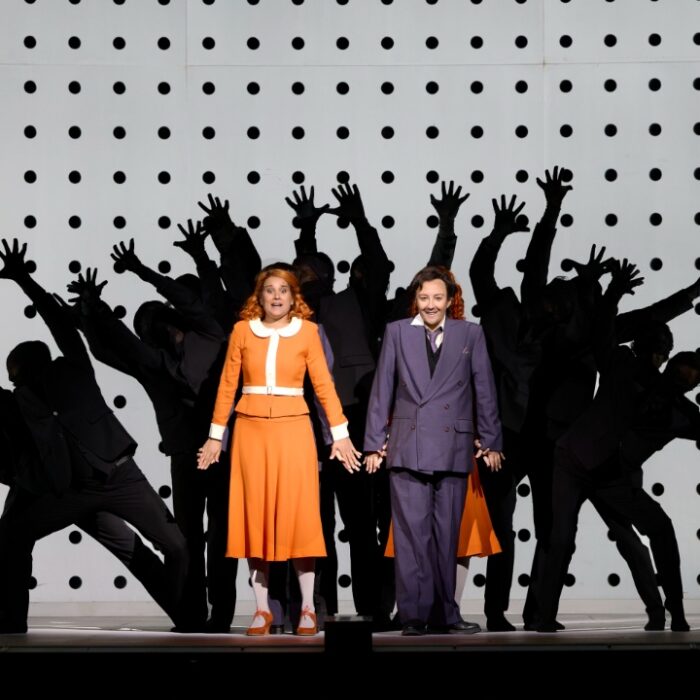
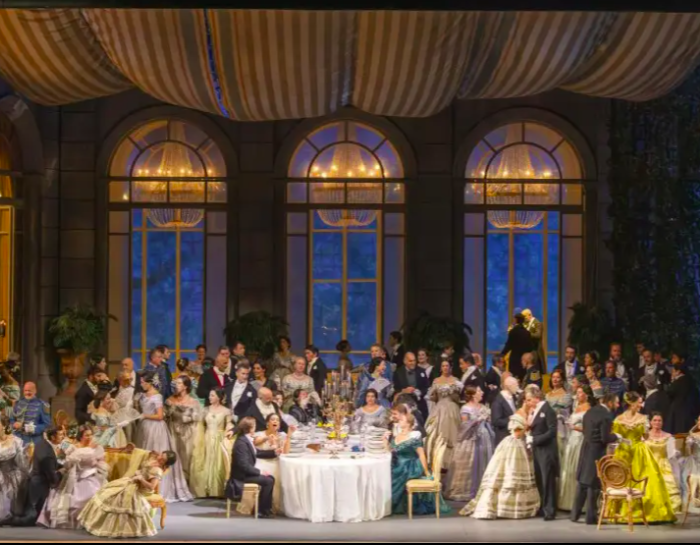
The stage revolved and was wreathed entirely in black. There were two problems here. Firstly, the staircase must have rotated almost 30 times throughout the entire runtime of the opera with only slight changes made in several scenes. It became tedious and destroyed the beauty of such a massive and radiant set. Secondly, it is very difficult to light completely black stages, so the lighting was very strange in moments, with beams of light pointing towards the audience. Maybe this was intentional, telling the audience that this it was a “modern production” even though it otherwise had realistic sets and period costumes. In Act Two the lighting was embellished through long white LED sticks forming abstract patterns under the staircase. This completely broke the realism of the sets and they were quite disturbing. This abstract structure of extreme white lights also surrounded Juliet’s bed during the Act Four duet “Va! Je te pardonné.” When will lighting designers realise that very bright LED lights in the face of the audience only blind and bother the eyes of spectators? The first part of Juliet’s “poison aria” was a magnificent theatrical effect. The soprano was in the proscenium in front of a moving black curtain, creating the impression of waves, that was lit in red. It was tremendously powerful and carried great meaning, proving that with real talent you do not have to present expensive effects or grand sets. Thomas Jolly was a very good stage director. The acting was believable and he clearly knows how to move the chorus and extras around so as to mark the focus of attention in crowded scenes. The modern choreography by Josépha Madoki was splendid, blending perfectly with the period costumes and sets.
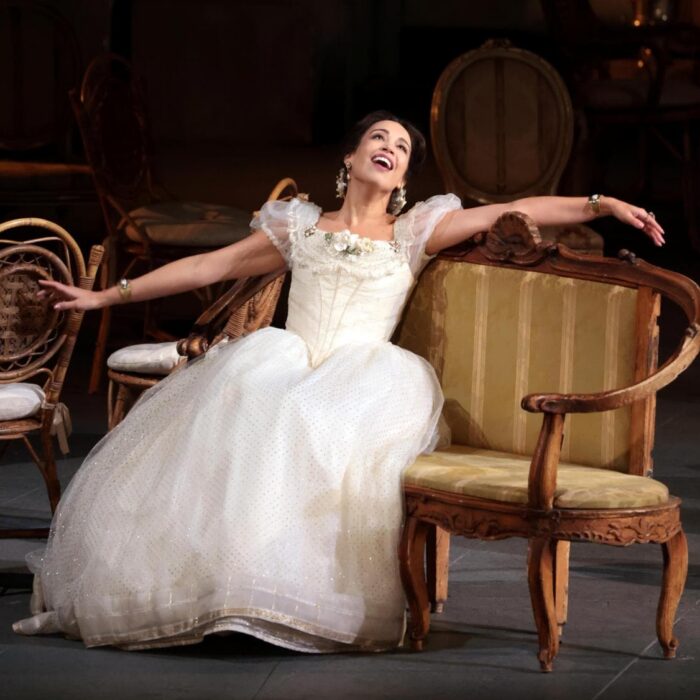
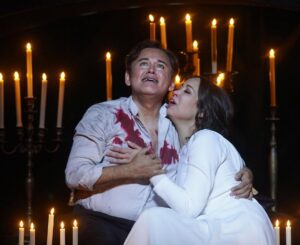
International opera star Nadine Sierra sang the title role of Juliette. She has a Lirico leggera voice with a warm, velvety timbre and bright, projected high notes that enable her to tackle a difficult score that demands a leggera soprano for the first act but a true lyrical voice for the rest of the opera — light voices can have problems with the dramatism of the fourth act and the “poison aria.” Sierra was vocally impeccable, showing her depurated coloratura technique in her entrance aria, “Ecoutez,” which immediately demands two fast scales rising to high D. Her interpretation of her Act One aria “Je veux vivre” was a showcase of trills, clean fast scales up to a high D, and bright B flats. But it was Sierra’s portrayal and interpretation what was brilliant. You could really see a 14-year-old girl throughout the opera, even in the most dramatic moments. It was not Sierra performing or “pretending to be” — it was a truly convincing creation of a character. This is something rarely seen in opera performers, and it made her performance unique. She was joyful and childish in the first act; ardent and loving for later scenes; and frightened, harmed, angered and determined as the action advanced towards the climax. The highlight of her performance was her interpretation of the “poison aria,” “Dieu! Quel frisson.” Her doubts and final determination gave a vocal and dramatic characterization, delivering two perfect top ringing high Cs and a final strong B flat, which was rewarded with an unending standing ovation. After exchanging knowing looks with the conductor, the soprano decided to offer an encore of the aria which was as perfect as the first one. The consequence of this was an even wilder standing ovation — a ringing accomplishment that was streamed worldwide. Her “fake death” during the wedding was hair-raising, the soprano falling on the stairs and rolling down the steps before lying motionless — something that is physically demanding and requires a lot of body control to avoid injury. Her final duet with Romeo in Act Five was exciting and moving at the same time. She delivered a strong secure B natural alongside the tenor in the climax, but her singing became desperate and sad when she realised Romeo was dying and she finally decided to take her own life. Her voice was fresh till the very end of the opera, which is not easy after a long night of singing and giving the encore of an aria that many sopranos usually cut from the score. Sierra was the absolute protagonist of the night and proved why she is one of the best sopranos today.
Romeo was played by Javier Camarena, who possesses a light bright voice. He had focused his career in the bel canto repertoire, though he is now moving into a lyrical repertoire. He was perfect in the sections that required long legato lines, mezza voce, and secure, sustained high notes. Her interpretation of the short first act duet with Juliet, “ange adorable,” was beautiful. His second act aria, “Ah! Lève toi soleil,” proved his bel canto background with a splendid fraseo, perfect French style, and three bright B flats. When Romeo is singing the orchestration is mostly light, so Camarena’s voice, especially with his astonishing projection, easily carried over. His voice melded perfectly with Sierra’s, especially during the high B naturals of the “wedding scene” and “death scene,” as well as the high C alongside the soprano in the Act Four duet, when he sounded bright and present. The problem occurs when the orchestration gets heavier. Camarena’s interpolated high C, which closes Act Three, was barely audible. He had trouble during the first half of his Act Five aria, “C’est la!” The aria is mostly central, moving a bit around the pasaggio and only rising up to A flat. Camarena’s voice sounded muffled, distant, and heavy. It did not sound effortless at all. When the key changes and it rises one semitone, his voice got brighter and the projection improved. On the line “Juliet et vivante” the voice showed signs of tiredness and the notes sounded dry and unclean (the line demands phrasing in A naturals). But he delivered a bright sustained B natural in “sois béni” alongside the soprano, and another beautiful, effortless B natural in “de la lumière.” His death scene was very convincing.
The role of Capulet is very short and has neither aria nor solo moments, but when the interpreter is none-other than Laurent Naouri, things change. This bass-baritone not only has perfect diction and French style, but an astonishing stage presence. His performance was believable, emotional, and hypnotic. It was a luxury to have such an amazing artist for such a minor role.
Baritone Benjamin Appl, who portrayed Mercutio, effortlessly sung the difficult aria “Mab la reine…” Despite its fast tempi, high tessitura, and mixture of Parlato moments with legato lines, Appl was perfect in style and with impeccable French diction. Unfortunately, the rest of the role is relegated to a few spare lines.
Carlo Rizzi is one of the best conductors working today, and he proved it once again in this production. His reading of the score was truly moving, from explosive climactic moments to sorrowful lament music. He really knows how to extract the emotion from the music and exploit all the different timbrical details present in Gounod’s score. His balance between the voices and the orchestra was perfect, no singer being hidden by the orchestra at any moment. The chorus and orchestra of Teatro Real were brilliant and powerful.
It was a moving performance to be remembered for the incredible interpretation of Nadine Sierra as Juliet, the expertise and artistry of conductor Carlo Rizzi, and a luxury cast that counted among their ranks Javier Camarena as Romeo and Laurent Naouri as Capulet.