Händel-Festspiele Halle 2026 Review: Ariodante
By Mengguang Huang(Photo Credit: © Anna Kolata)
Arguably the most heavyweight highlight of the entire festival, this performance of Händel’s “Ariodante” assembled a stellar cast that uniquely included two laureates of the prestigious Halle Handel Prize, Magdalena Kožená and Andrea Marcon. Adding to the evening’s historical significance was the rare opportunity to hear the 1735 London version ending.
However, the acoustic condition of Concert Hall Ulrichskirche posed a formidable challenge with its unfocused environment creating overlapping echoes. Yet, under the exceptionally sharp and theatrical direction of Marcon, the La Cetra Barockorchester Basel and soloists treated the audience a phenomenon music drama.
Champions
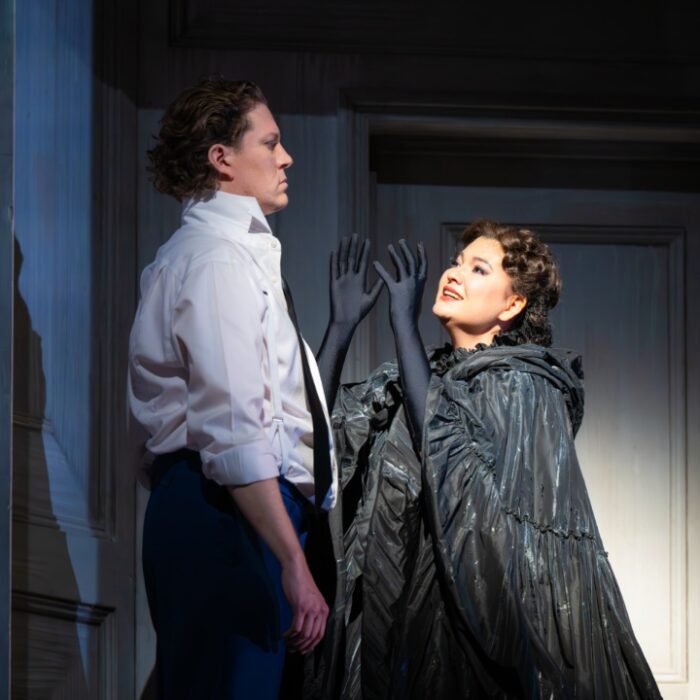
The title role found a magnificent champion in Kožená, whose presence on stage was nothing short of a miracle. Throughout the entire evening, her remarkably powerful vocal projection seemed completely impervious to the venue’s treacherous acoustics, as if the distinct frequency of her voice had found a secret understanding with the challenging space. Kožená infused her Ariodante with a profound level of psychological maturity, appearing in a specially selected costume that subtly nodded to the opera’s Scottish setting. Her vocal mastery has reached that rare, established artistic realm of absolute freedom—an expressive territory where she sings entirely with natural ease.
While her Act one “Con l’ali di costanza” was a vivid display of heroic, rapid coloratura, it was her devastating Act two lamento, “Scherza infida,” that became the absolute emotional axis of the night. Driven at a tempo slightly slower than usual, the aria was anchored by La Cetra’s outstanding bassoon work—deep, mournful, and filled with raw sorrow. Kožená’s singing during the middle section was harrowing; her voice audibly trembled and choked with an almost physical expression of grief. In the da capo repeat, she treated the audience to a ghostly, floating recap, utilizing a radically free re-phrasing and volatile rhythms that captured the suffocating despair of a man utterly broken by perceived betrayal. Equally breathtaking was the psychological arc she completed in Act three; her ecstatic, transcendent joy upon being reunited with Ginevra in the brilliant “Dopo notte” was an absolute revelation, delivered with a wild, soaring energy that brought her monumental portrayal to a triumphant climax.
Opposite her, Erika Baikoff’s Ginevra convincingly demonstrated a psychological trajectory that anchored the entire opera. In Act one, she embodied radiant joy, delivering her opening cavatina with an exquisitely flowery line that captured a carefree princess basking in absolute bliss. Yet, as Polinesso’s web closed in, Baikoff pivoted with extraordinary dramatic intelligence. Her rejection of the duke was fierce and sharp, cut through with biting, aggressive articulation and stunning octave drops. By Act two, the unjust accusation of infidelity pushed Ginevra to the brink of madness, and Baikoff’s portrayal entered a profound dimension. In “Mi palpita il core,” her breath control was spectacular. Her singing precisely mirrored Ginevra’s panicking heartbeat against Marcon’s fractured orchestral pulse. The true climax came at the end of the act with the harrowing, stormy recitative and the grotesque nightmare ballet. Waking into a state of total psychological dislocation, Baikoff unleashed an astonishing column of sound in her final accompagnato. In this moment, she demonstrated supreme vocal control and an incredible breath volume. In Act three, she leaned into a fragile state of sorrowful lamentation and humiliation. Accompanied by a sparse ensemble, her singing channeled a simple, heartbreaking longing and farewell. The venue’s difficult acoustics made her lines hard to hear during the final celebratory duet, “Bramo aver mille vite.“ Nevertheless, her complex musical navigation through those echoes solidified a deeply affecting portrayal.
Boundless Charm
Shira Patchornik’s Dalinda radiated the boundless charm of a young girl completely swept up in blind love. She brought a sweet, simple devotion to the stage. This initial innocence then beautifully bled into a slightly frivolous overconfidence. As she performed, she effortlessly commanded the stage with a bright, glittering high register and flexible breath control. Yet, her trajectory took a stunning turn; upon unmasking Polinesso’s treachery, she pivoted from pure shock into a tour de force of vengeance. In her Act three aria, Patchornik unleashed a radical, rapid coloratura packed with an intensely gripping bodily performance, perfectly capturing a woman reclaiming her agency after a shattering betrayal, before finally melting into the serene joy of the closing duets.
Christophe Dumaux was a highly effective Duke Polinesso, showing his usual strong stage presence. From his opening scene, he used a wide dynamic range and a clear vocal projection to command the room. He convincingly brought out the character’s manipulative nature, especially when seducing Dalinda in Act one. By Act two, his singing well captured the villain’s smug satisfaction at his plot’s success . Even as things fell apart in Act three, Dumaux handled the drama skillfully. Right before the duel scene, his character hypocritically hid behind high-minded words like “honor” and “duty” before facing his final downfall. However, from a purely vocal standpoint, Dumaux’s voice was the most heavily affected by the venue’s difficult acoustics that evening. The overlapping echoes often fought with his sharp projection.
José Antonio López brought a steady dignity to the King, delivering a grounded performance. His warm and solid lower register benefited from the venue’s acoustics, adding physical weight, especially in Act two long passage as he read a lengthy letter. The accompanying basso continuo during this reading was equally vivid and engaging.
Emiliano Gonzalez Toro delivered a loyal and refined Lurcanio. In Act two, scene 10, he delivered a round voice, marked by doubting nuances and vivid forte-piano contrasts that offered deep psychological insight. By Act two, scene two, this nuanced approach gave way to a rapid, fierce projection. Building upon this technical brilliance, his subsequent Act three reconciliation with Dalinda felt all the more precious and sincere.
The acoustic challenges of the Ulrichskirche again heavily compromised the instrumental clarity, yet the musical results remained deeply captivating.The numerous, sparkling dance movements interspersed throughout the opera, each one executed like a musical jewel. Maestro Andrea Marcon led with an infectious, passionate commitment, while La Cetra Barockorchester Basel poured unsparing empathy into every phrase, offering unconditional support to the singers. The basso continuo section was remarkably vibrant and alive throughout the evening, with Andrea Buccarella delivering an exceptionally outstanding performance on the harpsichord. As the audience stepped out into the Halle night, they left with hearts full of this artistic warmth and satisfaction, carrying with them a vivid gallery of flesh-and-blood character silhouettes that remained etched in the mind.