CD Review: György Kurtág’s ‘Fin de partie’
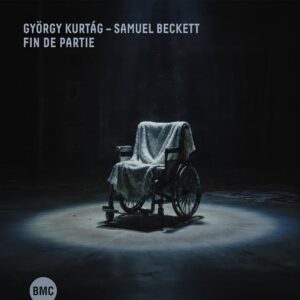
By Joe CadaginHungarian composer György Kurtág turned 100 years old this February. He spent his late eighties and early nineties working on his first opera, “Fin de partie” (“Endgame”), based on Samuel Beckett’s play, opened at La Scala in 2018. This was a century and quarter after Verdi’s geriatric masterpiece “Falstaff” premiered at the same fabled theater — an opera he wrote at 79. This CD set (BMC CD 363), recorded live at 2020 concert performance in Budapest, marks the first commercial recording of “Fin de partie.” It was released by the house label of Budapest Music Center (BMC), a contemporary-music institute where Kurtág had an apartment and completed much of the score. I had a very Beckettian encounter with the composer at a BMC event held the year after the opera premiered. Kurtág’s wheelchair was blocking the aisle, but I was too starstruck to say “excuse me.” I found myself trapped in a strange purgatory — “Waiting for Kurtág,” if you will.
“Fin de partie,” penned in French by Beckett is 1957, is a text that could only be set to music by an elderly composer — someone who has lived an exhaustingly long life. To fully appreciate its themes and characters, one needs to occupy the final tragicomic stage of life that directly precedes the end.
The play unfolds in a dingy room where the blind old Hamm sadistically berates his bitter-yet-obedient servant Clov. Also in the room are Hamm’s legless parents, Nagg and Nell, who live in sand-lined garbage cans and pop out periodically like Oscar the Grouch. As in Beckett’s earlier “Waiting for Godot,” the dialogue is repetitive, roundabout, and seemingly banal. The characters tell stories and jokes. They hurl insults and bicker. They reminisce.
One preoccupation keeps returning: la fin. The end. These wretches sit and wait to expire, but cannot figure out how to bring it about. So, for most of the play, they’re suspended in a grey eternity, somewhere between living and non-existence — like the endgame phase of chess, but in a match that never seems to conclude. Clov’s opening line — and Kurtág’s setting of it — encapsulate this concept; “Finished, it’s finished, it will finish.” The composer, who spent two years absorbing the language of Beckett’s script, respects the natural rhythm of French declamation. The first three ascending phrases are each a note longer than the previous: two notes (“Fini”), pause, then three (“c’est fini”), pause, then four (“ça va finir”).
This additive musical process perfectly illustrates Clov’s next line; “Grain upon grain, one by one, and one day, suddenly, there’s a heap, a little heap, the impossible heap.” Those last three phrases follow the same “plus-one” logic: three notes (“c’est un tat”), pause, then four (“un petit tas”), pause, then five (“l’impossible tas”).
Hamm later invokes the same image, enigmatically mentioning “the millet grains of that old Greek.” He is referring to Zeno, who paradoxically reasoned that ten thousand nothings somehow add up to a pile. It is a powerful metaphor for the hourglass-like accumulation of time. Kurtág scatters additive “grain” motives throughout the score, constantly reminding us of the absurdity of life’s imperceptible trickle. While not as systematic as Wagner, Kurtág does employ leitmotifs. They are usually not exact repetitions. Often they reprise in a varied form, constructed from the same intervals, but coming off more like vague recollections of an earlier theme. One notable exception is a simple ABA melody introduced at the very beginning of the opera on the bayan (a Russian accordion). It is a folk-inflected waltz — sweetly sentimental, if a tad trite. Kurtág wrote the tune as a composition exercise when he was a young man, and its nostalgic association is evoked in the opera. It tellingly reappears when Nell sings the word “hier” — yesterday — and fondly recalls the boat ride on Lake Como that she and Nagg took after their engagement years ago. The past is cast as a kitschy picture postcard, and the decrepit couple’s current existence as dustbin dwellers is set in stark contrast to the idealized memories represented by the waltz. As Nell recounts how she gazed down into the crystal-clear water, Kurtág quotes the rocking boat motive from Rachmaninoff’s “Isle of the Dead” before restating the waltz theme on clarinet.
In passages like this, the composer manages to achieve an aesthetic of the pathetic. I do not use that word in its original sense of “eliciting pathos” — like Beethoven’s “Sonata Pathétique.” Rather, I am using its colloquial meaning of something that mixes the pitiful with the ridiculous. These are not admirable or relatable characters. They are vagabonds who treat each other with cruelty and indignity. Accordingly, Kurtág’s score pathetically stutters and stammers along at a halting pace. The vocal writing — often calling to mind “Pelléas et Mélisande” — proceeds hesitantly. The characters’ statements are separated by long stretches of rests, as if they were simply vocalizing to fill the oppressive silence.
Kurtág’s Bartókian orchestration is typically sparse, but he will also throw in instrumental figures that imitate some baser bodily sounds and movements — sneezing and scratching, shrugging and shivering, coughing and cackling, farting and fidgeting. These grotesqueries, in alternation with the more static passages, generate a musical landscape that is an odd mixture of vaudevillian slapstick and bleak ennui. Nell sums it up best in her observation that, “Nothing is funnier than unhappiness.”
There is a certain formlessness to the score that grants it the same elliptical quality of Beckett’s play. Kurtág tends to follow the meandering logic of the text rather than impose any large-scale musical structure on it. So the opera can grow excessively chatty, especially during Hamm’s tedious monologues, which could have been amply trimmed. It takes several listens to acclimate to this absurdist sound world. But once you focus on individual moments rather than searching in vain for some overarching design, you realize how true the composer is to the spirit of Beckett’s play.
At two hours, this is the longest score ever composed by Kurtág, a certified musical miniaturist who often writes movements that last just a few seconds. And yet, despite its duration, this is ultimately a miniaturist work, comprising thousands of discrete musical moments that mount up like Zeno’s millet grains.
To be sure, Kurtág provides some signposts in the form of his leitmotifs, as well as a few closed numbers — the songs and anecdotes that the characters indulge in to break up the monotony. The composer will also interrupt the pervading pathetic mood with unexpected flashes of genuine humanity. The most affecting is Nagg’s tormented cries of “Nell!” when he discovers that his wife has died. It is followed by a Shakespeare quote from Hamm, “Our revels now are ended,” which Kurtág sets to a melody reminiscent of “Taps” — a brief yet poignant requiem.
Nell herself is the least repulsive of the foursome. Contralto Hilary Summers makes a profound impression in such a small role. In many ways, she provides an emotional core that is missing from the original play. The way she trails off into a whimper as her character gets lost in memory is touchingly melancholic. Kurtág has fortunately expanded Summers’ part by giving her a number to sing during the prologue — a cryptic setting of Beckett’s poem “Roundelay” that showcases different facets of her tannic contralto.
Summers’ lower range often overlaps with tenor Leonardo Cortellazzi’s high-set tessitura as Nagg, vocally duplicating in the way that elderly couples come to resemble one-another. It is particularly pronounced when the two giggle together in a kind of interlocking hocket. Cortellazzi gives a hilarious rendition of Nagg’s dark joke. A client complains that a tailor has taken too long to make a terrible pair of pants, pointing out that it took God only six days to make the world. “But my dear Sir,” responds the tailor, “look at the world, and look at my trousers!” The tenor is a natural raconteur, donning a showman-like air and putting on different voices for the different characters.
Baritone Zsolt Haja offers a complex portrayal of the maltreated Clov. His anguished delivery suggests he is stifling long-repressed resentment toward both himself and his master. And, indeed, we learn that Clov likely abandoned his starving child to become Hamm’s servant. This backstory fleshes him out more than the other characters — even if it costs him the audience’s sympathy. In his final monologue, Haja captures Clov’s weary complacency and his inability to break free of whatever binds him to Hamm.
Bass Frode Olsen admirably endures the mammoth role of Hamm. He comes off as a kind of Zero Mostel or Bert Lahr type — boorish but affable. Olsen always sounds as if he is half-yawning, an effect exaggerated in his opening monologue by the drowsy bassoon accompaniment. Kurtág will often double Hamm’s vocal line on timpani, enhancing the resonance of Olsen’s already weighty bass. Olsen stands out in Hamm’s final monologue — he is at his most pathetic here, calling out to his father like a desperate child before submitting with a dry “Bon” when there is no answer.
Markus Stenz conducted the world premiere at La Scala and knows this labyrinthine score intimately. Leading the Danubia Orchestra, he endows each isolated detail with spontaneity. Kurtág helps retain interest by juxtaposing block-like sections for different combinations of instruments that are typically treated as soloists or in small chamber groups. He has included some unusual specimens — besides the bayan, there is the steel drum and the cimbalom. This latter instrument, a Hungarian hammered dulcimer, is often used by composer George Benjamin in his operas to conjure an eerie atmosphere. But in Kurtág’s hands, it comes off like a nostalgic nod to his past — a folksy bit of reminiscence from an aged Hungarian composer occupied with his own endgame.
This CD set does not come with the libretto — understandably, as it was probably too difficult or expensive to get the rights. But if you can get ahold of Beckett’s own English translation of the play, it is simple-enough to follow along, since Kurtág has essentially set extensive portions word-for-word. With some basic knowledge of French, you can figure out which scenes were cut and where to pick up again in the script.
Categories
DVD and CD Reviews