CD Review: Sarah Fox’s ‘Mozart Concert Arias’
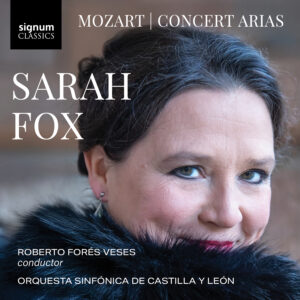
By Bob DieschburgSarah Fox has, for decades, been a fixture of English opera — at Glyndebourne and Covent Garden — as well as on disc, in works by Ralph Vaughan Williams and Kenneth Leighton. Yet she also has a well-established track record in the classical repertoire — Mozart, in particular — which Signum Classics celebrates with the release of “Mozart Concert Arias.”
There is, of course, a recent precedent: Lisette Oropesa’s glorious recording of “Ombra Compagna,” a masterpiece of technique and chiaroscuro expression. By contrast, Fox is lighter, more radiant perhaps, and affirmative. They sit at almost opposite ends of the spectrum, though I cherish both singers in equal measure.
The program consists of eight tracks, with a total running time of 50 minutes — compared to one hour and 21 minutes for “Ombra Compagna.” I could happily have done with more, as Fox traces the arc from “Conservati fedele” to “Vado, ma dove?” beautifully, and in meticulous detail. In particular, Fox traverses multiple genres — opera seria, German song, and accompanied scena — which together span 24 (out of 35) years of Mozart’s life. “Conservati fedele” was composed in 1765, when Mozart was nine; “Nehmt meinen Dank” followed in 1769; “Non più! Tutto ascoltai” in 1786; and “Al desio, di chi t’adora” in 1789.
The common thread is that the writing is elegant rather than virtuosic. Fox shapes the line accordingly, with immaculate clarity and deceptive ease. In “Conservati fedele” she preserves an innate youthfulness, akin to the intimacy of “Al desio di chi t’adora” — all carried, as it were, by a sustained legato and velvety cadenza.
With “O temerario Arbace,” Fox enters more dramatic territory. The situation is as follows: Arbace has been wrongly accused of murdering King Xerxes and now faces death himself. Yet the real murderer is his father, Artabano, who conceals his guilt.
Their farewell is tender rather than brash, true to the sentiment of opera seria. Mozart would have looked for a dignified rhetoric, firm but unobtrusive. In Fox, he might have found an infallible interpreter, one who conveys a spot-on delivery, free of heaviness or pathos, even in the accompanied recitative. The cadenzas are once again effortless, the passagework unassuming while bathed in the silvery gleam of her upper register.
The same is true of “Vado, ma dove?” It is a piece of remarkable economy, laden with existential weight. Here, the drama — “I go—but where? O gods!” — is internalized, and Fox is at her most nuanced. Through subtle gradations of colour she reveals her inner turmoil, as does the transition from piano to mezzo forte. Meanwhile, her appoggiatura on “pietà” carries great rhetorical weight, though the one on “O dei,” intertwined with a trill, is – I think – a little less successful. Still, it is a superb rendition, not least because of its contrast with Oropesa’s darker, inward reading. They are two sides of the same coin, and both benefit from expert orchestral accompaniment.
Fox has the support, on the podium, of Roberto Forés Veses and the Orquestra Sinfónica de Castilla y León. The orchestra’s transparent, malleable sound proves a congenial match for her own instrument, making this Signum release a glowing testament to Fox’s career.