CD Review: Decca’s ‘Marina’
By Bob DieschburgDecried, derided, dismissed—such was the fate of verismo opera, viewed through the lens of musicological conservatism, that is.
Accused of sordid gutter realism, it tended to be overlooked as the declining, or terminal, chapter in the evolution of Italian melodrama: “Last Acts” (2000) and “The Autumn of Italian Opera” (2007) are but two book titles illustrating this bias—in spite of their respective authors’ unmitigated enthusiasm for chefs-d’œuvre such as “Andrea Chénier,” “Fedora,” or “Siberia.” Add to this Umberto Giordano’s first operatic undertaking—“Marina”—which has now debuted on disc thanks to Decca’s most recent revivalist efforts.
“Marina” inserts itself at a critical juncture in the emergence of the verismo movement, or subgenre: composed for the 1888 Sonzogno competition, it finished in sixth place—but marked the beginning of Giordano’s fruitful, if torturous relationship with the notorious music publisher. A one-act opera in two parts, “Marina” then fell into quasi-oblivion—in particular after the resounding success of “Chénier.” Its compactness, however, would become the hallmark of “Fedora,” just as its blood and murder theme anchors “Marina” within the wider orbit of Mascagni’s “Cavalleria rusticana”—the undisputed winner of the 1888 competition.
All of this goes to show that “Marina” did not exist in a musical vacuum. Rather, its opening chorus, blossoming melodic lines, and even the brindisi are consistent with tradition; the number-piece structure is still apparent, even if Giordano’s opera breaks it apart—more so perhaps than “Cavalleria” or Puccini’s “Le Willis” (another Sonzogno submission). Innovation—instrumental and otherwise—thus runs along the lines of previous generations’ success. Giordano and his contemporaries did not represent an epochal divide, far less so a last hurrah; if nothing else, boundaries between periods were porous.
From the pen of Enrico Golisciani—who wrote a total of over 40 libretti—the plot brings all the unmitigated excitement of a tranche de vie. The outlines are quite simple: a love triangle is set against the backdrop of armed conflict between Serbia and Montenegro, in the wake perhaps of the Russo-Turkish war and the emergence of Balkan nation-states in 1878, though the details are not explicit.
Giorgio Lascari, a Serb, gets wounded in battle and retreats to the house of the title-character Marina, a Montenegrin, who shelters him. Yet her brother Daniele and Lambro, from the Montenegrin faction, intervene, ordering Marina—who is suspected of treason—to witness Giorgio’s execution. Her attempt to escape with him ends in catastrophe, as Giorgio is shot and Marina stabbed to death…
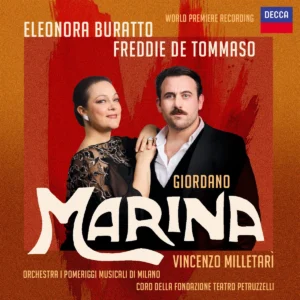
The narrative fits the unbridledness—or unsophistication—of juvenilia at large, including Giordano’s “Mala Vita” (1892), its spiritual successor in both subject matter and temperament. Overall, the effect is quite striking; and Eleonora Buratto and Freddie De Tommaso are glorious in their parts. De Tommaso in particular excels, the arching lines of Giordano’s Romanticism (reminiscent, for one, of “Otello”) fitting his burnished masculine timbre like a glove. It’s the best I’ve heard him on disc so far—the present recording having been captured from live performances at the storied Teatro dal Verme earlier in 2026.
Throughout, the breadth of De Tommaso’s phrasing is bold, confident, and sensual to the fullest. In Giorgio’s signature aria “Chi sa se un dì,” his upper register rings with iron-clad firmness, comparable to spinto tenors from the 1950s; Del Monaco, for instance, springs to mind. Yet despite its verve, De Tommaso’s interpretation is not short of expressive nuance. While enthusiastic, heroic even, one appreciates the introspection of diminuendi such as the one on “io strapperò” (“What sad memories I’ll wrench from her kind heart;” in “Chi sa se un dì”). The result is not just a show of vocal bravura; rather, it reveals the tenor’s effort to balance ardor with temperance.
As Marina, Eleonora Buratto delivers a luminous rendition, with a wide-ranging tonal palette. In the opening scena—for instance—I appreciate the subtle changes to each repetition of “sterminio” (including the use of the chest register), while the ensuing romanza is a showpiece of fine legato singing. The smorzando effect in “ohimè,” for example, is superb.
But it does not stop there: in conjunction with Mihai Damian—as Lambro—and Nicholas Mogg, in the part of Daniele, she achieves a grandeur akin to the caliber of Puccini’s “Tosca.” The confrontation with Daniele in particular quivers with dramatic tension. Buratto’s transition from “Cessa! Deh! Cessa!” to the staccato of “A me perdona, l’errore insano” and the defiance expressed in “Quell’uomo io salverò”—foreshadowing Minnie in “La Fanciulla”—all accord with the general sentiment of anguish and despair, mixed with a stoic sense of self-sacrifice.
If criticism be permitted, however, I do find the baritone parts a tad too similar—from a compositional standpoint rather than as a casting flaw. Without the libretto (provided in the booklet), it is hard, at times, to make a meaningful distinction between the two characters. On a side note, however, I’d like to single out the timbre of Romanian baritone Mihai Damian (Operalia, first prize), which—of the highest caliber—is redolent of Giorgio Zancanaro’s vocal elegance. “Marina” is his discographic debut but the expectations this rare voice has stirred might be nothing short of immense.
Vincenzo Milletarì conducts the Orchestra I Pomeriggi Musicali di Milano with appropriate thrust. From the first bars, he matches the score’s blend of militaristic flavor—think the opening fanfare—and Romantic expanse with a secure sense of musical elasticism—avoiding metronomic rigor as much as deflection from the narrative’s linear progression. The live provenance suits this approach well: it keeps Giordano’s variegated, if not brash, impulses from sounding archival, or even archaic.
Overall then, “Marina” is a world premiere recording worth noting. Its execution ticks all the boxes—even if it is not a lost masterpiece on the scale of “Andrea Chénier.” Still, it proves that Giordano—like his contemporaries Puccini, Mascagni, Leoncavallo—were poised, in equal measure, between the inherited Romantic melodrama and the verismo shorthand—set to become the new lingua franca of the Italian Novecento.