Bayreuth Festival 2026 Review: Die Walküre
An Ardent Apologia for Forgotten Images – Bayreuth’s 150th Anniversary AI Tetralogy
By Vincent Lombardo“The stage action should avoid any suggestion of routine; freedom and spontaneity should not lead to unmotivated running hither and thither – every change of position and indeed bodily movement must be dictated by the events.”
– Richard Wagner, when rehearsing the “Ring”
“An AI image of a tree is in every way a tree, as long as it looks back to us.”
– Aphorism, Anonymous
On this 150th anniversary of performances of Richard Wagner’s operas in his Bayreuth Festspielhaus, one imagines it would be the composer himself to again thank King Ludwig II for making it all possible, united in their wish that their cultural efforts would stand the test of time. Perhaps it was those same lofty sentiments that saw Claudio Monteverdi, when dedicating the printing of his score of “L’Orfeo” to his benefactor Prince Gonzaga in 1609, hope that the opera “…would go forth into the great Theater of the Universe, revealing itself to all Mankind.” Their dreams were achieved.
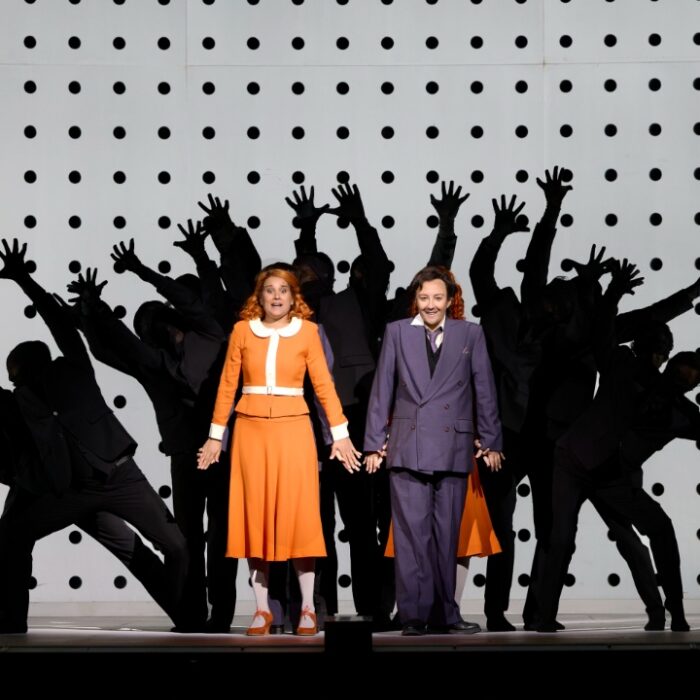
This “Ring” was indeed the uniquely conceived, unrepeatable, musical-theatrical event of our time, though it was almost unanimously contested by critics and public alike. A large part of these attacks focused upon two observations. Firstly, that the entire cycle was semi-concert in form, and secondly, that the AI-generated images forming the backdrop were too abundant and scarcely related to the stage action. This latter critique suggested the absence of a stage director and that technology had taken possession of the operatic stage. These accusations may bear some truth, but may also be partially oblivious to the true intentions of those responsible for the overall mise-en-scène. This was not an opera in concert form – wherein the singers wear formal dress and stand almost fixed before music stands and an orchestra, almost a CD recording in a sound studio. The question of it being semi-staged is debatable. The Bayreuth production team did not resort to adding visually connective elements, such as a scarf, a spear, or a sword, while reducing the singing-actors’ physical movements to minimal gestures, only hinting at a verified operatic event. This has been done on several occasions recently, with “Der Ring” transformed into a concert with big ambitions, played before a large cinema screen projecting a variety of images which are received as theatrically limited, ineffective, uninspiring, and hardly worth being done.
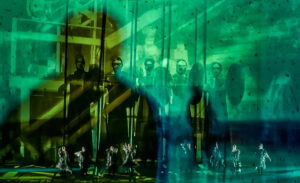
In this operatic outing the raison d’être of the Tetralogy was to recapture scenic and theatrical episodes from historical productions of the same operas performed on the very same Festspielhaus stage. As the creators of this “Ring” told us, there were to be stream-of-consciousness visions within algorithmic recollections. “The performers were to be the fixed point within a visually seething cosmos of light, texture, history, and association, amidst projections that erupt, constantly shift, and merge into one another.” This was the reality of four evenings in Bayreuth, experienced, if one so willed, through an aesthetic simplicity that grew uniformly as the Nibelungen saga took form.
Unchallenged Confusions
Elements of theatrical expression always act as mirrors, peering into mental states representing the protagonist’s primitive drives as ours – fear of death, the drive for desire, for power, and for belonging. So very Wagnerian and Schopenhauerian! What then if today these images are generated through Artificial intelligence (AI) or other means of Augmented Reality (AR), or are simply created by sophisticated, yet by now traditional audiovisual means such as television screens, film segments, wavering projections, or even laser beams? The technical abilities implemented may appear as being of less importance than the result achieved. Bayreuth’s 2026 “Ring 10010110” – corresponding to the number 150 in binary code – laid out exactly what its objectives were: to delve into the festival’s history and sift through visual recollections – especially photographs – while exploring the ties between myth and today’s digital technology.
This was the cause of much of the unrest amongst public and critics alike who felt that the production went one way, the music and text, along with the spectators, another. But was this really so? Some of us believe not, as the “higher powers of the image” seemed to be at play and the technically advanced crew convinced us that they knew exactly what they were doing. Thus, this idea of the opera itself going one way and the images another is disproved if only we accept the two as separate – as bona fide entities in juxtaposition, not attempting in any way to bring them together. It is in this manner that the emotions within Wagner’s music assume less concrete definition while time takes on an almost synesthetic multi-sensory flow as we sit in the Festspielhaus. This is why images alone seem to condition time in a performance of “Die Walküre,” tending generally to accelerate the experience, whereas a non-virtual staging may seem to last for extended stretches.
Wagner’s determination upon how human consciousness experiences art and its cumulative flow through his “unending melody” directly inspired Henri Bergson’s understanding of how an intensive psychic state can unfold continuously, transcending our ordinary knowledge through cinematographic technique. Was this AI imagery not absorbing from Wagner’s music all that is Wagner? Has this technological experiment not induced us to answer new questions?
Breathing through the image
As the world of opera awaited Bayreuth’s new AI-inspired “Ring Cycle,” much of how it would be received by the press and public was perhaps pre-construed. The fact that it would be experimental and eyebrow raising was taken for granted. The main curiosity concerned the way in which images and references to previous Festspielhaus “Rings” would be presented. Would the passing parade of collages be three-dimensional; an attempt at recreating an AR world visible to all without the use of those special glasses used for “Parsifal?” Perhaps we overlooked the fact that every spectator would arrive with their own sentiments regarding the music and stagings of their past. There were three forms of reception: the knowledgeable novice, the seasoned Bayreuth habitue, and the professional musician, theater technician, or critic. The main consideration revolves around one’s attraction to the stage as 16 hours of music roll by.
Predictably, the novice tended to reject the flow of images as a distraction, creating confusion and lessening one’s powers of concentration. For those who had actually witnessed the previous stagings visually referenced by AI, they questioned what the projections had to do with this statuary staging. Add this to the perceived spareness of stage action, and the viewer was once-again confused. Musicians and theater craftspeople were divided on various points, yet the majority of journalists appeared unanimously outraged – justifiably negative, certainly not enthusiastic.
From another viewpoint, “Ring 10010110” was not fully accepted for what it was, and not because it was judged as having fallen outside the canon of operatic production. Instead, the goal of honoring the 150th anniversary was not only noble, but was achieved. One-thousand images played fitting tribute to history’s greatest Wagnerian moments. There was much joy in seeing Harry Kupfer’s Brünnhilde on the rock – not encircled by the flames of a magic fire but floating in a cube of red laser beams. Or the arrival of the hunched giants Fasolt and Fafner in “Das Rheingold” from Patrice Chéreau’s centennial production. Yet, there was something uniquely special that went beyond the occasion’s sense of time. The production offered us the opportunity to listen to Wagner’s supreme achievement in his theater, sung as only there it may reach our ears, but now, as never before, to have the flow of the music seep within us accompanied by oneiric impulse. For some of us, even a month after the performances, dream images return of an entire cast donning feathered dresses in shades of grey, somnambulistically moving about the stage. One-thousand projected images in a theatrical production can be perceived as a single, unified visual ecosystem rather than a disjointed series of separate pictures. When images share a consistent variety of colors, all framed by the charcoal bird-feathered costumes of the “Ring’s” characters, the spectator perceives a continuous ambiance rather than a fragmented slideshow.
An intimist world within music
As this was a theatrical performance, one naturally wondered how the singers placed themselves within the center of the AI images, and if indeed they felt part of another world. However, they did not see the fleeting images the audience witnessed – just immense waves of color. They appeared as if floating out of a naturalistic production alla Stanislavski, their identities closing in on them as they reached out to their audience for comprehension. They did moved little, it is true, instead feeling more like theatrical presences. Singers did describe blinding rays of light coming in from the wings, but little else. Observers believed that the electronically-wired bulky costumes inhibited movement, and that the protagonists had to remain in fixed positions for too long, yet we do not know if this was true. There was only a single nine-hour rehearsal with the cast broken into group meetings with the technical staff – something rare for Bayreuth in any situation. Perhaps only with singers of this caliber and performance experience could this version of the “Ring” have been as good was it was. The real question that should be asked, to the technical staff as well as the singers, was whether being left alone onstage in a director-less opera caused them to feel inadequate and unable to deliver the emotions of the drama to the spectator. Big scenes throughout the “Ring” proved to be let-downs for many. But had they been spectacular in one way or another, they would have broken the established synthesis of the chosen installation. The closing scene of “Die Walküre” seemed to have disappointed many, with Brünnhilde abandoned, standing forlorn in profile. Yet, it could have been deeply moving, perhaps in another production and presented in another way. One recalls Heiner Muller’s “Tristan und Isolde” (1993), with an immobile Isolde dying standing upright as her spirit evaporated to the spheres.
Any directorial choice once taken must follow through with that decision to the end. So it was with Maestro Thielemann’s interpretation of Wagner’s score. Within this world of Wagner’s depiction of the human condition, Thielemann focused on the individual and the moment, as perhaps in a recording studio. All seemed chamber-like – not reduced in scale but intimist through highly-stylized descriptions of sound belaying drama (at least in regards to color). Marek Janowski’s “Ring” with the Staatskapelle Dresden of 1980-1983 comes to mind. One does not believe that Thielemann was battling the AI settings, nor taking it upon himself to have the music regulate the progress of the stage action (knowing the singers were nearly inactive). He made his voice heard, insisting that the stage curtains remain lowered for all the Preludes in “Die Walküre.” We may assume he would have asked for this even in a non-AI production, where an all-too-often useless, grotesque pantomime is inserted. Yet here it seemed that this was not a good idea. Everything was without imagery as we stared at a soft, subtly-illuminated famed curtain, expecting something to happen. It was now all so oddly out of place.
The orchestral playing in this “Die Walküre” seemed to carry more weight than usual as the rhythmic and dynamic precision of Thielemann brought out the solo characteristics at every turn. The overall sensation was that the winds were the most pungent and heavily accented of all the sections, perhaps as Wagner would have wanted, while the strings assumed great power and tension as the brass sweetly breathed leitmotifs. Throughout, push and pull energies seemed bent on subtly supporting the singers, and this is what comes from Wagner’s wish to have the drama itself predominate. This should not be confused, however, with the assumption that if the stage action were to leave something to be denied, the orchestra could pick up the slack and carry the action.
As concerns the expression of the theatrical through the singing, not all was convincing. More could have been done regarding the interpretation of the text – as a singing-actor must do alongside the conductor. Taking nothing away from the public’s reaction, one feels that the audience shifted their attention onto the purely musical side due to the delusion transmitted by the AI projections. Take Sieglinde’s arioso narrative, “Der Männer Sippe.” It is one of the greatest moments in all Wagner, wherein a repressed woman opens herself up to a stranger after years of being psychologically drained. Thielemann clocked in at four minutes, whereas it almost always comes off in four and a half minutes. This is a small matter in itself, but the issue was the pacing of the monologue as to its emotional necessities. Sieglinde was somewhat uninteresting in the moment she told the fugitive stranger, Siegmund, how she sat at her wedding, watching while the men drank. In her alone was “sweet, yearning sorrow” aroused. This is a storytelling moment, and she must relive those moments, forgetting who she is speaking to and drifting back to those vivid memories. The vocal aspects were not in question. Musically, however, it was flat, with little variation, and the dramatic tension disappeared. When she mentions the sword stuck in the tree in her house, as planted by Wotan in a challenge for one to remove it, she tells us that “guests came and guests went, the strongest tugged at the blade, but it did not budge… and there it still clings silently.” Everything here felt rushed as the flames of hope within her died. The sweeping theme of Wotan’s “Magic Fire Music” also seemed to slip by listlessly on the violins, lacking a bit of solemnity. On the other hand, the summing up of Loge’s flames was brilliant, even overwhelming. One cannot deny that it was a wonderful reading of the score by Maestro Thielemann, and be grateful for the dynamics of orchestral balance afforded.
A family group in an interior
Borrowing the title of a Luchino Visconti film, one is able to place and evaluate the characters in this “Die Walküre.” They huddle somewhat centerstage, immersed within the projected images. For this opera, we may gather the protagonists by family ties into three intertwined groups: Siegmund, Sieglinde, and Hunding; Wotan, Fricka, and Brünnhilde; and her eight Valkyrie sisters. The mortals live in a somewhat uncivilized world. Here the action takes place in Hunding’s forest home where he lives with his wife Sieglinde, kidnapped as a child and forced into marriage. The intruder, Siegmund, is her brother as fathered by the god Wotan.
In deep appreciation for tenor Klaus Florian Vogt, one must praise him for preserving his instrument throughout the years. One was reminded of his La Scala “Ring” performances two years ago when he took on four roles over the course of this AI cycle. His acting abilities improve with every performance, and one notes more poise and less constraint. His affinity with Wagner’s messaging through music is astonishing. His voice is always eloquent, even in the most demanding pages of musical declamation. It is lyrical in nature, yet blessed with an inherent and somewhat dark “heldentenorism” when required. The role of Siegmund is complicated. He must go through the process of first recognizing his sister before submitting to carnal passion in a tormented relationship with her. Here is the wounded, desperate, hunted man, discovering his ideals and responsibilities through accepting his ever-blossoming love for Sieglinde, as demonstrated by his “Winterstürme.”
Soprano Elza van den Heever, a seasoned Sieglinde, grew into her love duet with Siegmund. Her vocal acting must convince us more of the emotions beneath the words. Perhaps the convictions of her motivations will allow the voice to soar even more through fervor. As a Wagnerian singer, her timbre is rightly placed in the middle register. Those who heard her at La Scala may feel she was almost identical here, which is not a criticism but recalls the fact that she began her career as a mezzo-soprano. In all, her vocality won our hearts in a Wagnerian way.
Bass Mika Kares embodied the primitive crudeness of tribal chieftain Hunding. As a universal wild card substitute, Kares appears throughout this “Ring Cycle,” portraying the gentle giant Fasolt, the almost-barbaric Hunding, and the villain Hagen. His musicality conveys the strength of the wounded, insensitive hunter, yet lacked the true attributes of a menacing basso profundo. The role calls for great acting – a primitive, jealous, hospitable, dignified, and insecure leader who will lean upon his tribe for support. It is a role for an experienced actor. Vocally, Kares was all these things, though almost always obscured behind a scrim. Overall, he merited the success he was granted.
Baritone Michael Volle continues to possess the god Wotan as much by his presence as his voice – as all who heard him at La Scala can attest. Each word arrives in the theater as if he were speaking to every one of us. His 20 minute extended monologue, shared with his daughter Brünnhilde, has become a sort of trademark. Every syllable enters into a word. The mellifluous baritone is also suavely bass, holding our attention through the inner conflicts and tensions. His words of farewell to Brünnhilde as he encircles her with magic fire were pure emotion. One has the idea that the leitmotifs which he either sings or allows to surround him are the source of his inspiration in creating his character. Though we saw little of Wotan on the stage, buried amidst images, the singer felt no less involved. Volle told the production’s AI curator, Marcus Lobbes, of his experience performing in this AI version: “I found it far more exhausting than I’d imagined. It demands an even greater level of concentration.” Would that he could sing forever on the Festfestspiele stage!
Contralto Anna Kissjudit was invited for the AI anniversary, singing the role of Fricka for the first time. She, too, shared her sentiments regarding this unique occasion: “I also thought it would be very easy – and I still believe it could be, if only we had more time, or even just one extra rehearsal.” Imagine! Bayreuth was forced to cut their budget a bit, through no fault of their own, doubling roles as is done in regional or touring productions. The Fricka episode was an exhilarating success. Kissjudit fared well with Thielemann’s mercurial tempi of a role that at times calls for hysterics. Though still young, her instrument is of rare value, as her performances as Erda have demonstrated. Here, as Fricka, she falls in line with Wagner’s double stage directions, asking of her to “pause with dignity before Wotan,” yet to act with “extreme indignation.” Her anxious rationality, as the goddess of marriage, forced her to defend Hunding against the infidelity of Sieglinde. Her powerful, sharply dramatic voice brought out hidden meanings in the text, and throughout her scene her vocal qualities were definitely Wagnerian as to volume and ability to sustain the long melodic lines.
As Brünnhilde, soprano Camilla Nylund arrived in Bayreuth a year after the La Scala “Ring,” in which she shone. Her first experiences as a Valkyrie began with the Zurich “Ring” in 2022, at which time she was already known for other Wagnerian roles both at Bayreuth and around the world. Here she maintained her remarkable control and mature interpretation of this complicated role. Her musical acumen, phrasing, and deep awareness of Brünnhilde’s subtilties color every phrase. Her emotionally-charged confrontation with Siegmund, the “Todesverkündigung” (Annunciation of Death) scene, is a deeply philosophical treatise on human love wherein a divinity falls prey to human love and pity.
The eight Valkyrie sisters did as they always do in “Die Walküre.” They called to one-another in true, united form, and one could envisage them, as ever, flying though the air on horseback, gathering up the bodies of soldiers slain in battle, and regrouping around their sister Brünnhilde. Yet, if they did do any of this in this production, it was only in the mind’s eye, for we did not see them do anything except sing. Soprano Martina Welschenbach was Gerhilde, soprano Brit-Tone Müllertz was Ortlinde, mezzo-soprano Karis Tucker was Waltraute, contralto Freya Apffelstaedt was Schwertleite, soprano Magdalena Hinterdobler was Helmwige, mezzo-soprano Alexandra Ionis was Siegrune, mezzo-soprano Marie Henriette Reinhold was Grimgerde, and mezzo-soprano Natalia Skrycka was Rossweisse.
The AI production crew included curator Marcus Lobbes; artistic and technical conception by Lobbes and Nils Corte; dramaturgy by Andri Hardmeier; digital and AI-storytelling by Roman Senkl; creative code and visual art by Corte and Phil Hagen Jungschlaeger; set design by Wolf Gutjahr; and costumes by Pia Maria Mackert.