Q & A: Phil Hagen Jungschlaeger on Digital Art & Creative Technology for Bayreuth Festival’s ‘Ring 10010110’
By Jennifer E. Pyron(Photo: Enrico Nawrath)
The Bayreuth Festival celebrates its 150th year anniversary of Richard Wagner’s “The Ring” with an experimental concept that embodies an archive of the past designed to usher opera into the future – Artificial Intelligence unleashed.
The creative team for this historical project includes artistic and technical concept by Curator Marcus Lobbes and Nils Corte, Digital and AI Storytelling by Roman Senkl, Creative Code and Visual Art by Nils Corte and Phil Hagen Jungschlaeger, dramaturgy by Andri Hardmeier, stage direction by Wolf Gutjahr, and costumes by Pia Maria Mackert.
A.I. as a visual storyteller reflects 150 years worth of stage designs and performances to document an image-generating machine in response to Wagner’s genius. Every performance will be different and audience members from any level of opera interest are encouraged to freely dream with and explore the unfurling nuances of this work’s approximately 16 hours of material.
OperaWire spoke with digital art and creative technologist Phil Hagen Jungschlaeger to learn more about what makes this production so special and unique.
OperaWire: What is your role in Bayreuth Festival’s 150th anniversary “Ring 10010110?”
Phil Hagen Jungschlaeger: I’m the creative technologist and digital artist, working alongside Nils Corte and Joel Schäfer in our department. Together with “The Ring” team, we conceived and developed the AI system that runs throughout the entire cycle. In an experimental way, it reflects on the 150-year history of “The Ring” at Bayreuth, exploring not only the evolution of its productions but also the historical events that unfolded during that period.
The AI system was developed collaboratively by “The Ring” team. The project’s initial artistic and technological concept was created by Marcus Lobbes and Nils Corte. Further key contributions came from Roman Senkl (digital and AI storytelling), Wolf Gutjahr (stage design), Pia Maria Mackert (costume design), and Andri Hardmeier (dramaturgy).
(Photo: Enrico Nawrath)
OW: How will you work with AI as a creative experiment on stage for this production? What is its role?
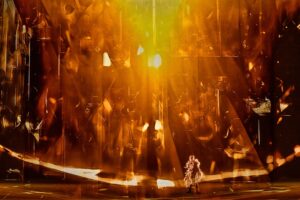
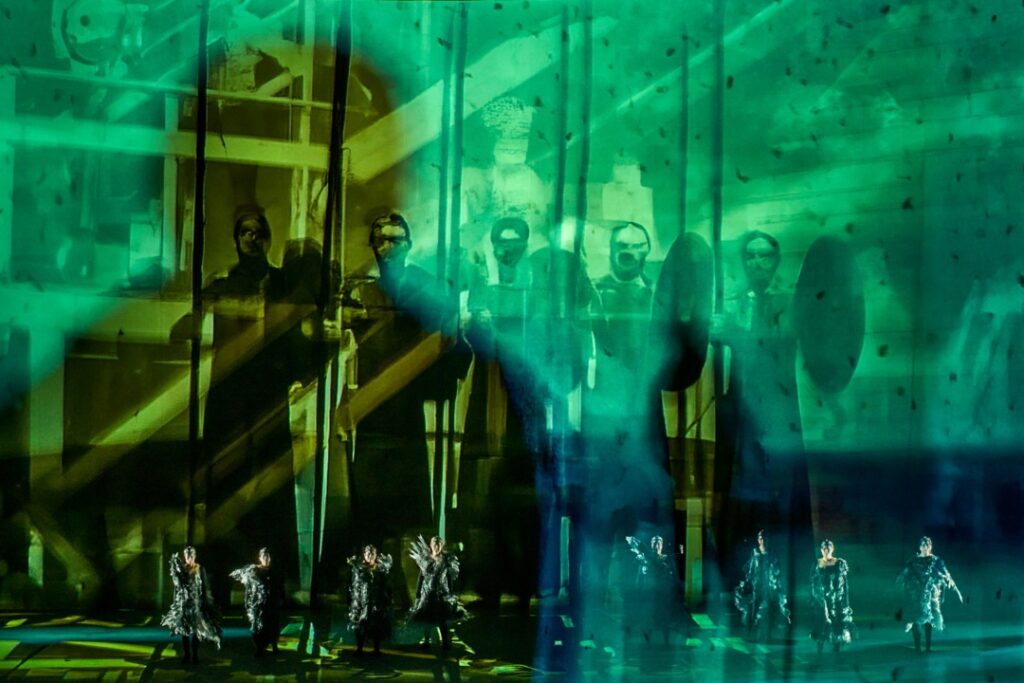
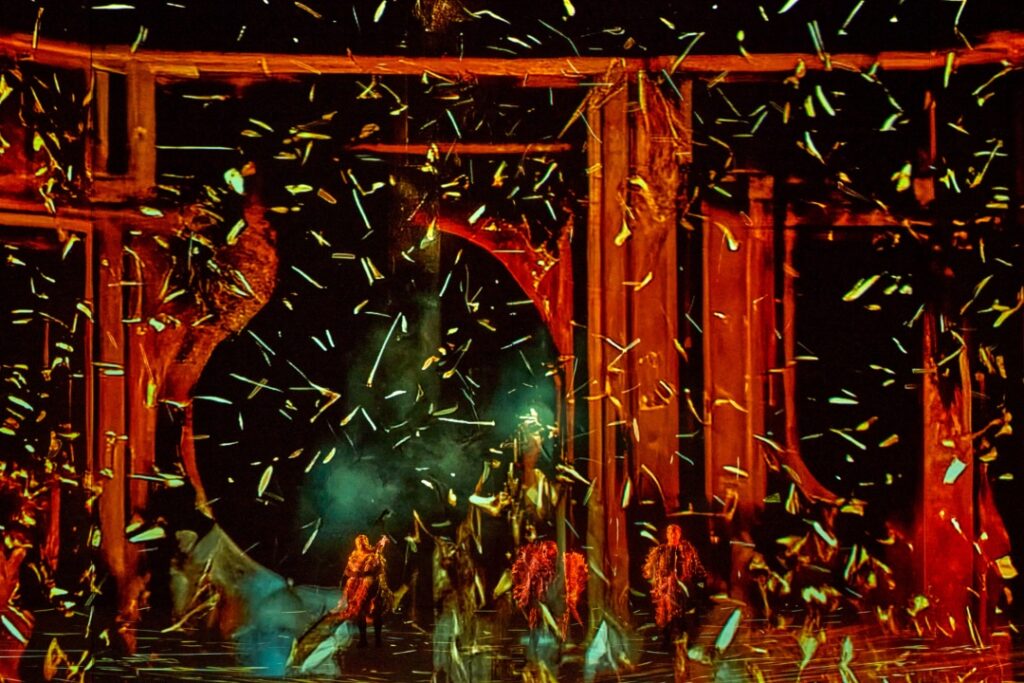
PHJ: In “Ring 10010110,” AI (and the medium itself) plays a central role. The AI system creates a visual space driven by a continuous stream of associations and imagined connections, drawing on the 150-year history of “The Ring” at the Bayreuth Festival. At the heart of this projection environment are the singers, who appear as floating sculptural figures, with costumes created by Pia Maria Mackert.
The AI continuously tracks the performers’ positions and responds to their voices as well as to the orchestra, allowing these live inputs to shape the evolving visual environment. Alongside an extensive archive of historical imagery, the system also analyzes the libretto, generating new layers of visual interpretation.
What I find particularly fascinating is the system’s recursive feedback loop. The AI continuously analyzes the current visual state of the stage—including the singers, the projected imagery, and the evolving composition—as part of its own input. It then uses this ever-changing visual environment to generate new interpretations, refine the imagery, and create further associations. This recursive process can produce unexpected and compelling chains of visual and conceptual associations.
OW: Tell us about the research process behind the scenes. Where does most of the inspiration for “Ring 10010110’s” digital art come from?
PHJ: We undertook an extensive exploration of the Bayreuth Festival archives. Over the past 150 years, many remarkable directors have reimagined “The Ring,” each production reflecting its own themes, aesthetics, and often the technologies available at the time. Our work is built upon this vast visual history, drawing on images and materials spanning the entire 150-year legacy of “The Ring” at Bayreuth.
OW: Where did you learn about all of this history? Is there a library in Bayreuth that you focused on?
PHJ: The Bayreuth Festival provided us with extensive historical material from its productions. In particular, curator Marcus Lobbes and our dramaturg, Andri Hardmeier, dedicated a great deal of time to researching, organizing, and tagging the countless images that became the foundation of the AI system. The archive traces the evolution of stage imagery across 150 years—from early stage models and painted stage designs to black-and-white photography and, later, color images.
OW: What have you discovered most when learning from the past 150 years of this cycle?
PHJ: For me, as a creative technologist, it has been fascinating to observe the evolution of technology and media throughout the past 150 years. Bayreuth’s productions have always been ambitious, consistently pushing the boundaries of what was technologically and artistically possible. The construction of the Festspielhaus itself in 1876, the use of lasers in Harry Kupfer’s 1988 production, and the extensive integration of live video in Frank Castorf’s 2013 production are just a few examples of these ongoing explorations.
I was particularly drawn to the stage designs of the earliest productions, which relied heavily on painted stage drops. In a way, I feel that the stage design for “Ring 10010110” creates a compelling connection to this tradition, bringing together historical approaches to theatrical imagery with contemporary digital possibilities.
OW: What inspires you most when working with creative technology in opera?
PHJ: I work in theatre and opera, and what fascinates me most about opera is its inherent sense of time and rhythm. Every moment has a specific duration, creating a structure and flow that technology can respond to and build upon. For me, this creates an incredibly exciting creative environment.
In this production, I’m fascinated by the way all these different elements come together. We have the performers’ positions on stage, their voices, the orchestra, and the rich historical material that informs the system. The AI brings these elements together, using them to generate and shape a constantly evolving visual space.
I also find the experimental nature of the project particularly inspiring. We are working with this AI system across the entire 16-hour cycle, allowing it to develop and transform over time. It can create moments that are surprising, humorous, melancholic, or unexpectedly quiet. The possibilities are constantly shifting, and that openness is what makes the process so exciting.
(Photo: Enrico Nawrath)
OW: How do you keep the rhythm of the digital art generating, coinciding with the opera’s tempo?
PHJ: The AI system analyzes the singers’ performances and the orchestra’s sound in real time, using this information to adapt and shape the evolving visual environment.
OW: How have rehearsals been with the singers? What is their response to this?
PHJ: “Ring 10010110” is a unique production in that it has no traditional stage director, unlike previous Bayreuth Ring productions. Instead, Marcus Lobbes serves as the curator of this experimental process, guiding its artistic development.
Compared with earlier “Ring” productions at Bayreuth, the rehearsal period with the performers was more limited. The interaction between the singers and the digital environment works very well. The performers become the central focus of this imaginative visual space, creating a strong sense of connection between their presence, the music, and the evolving digital imagery.
OW: What are you building for future generations in this production’s creative endeavors?
PHJ: Over the past 150 years, we have arrived at a moment in which technology has become a fundamental part of our everyday lives, shaping the way we work, communicate, and relate to one another—whether we actively choose it or not.
In theatre and opera, the use of new media and emerging technologies continues to grow. Yet despite technology’s profound influence on contemporary society, its artistic integration into opera and theatre remains comparatively limited. With this production, I hope we can contribute to bringing technology more fully into the artistic conversation, creating a space in which both its creative potential and its ethical and societal implications can be explored.
Artificial intelligence, in particular, plays a central role in this production. We are living through a moment in which AI is transforming nearly every aspect of our lives. The internet is increasingly saturated with AI-generated content, natural resources such as water and energy are consumed at unprecedented levels, and entire professions are being reshaped as automation and machine learning redefine the nature of work.
OW: What do you hope that audience members take away most from “Ring 10010110?”
PHJ: For me, it feels as though we are witnessing this AI system digesting 150 years of history. It conjures ghosts of the past and unexpected chains of association. I think the experience is inherently subjective because of the continuous stream of imagery. Every audience member will form different associations and discover different connections between what they see.
Familiarity with “The Ring” or the history of Bayreuth may enrich the experience, but it is by no means essential. What excites me most is the thought of audiences discussing their experiences with one another afterward—sharing what they noticed, what resonated with them, and the unexpected connections they made.
Categories
Interviews