Wexford Festival Opera 2026 Review: L’Equivico Stravagante
A Performance of a Rossini Rarity Confirms Composer’s Theatrical Brilliance
By Alan Neilson(Photo: Padraig Grant)
In 1811, Rossini’s first attempt at a two-act opera, “L’Equivico Stravagante,” premiered at Bologna’s Teatro del Corso. After only three performances, it was closed down by the censors and the police. Certainly, Gaetano Gasbarri’s libretto is fairly risqué with sexual innuendos, double entendres and a plotline that plays with ideas of sexual identity, in which the prima donna is described as a castrato masquerading as a woman so that she could marry the man she wants. But there were other factors at play that may well have provoked the police to act: its bawdy content and mockery of self-made men with money but lacking education would not have endeared itself to the audience members of the Teatro del Corso, who saw themselves as intellectual, middle-class sophisticates. Nor would its depiction of the soldiers as particularly stupid and as deserters sit well with the authorities. It was, in effect, a work almost designed to encourage complaints. Moreover, its storyline with its references to a castrato at a time when the practice of castrating young boys was becoming increasingly unacceptable was likely to add coals to the fire.
Yet, Gasbarri’s libretto is an excellent piece of craftsmanship, and Rossini responded to it with some fabulous music, notably so in the larger ensemble pieces containing his signature racing strings and quick-patter vocals, and also with a number of fast-moving scenes such as Ernestina’s scena and rondo with chorus, “Il periglio passò – Se per te lieta torno – vicina al termine.” It is also dramatically entertaining text, comprising a handful of ridiculous characters and a plot that, once it gets into its stride, rattles along with plenty of comic episodes and hilarious dialogue that had the audience laughing along.
The mechanics of the plot are essentially the same complex series of misunderstandings, disguises, improbable behavior, and convoluted relationships as found in most of Rossini’s farces. After all, it is not the quality of the drama per se that matters, but the comical, nonsensical shenanigans that it is able to generate. The penniless Ermanno and the rich dandy Buralicchio both want to marry Ernestina. Obviously, her socially ambitious father, always on the lookout for opportunities to improve his position, favors Buralicchio. Fortunately for Ermanno, however, Frontino and Rosalia, the servants, intervene, which takes the plot into an unexpected direction! They leave a fake letter carelessly lying around so that Buralicchio can find it. It reveals that Ernestina is actually not a woman but a castrated man, named Ernesto, who has deserted from the army. Buralicchio, beside himself with rage, informs the authorities, and Ernestina is arrested. Her father, Gamberotto, is devastated, and so is Ermanno, who never expected such an outcome. But, as comedies never end on an unhappy note, the situation is quickly resolved, and Ermanno and Ernestina are finally united with her father’s blessing.
Hoehn Maximizes the Comic Potential
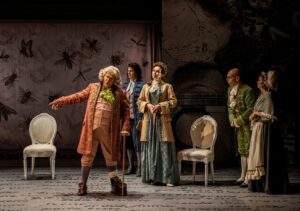
The director, Max Hoehn, set the opera in the early 19th century, the time of its composition, allowing the hierachical relationships that existed between the characters to be maintained and easily understood. This was further reinforced by Massimo Carlotta’s costume designs that played to each character’s social position, molded to fit their personality. And given that they were a very loud, bizarre bunch, it was not surprising that it led to a number of very colorful outfits. The most spectacular was Buraliccio’s multi-colored outfit with red shoes, long white socks, and red breeches with a red, white, and black waistcoat and a long purple and gold jacket, making him look like a cross between Beau Brummel and a circus clown. It was an image that reflected his character perfectly.
The scenographer, Darko Petrovic, and his set designs also proved to be successful. The first Act basically used a versatile single set that could be transformed in an instant from an outside to an inside setting. The inside of Gamberotto’s house was constructed on two levels so that characters, usually the servants, could eavesdrop on what was going on. The back of the lower level opened up to reveal the library, in which Ernestina is first introduced. It all ensured that the drama was never held up by set changes and that space was always available to accommodate the characters and chorus. It also provided a fitting backdrop for the drama. The staging for the second Act had a little more variety as the narrative shifted from Gamberotto’s house to a prison and to an outside street. It too was successfully constructed.
When directing a comedy by Rossini, it is probably wise to focus on telling the story as clearly as possible while taking up every opportunity to play up the humor. And that is exactly what Hoehn did, and he did it very well! He not only exploited the obvious but also, by attending to the detail, such as Gamberotto’s gout, ensured that the whole performance was infused with comedy; even the not-so-funny parts only needed a little push to have the audience tittering. Barely a scene went by without there being something to laugh or smile about. He was very attentive to the gestures, postures, and movement of the cast. Scenes that may otherwise have not been particularly dramatically interesting were transformed. In the pleasing terzetto, “Vogli le amabili,” for example, Hoehn had Buralicchio dancing at the side, while Ernestina and Gamberotto stood firm. It may not have been hilarious, but it kept the sense of fun alive and prevented the momentum from dropping.
The one aspect that he focused on that was slightly tangential to the plot was Ernestina’s gender. Although clearly a woman, Hoehn introduced the idea that she actually might be a man before Frontino’s ruse popped into his head. When sitting down, for example, she would spread her legs slightly and deliberately pull back her skirt to reveal a pair of men’s trousers. Maybe she had issues about her gender, regardless of the plot! It was a nice touch; it was not something that Hoehn continued to force, but it opened up a variety of perspectives from which to view her character.
Maria Barakova Stands Out Among a Quality Cast
Mezzo-soprano Maria Barakova produced a dominating performance as the learnèd Ernestina. Having spent her younger years in intellectual pursuits, she has now awoken to the attraction of the male sex; her unique approach to finding the right man was naive, logical, and totally ridiculous. It was also very funny indeed as she embarked on interviews with Ermanno and Buralicchio; every question and/or answer had a double-meaning to which she was oblivious. She was also a very confident woman and swaggered around the stage in a manly fashion, telling everyone what to do, resulting in further hilarious consequences. Vocally, she was exceptional. She has a colorful palette and sings with strength and control. The ease with which she was able to push her voice, control the vocal line, while infusing it with dynamic and emotional contrasts, and her ability to rise confidently above the orchestra were impressive. Yet, she was equally adept at crafting delicate lines, full of intricate, detailed embellishments. Underpinning everything, however, was the beauty and expressivity of her singing. She set the standard with her first solo piece, the cavatina with chorus, “Oh come tacita – nel cuor un vuoto io provo,” with a charming rendition that allowed her to show off her audacious talents to excellent effect.
Baritone Stefan Astakhov played the role of Ernestina’s “procreator,” Gamberotto, in typical buffo style, hamming it up for all it was worth. He was loud, pompous, overbearing, and vulgar, but very funny. He hobbled around the stage with his gout-riddled foot in a huge shoe that looked like a brick or a bandage bundle. There was nothing at all about him that one could call refined; he loved money and thought nothing of picking his nose in public. It was an excellent characterization, which he supported with an equally strong vocal interpretation. Each line, each word was carefully animated to maximize the effect. Recitatives were delivered with a lively energy that kept the stage in a constant state of turmoil, while his solo and ensemble singing displayed an impressive level of vocal control, which he used to promote his exaggerated sense of outrage, anger, or pride.
Baritone Gurgen Baveyan was outstanding as Buralicchio, whom he characterized as a vacuous, superficial, wealthy fool, whose interests rarely moved beyond his sartorial appearance and how he may be perceived by others. It was clear from the outset that he was totally unsuitable for the bookish Ernestina, but her father loved his money and status. From his first entrance onto the stage, Baveyan had the audience in his pocket as it laughed along at Buralicchio’s absurd and petty behavior. Every gesture was carefully crafted to promote the comedy, and the fact that he was smaller than his rival Ermanno, which he compensated for by parading himself around the stage like a puffed-up peacock and taking up ridiculous postures, added to the fun. His vocal performance was no less impressive. His voice has a natural expressivity, to which he is able to introduce nuance and subtlety; he possesses a colorful palette, which he used intelligently to enliven the vocal line, particularly in passages of recitatives; and his vocal flexibility and beautiful phrasing added to his confident, controlled, yet seemingly casual presentation.
Tenor Sebastian Mach playing the role of Ernestina’s suitor and faux tutor Ermanno suffered from being surrounded by three larger-than-life characters but produced a solid performance. However, by comparison, he appeared somewhat insipid. His voice has a pleasing lyricism with a suave finish, which stood him in good stead in the seduction stakes, but his occasional unsteadiness in delivery undermined the impact. Nevertheless, his lower profile generally worked in his favor. And he certainly had his moments: his Act two cavatina, “D’un tenero ardore,” was beautifully presented, which convincingly displayed his deep love for Ernestina.
Soprano Kelli-Ann Masterson made a splendid impression in the supporting role of the mischievous maid, Rosalia, with a fully engaged performance that chimed perfectly with the general state of buffoonery. Both her acting and singing displayed real quality, which was perfectly illustrated in her aria, “Quel furbarel d’Amore.” Worse for wear, she stumbled, hiccuped and laughed her way through the piece while spinning out sensitively molded lines that captured the beauty of her light, versatile voice.
The servant, Frontino, without whom the plot would never have got off the ground, was given a compelling interpretation by tenor Carlos Natale. Frontino is the man who has the ideas for the fake letter and of introducing Ermanno to Gamberotto as a tutor in the first place. He is the typical clever servant who manipulates his employer. Natale’s expertly layered characterization presented both the dutiful professionalism and the disruptive sides to Frontino’s nature, which he overlaid with the usual exaggerated gestures.
The Chorus of Wexford Festival Opera joined in the fun, singing and acting with a hearty enthusiasm.
The conductor, Riccardo Bisatti, produced a lively, pacey interpretation from the Wexford Festival Opera Orchestra, which he neatly aligned to the dramatic momentum of Hoehn’s presentation. Moreover, it was also a finely balanced reading, one that, even during the quick-fire, agile vocal ensembles, successfully maintained a precise coordination between the orchestra and the singers. The only negative criticism one could level was that, on occasions, the sound was a little heavy, which acted against the magical sparkle that propels a performance to a higher level.
Nevertheless, this was a super show. It had everything one would want from a production of a Rossini opera. It did, however, leave one wondering as to why “L’Equivico Stravagante” has been relatively neglected.