Donizetti Opera Festival 2026 Review: Le convenienze ed inconvenienze teatrali
Baritone Paolo Bordogna as Mamma Agata Illuminates New Production
By Bernardo Gaitan(Photo: Credits: © Photo Studio U.V. – Fondazione Teatro Donizetti)
In the language of the operatic world, “convenienze” referred to theatrical conventions or customs: not in the negative sense that is generally attributed to the word in Italian today, but rather as those rules considered “appropriate” both to the artist’s requirements and to the audience’s expectations. “Le convenienze ed inconvenienze teatrali” is a farce by Gaetano Donizetti whose title might nowadays be translated as “Theatrical Conventions and Improprieties.” In 1969, the work also began to be known as “Viva la mamma!” on the occasion of a series of performances in Munich, a title that has endured to the present day.
It is an extravagant comedy about a small Italian opera company attempting to bring a production to the stage, in which absolutely everything goes wrong. The impresario is worried about money; the performers are trying to secure additional pieces to sing; the composer and librettist keep passing responsibility back and forth for secretly inserting yet another duet. The two female singers detest one another: the prima donna has the support of her husband, while the seconda donna is backed by her terrifying mother, played by a baritone. The German tenor cannot pronounce Italian, and the castrato has no parts to sing: the end result is a disaster.
Forced to work within the conventions imposed by untouchable prima donnas and impresarios fearful of anything new, Donizetti at least found satisfaction in parody. Among the numerous comic operas belonging to the genre of metatheatre, this title remains the most hilarious and relevant. Although composed almost two centuries ago, the farce retains all its topicality because it is built upon the enormous egos of singers, the ferocious insults they exchange, and the caricature of opera seria they enact, each attempting to outdo the others. Mamma Agata occupies a prominent position: she interferes, sows discord and even goes so far as to raise her hand against the other singers in order to promote her daughter. It is an utterly preposterous comedy, but one that allows us a glimpse into theatrical practices and, above all, theatrical malpractice, from the nineteenth century to the present day.
(Photo: Credits: © Photo Studio U.V. – Fondazione Teatro Donizetti)
New Production Bears the Signature of Silvia Paoli
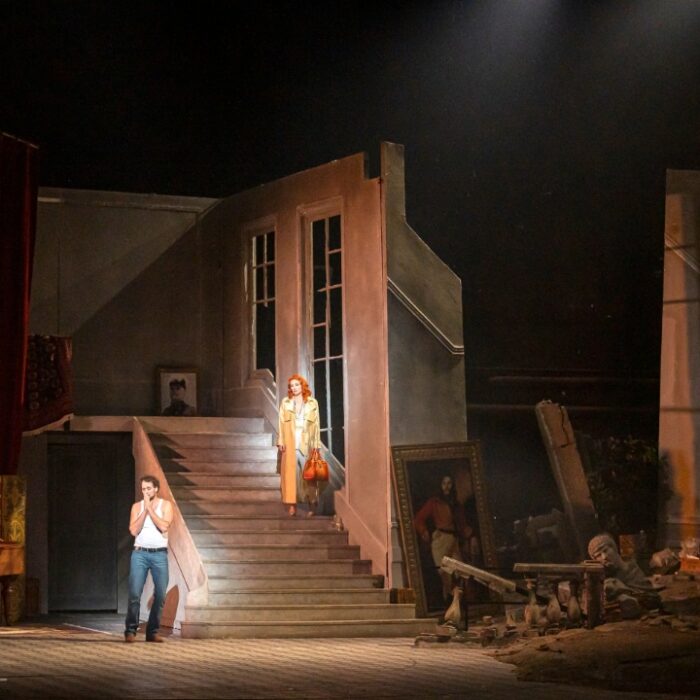
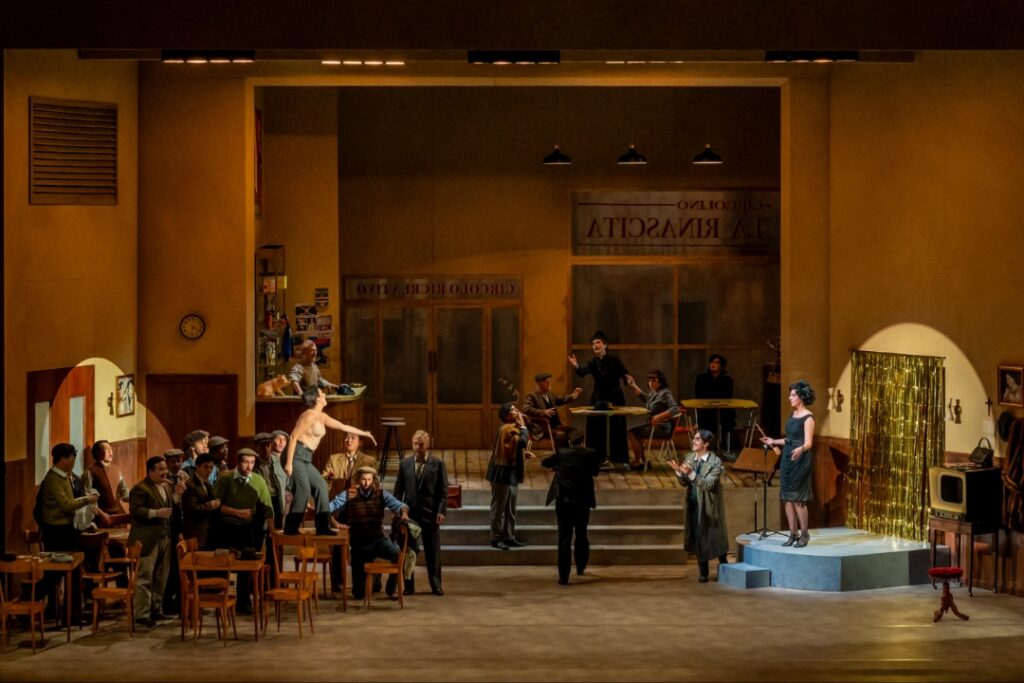
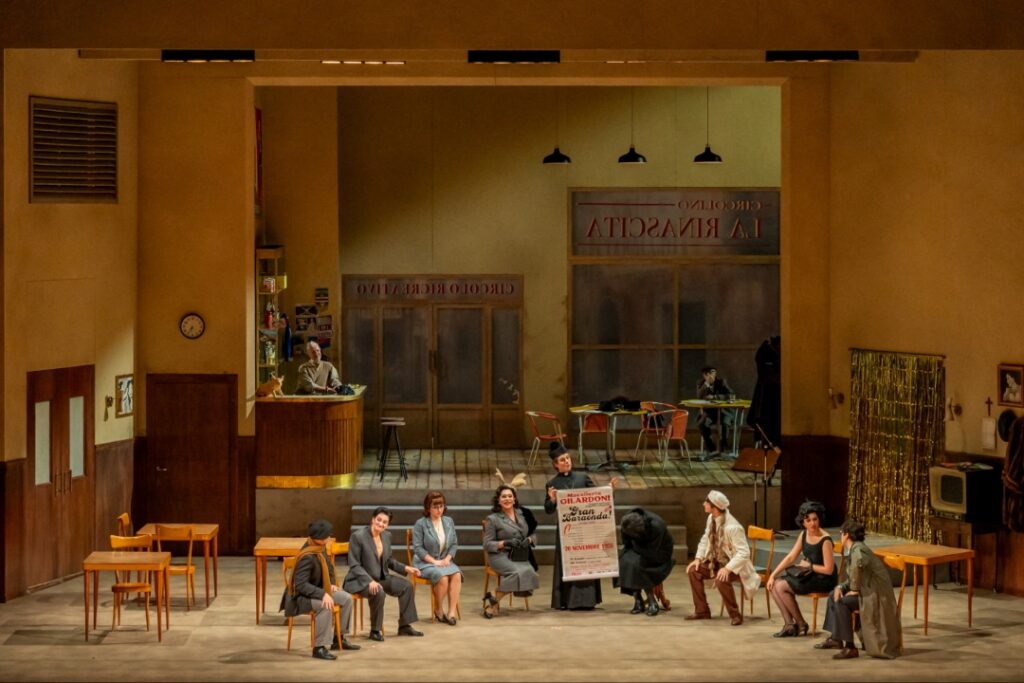
The new production for the twelfth edition of the Donizetti Opera Festival in Bergamo—the composer’s birthplace—bears the signature of Silvia Paoli. The director transposes the action to provincial Italy in the 1950s, specifically to a typical post-war recreational centre with a small adjoining parish theatre. Between the bar, games of bingo, numerous expressions in Neapolitan dialect and rehearsals constantly interrupted by the voices of the local community, Paoli constructs a dynamic production in which the singers become genuine comedians through exaggerated gags and physical-comedy devices that work rather well, thanks to the vis comica of the entire cast.
The setting, both of the community center and of the 1950s-style parish theatre, works thanks to Eleonora De Leo’s set design, which is further enriched by references to the popular imagery of the period. Its central dramatic focus lies in the confrontation between the company and a community increasingly drawn to television. At times, the production feels somewhat forced, particularly through the insertion of a priest who is in fact the poet, the group of people playing tombola (the Italian version of bingo) who become the company’s chorus, and certain scenes which, although few in number, occasionally disrupt the comic timing. The production’s effectiveness is supported by Ilaria Ariemme’s costumes, entirely appropriate to the period, Fiammetta Baldiserri’s consistently effective lighting, and Alessandra Bareggi’s thoroughly delightful choreography for a group of elderly vedettes. Together, they contribute to recreating a deliberately modest aesthetic, closer to that of a provincial parish company than to that of an operatic institution.
Illuminating Music
From the pit, Alberto Zanardi, returning to the DOF after his participation in “Zoraida di Granata” during the 2024 edition, delivered a conducting performance particularly well suited to bringing out the brilliance of Donizetti’s style. The Italian conductor led the Orchestra Donizetti Opera with precision, confidence and authority, offering a carefully considered reading of the score, respectful of the composer’s stylistic characteristics and marked by sonorous brilliance, cohesion and rhythmic vitality. His conducting, attentive to the young voices and the demands of the stage, stood out for its ability to control the score’s constant changes of register, reconciling flexibility of accompaniment, clarity of execution and overall balance. Together with the precise contribution of the Coro dell’Accademia Teatro alla Scala, prepared by Salvo Sgrò, and Hana Lee’s competent fortepiano playing in the recitatives, Zanardi achieved a combination essential to reconciling the comedy’s liveliness with the brilliance of Donizetti’s magnificent score.
(Photo: Credits: © Photo Studio U.V. – Fondazione Teatro Donizetti)
Paolo Bordogna as Mamma Agata
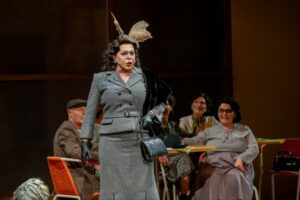
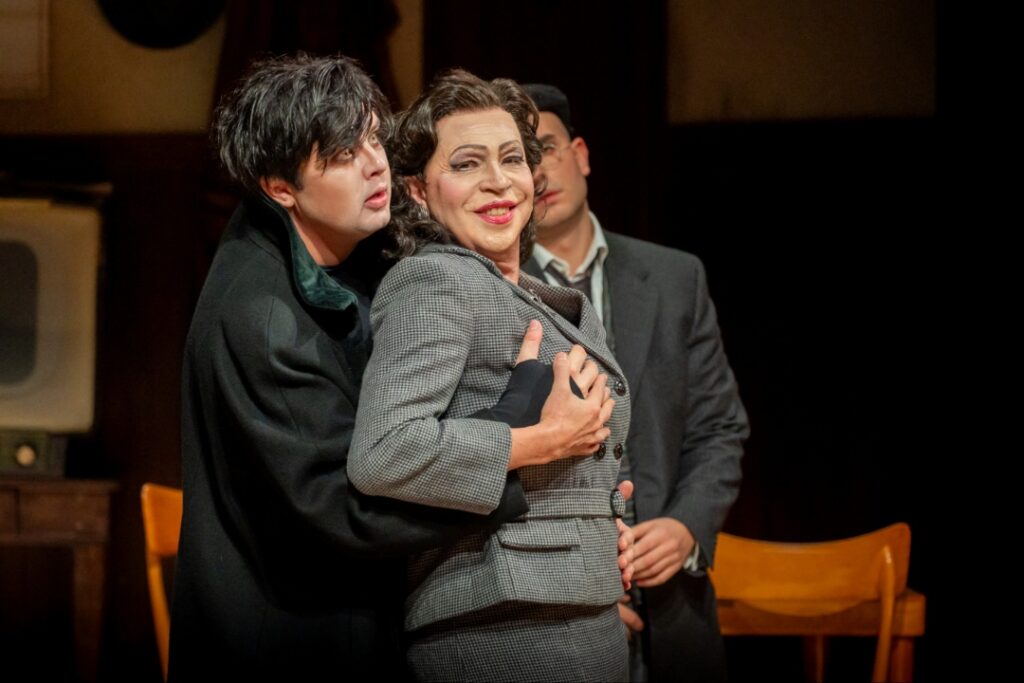
Half of the cast was admirably made up of students from the Bottega Donizetti 2026, who, under the direction of Giulio Zappa, shared the stage with experienced professionals capable of raising the standard of the performers who are still in training. Nevertheless, the undisputed star of the evening was Paolo Bordogna, who portrayed Mamma Agata, mother of Luigia, the seconda donna. This is a female character written for a buffo singer, whom the Milanese baritone transformed into an extraordinarily entertaining creation, demonstrating a particular aptitude for the travesti role. Possessing a powerful and well-supported voice, Bordogna always sings with accuracy, thanks to a solid and evident technique that even allows him to play musically with passages written for other vocal registers. He did so with impeccable verbal articulation and a stage presence radiating energy from his magnificent entrance in his first aria, “Mascalzoni! Sfaccendati!,” which already foreshadowed the extraordinary performance he was about to deliver. His portrayal was so entertaining that, particularly during the Romolo ed Ersilia scene, the audience could barely contain its laughter. Bordogna is quite simply a true stage monster, with astonishing vocal and dramatic characterization; consequently, the audience rewarded him with the evening’s loudest and most deserved ovation.
Elene Gvritishvili as Daria Garbinati
Elene Gvritishvili portrayed Daria Garbinati, the prima donna, and succeeded in bringing considerable personality to the insecure singer, modest at times and haughty at others. Wearing an elegant black dress, the Russian soprano offered a variety of expressive nuances in her singing. She possesses a beautiful voice, with a sweet, velvety timbre and moderate volume. Her vocal color is lovely, and her upper register is bright, powerful and clean in coloratura passages and agilità. Following Paoli’s post-war concept, the singer also performed the popular song “Grazie dei fiori” by Nilla Pizzi, winner of the 1951 Sanremo Music Festival, accompanied at the piano by Stanislaw Masseroli.
(Photo: Credits: © Photo Studio U.V. – Fondazione Teatro Donizetti)
More Cast Highlights
The prima donna’s husband Procoro, was portrayed by Giacomo Nanni. His elegant and refined baritone register did not prevent him from successfully exaggerating his delivery in the aria in which he defends his wife. He was highly convincing both vocally and in his portrayal of a husband subjugated to his wife’s fame. His voice, flexible and full of nuance, completed a thoroughly accomplished performance. Giovanni Accardi, meanwhile, assumed the role of the conductor Biscroma Strappaviscere and enthusiastically joined in the overall spectacle, thanks to his beautiful, well-supported and resonant voice, with ease in the middle register. His vocal contribution proved particularly effective, since he is the character who skilfully maintains the narrative thread of the story. Accardi knew how to give his likeable character a strong stage presence.
Veronica Prando as Luigia, the seconda donna, also acquitted herself very well, despite the brevity of the role. She enters fully into Mamma Agata’s game and proves particularly effective on stage: she even performs a cartwheel to demonstrate Luigia’s qualities and the need for everyone to see her. In this way, she creates a lively character, endowed with a beautiful voice and stage agility that extends to unexpected acrobatic feats. Camilla Carol Farias meanwhile, portrayed the musician Pippetto. She possessed a warm and agile vocal quality and was equally convincing from a theatrical standpoint in her male characterization. Farias stood out for her vocal freshness, stage presence and the naturalness with which she assumed this male role.
Giulio Iermini, for his part, brought the poet and priest Cesare Salsapariglia to life, with a convincing performance both vocally and dramatically. His voice, with clear diction and good projection, reached every corner of the theater. Although these were small roles, the remaining performers contributed to making the performance extraordinarily entertaining and sustained the production’s comic momentum, supporting their colleagues. Mattia Venni as the impresario, and Omar Cepparolli as the stage director, likewise delivered convincing contributions, with good pronunciation.
A special mention is deserved by Filip Filipović as the German tenor Guglielmo. The Croatian tenor’s voice is extraordinary, of uncommon beauty, with a squillo perfectly suited to bel canto and an unusually distinguished legato line. His contribution included the aria “Come uno spirto angelico” from “Roberto Devereux,” which became a genuine gem to share with the audience. His stage portrayal of the German singer, who experiences considerable difficulty speaking Italian, was equally delightful. Without a doubt, we are dealing with one of the most beautiful young voices on the current operatic scene, and his career deserves to be followed closely for all his remarkable qualities.
At the end of the performance, the audience could not stop expressing how much it had enjoyed the spectacle, applauding enthusiastically. However, when Bordogna appeared, the theater almost erupted with excitement: cries of “Bravissimo!” resounded from the loggione to the stalls. Visibly moved, the baritone thanked the audience wholeheartedly for its ovation, while the creative team also received applause.