Bayreuth Festival 2026 Review: Das Rheingold
A Ring for No One, but for All – Bayreuth’s Overlooked Success
By Vincent Lombardo“It is typical for humans to spur their creations without boundaries,
but when AI advances too far, the way back to true harmony is obscured.”
AI interpretation of a Confucian thought
“An abundance of new experiences or images may unsettle our realities;
perception and intuition alone will bring us to surpassing their cosmic illusions.”
Aphorism, Anonymous
It has always been assumed that a confrontation with images brings us into the recesses of our unconscious minds. As today’s children may follow a stream of animations in a video game, an onlooking adult may identify repeated human ur-myths, filtered as archetypes, that possess an near-autonomous life of their own, wielding power through human awareness. These images themselves may seek to be experienced, rather than merely analyzed. In the here and now, Bayreuth’s experimental (and exceptional) 150th anniversary “Der Ring des Nibelungen” becomes just such a “video game” — and a challenging one at that. The criticisms reserved for this production outweighed the merits of this experiment, failing to recognize its true value. We were witnessing a Wagner performance as never before, wherein the dramatic action and music not only remained intact as Gesamtkunstwerk, but related to the irrepressible passage of Time itself, while also shattering realities. Wagner’s visions were always immersed in the intricacies and psychic energies of an “illo tempore” approaching Henri Bergson’s philosophical metaphysics. If not seen in this way, the entire production would be understood for what it was not – stage action and images going one way while the music and the opera went another.
In psychological terms, all images, whether fine works of art or simple rough sketches, reveal unconscious impulses and tensions. Our active thinking will stretch these to find justification regarding our sense of beauty. Philosophically, a work of art may aim at identifying that which, though removed, embellishes the creative act. Bordering on deconstructionism, all visual phenomena relates to purity of self-contained form, at times even isolating what is unstable within it. The same discourse is a cousin to the age-old operatic argument of whether the words or the music are more important.
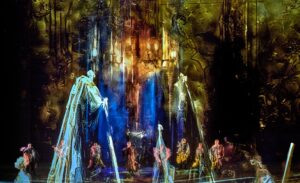
“Ring 10010110: From Myth to Code,” (10010110 being the binary of 150) was a myriad of images and photographs from Bayreuth’s historical productions and events, many recognizable for the gleeful faithful. A veritable potpourri of themes abound as related to nature, dystopic industrialized cities, and great humanitarian figures (and others less-so). As time went on, act by act, opera by opera, restlessness grew. Many spectators felt Wagner’s unifying elements were straying, becoming less cohesive. For some, the theatrical essences of tragic progression seemed to disappear, while for others they were non-existent. Yet, one may have perceived something unique: the singing-actors on the Festspielhaus stage, held together by music and text, were indeed dramatically involved. It was theater, and not at all resembling one of the many recent “Ring” cycles in semi-concert form, ornamented by a single photographic image. For many, these projected snapshots have appeared as dismal fragments, remnants and reminders of other events, and have one longing for theater in its unique, yet recognizable, form. Here, however, something else was going on. Reality was integrated in an intriguing way, rejecting operatic mannerisms professing the realities of theatrical pretense. The scenic was no longer a background suggestion of a realistic theatrical reality. Here the space was totally engulfed in Wagner’s world: ethereal, cryptic, dream-like, somnambulistic in its abstract, ever-absurd in its posture and suggestion. After all, did not the composer conceive the opening music for “Das Rheingold” out of a half-dream while resting near the Mediterranean? In a subtle way, we sensed the visibility of artifice, manufactured as to make us even more aware of a construed world rather than the make-believe. The stage personages never left us, instead they held their ground. Though they were somewhat immobile, their poses represented sheer physical prowess and, surrounded by music, made for incisive dramatic power.
In The Midst of A Glitch
Though concentrating here only on “Das Rheingold,” the discussion regarding AI imagery as it refers to this entire “Ring” must center upon one’s over-all reaction to the almost completely cinematographic framing. The duties of such figures as stage director, dramaturg, and storyteller were now metamorphosed into the role of “engineers of staged perception,” immersing the theatre space in a holographic environment. All essences of movement, human or decorative, were retrieved from over a thousand documents from Bayreuth’s own archives. Any belief that these movements were haphazard was mistaken. Almost everyone knew that the round-robin choice of images varied performance by performance, though this information did not reveal what was actually being projected upon the transparent screens lining the stage. The performers’ positions were being constantly tracked, the text of the libretto analyzed, and the sound frequencies of the singers and the musical instruments absorbed. Impressive references to symbols came and went with speed, so much so that during intervals spectators puzzlingly quizzed one-another if they had caught an image or not: was it a photo, a moving blur, or a dissolving mass? The effect of absorbing hundreds of images and reproducing them as hypnotic, slightly brain-washing flashes were evident among the audience. Almost no-one refused them – they possessed an unexplainable fascination. Some visuals were too beautiful to grasp even as they disappeared forever, while others returned in identical form, or perhaps with slight variations.
One technique resounded: an iconic image in the shape of a jigsaw puzzle piece, fading yet leaving the outline for the span of seconds that seemed hours. We either lamented its absence and hoped for its return, or stored it within our memories as a precious token of the performance. This striking visual style is known as Glitch Silhouette Art or Pixelated Shape Distortion. It removes all details such as faces, clothing textures, and lighting from within the outline of the image, be it a photograph or a distorted non-representational form, and fills only the remaining outline with apparently digitized errors. Disturbing and fascinating at the same time, the impression lasts, and a new class of imagery is created. One such image immediately comes to mind: the outlines of the two giants, Fafner and Fasolt from Patrice Chéreau’s centennial “Ring” in 1976. They hung in space as if production design sketches; hunched, balding, proportionately small-headed Cro-Magnon figures draped in cloth, taking on features leading to “modern man” as tool-makers, artisans, and castle-builders. This was one of the most iconic images used that evoked the Bayreuth of the past and celebrated the festival’s history. We should not ask how many spectators caught this image, but rather whether those who did grasp it were brought together through their life-experience with Wagner. Assuredly the image is less iconic than Brünnhilde floating within a red laser-outlined cube from Harry Kupfer’s “Magic Fire” scene from “Die Walküre,” which was an image also sampled in this production. There was also the lesser-known Kirschner-Rosalie version of the same scene which included a vast standing-triangle sail within a huge circle of candles. All of this was pure Wagneriana visual overflow, and this was the spirit of the 2026 “Ring” cycle.
A Parliament of Owls
As to the physical elements of this production, there is little to discuss save the costumes, clinging to the silhouettes of the characters. Harshly criticized as indistinguishable, ridiculous, and awkward, some will have found them the ideal solution for this production. It is true that no-one makes a change of costume throughout this entire “Ring,” and the cast wore what at first seemed to be nearly-identical garb. The basic color was dark grey, and all were feathered in some measure. None of the costumes seemed particularly easy to move in. What, then, did they represent, and were they necessary? The evocation of birds did not hold, yet, oddly, there was a certain lightness as the characters changed positions at times within a tableaux-vivant. Some were winged, others wore apparently Victorian flowing gowns, while others still appeared to hail from the pure 1920s.
One could have confused the costumes within this AI ambiance to be reminiscent of owls – mostly for their color, overall stockiness, and the stiff movements of their wearers. Little changed over the entire gamut of four operas. This made for difficult viewing if one was unfamiliar with the operas, their character relationships, and interchanges. For the greater part of the show, the positioning of the performers in their rigid costumes downstage center evoked a family portrait snapshot session. The owl metaphor held here, even though the animal is known to be a solitary bird. As related to their legendary wisdom, owls are collectively referred to as a “Parliament” when grouped together, and such was the case of those men and Gods of “Der Ring” when discussing their predicaments and futures in true Wagnerian manner.
These uniform, subtly shaped outfits did not wear thin during the entire “Ring.” Though blandly appearing to be nothing, they encouraged us to attribute to and justify their actions and motivations. If this was the intention from the outset, then a universal theater costume was ingeniously created. Though spectators may have booed, the owls had the last laugh – or, rather, hoot.
Fear of The Unseen Whole
Exploring the visual world of this anniversary “Ring” allowed us to encounter innovative styles, incongruously surreal scenarios, and conceptual interpretations that challenged our human creativity. Artificial intelligence may have been assumed by many in attendance to have redefined opera. It is odd that we remain baffled by this concept after the MIT-led staging of “Parsifal” in 2023 using AR (Augmented Reality). Through the use of dark glasses, one was immersed within another world, surrounded by images. Some were frankly ineffective or tasteless, others repeated infinitely. Many of us in attendance then discussed possibilities for a future “Ring” with this technology, but after three years this conversation has apparently fizzled out. Immersive technology within opera manifests in other, subtler forms. Bayreuth productions have used QR Codes in their theater programs to explain in depth what might have escaped the spectator.
One’s reflections upon leaving the Festspielhaus after “Das Rheingold” depended solely upon one’s reaction to the barrage of overwhelming imagery within a larger cautionary drama related to the fears of replacing artists with machines. Those unsettled by it all perceived the lack of theatrical imagination to be a product of AI stunting art. But those who created this historical event were human, and chose this artistic path. The apparent minority of operagoers saw a production that laid the foundations for is to develop into an innovative theatrical experience.
“Ring 10010110: From Myth to Code” was conceived by Marcus Lobbes, as supported by the artistic and technical conceptions of Nils Corte. The technical team is completed through the dramaturgy of Andri Hardmeier, digital and AI storytelling of Roman Senkl, and creative code and visual art by Corte and Phil Hagen Jungschlaeger. Scenery was by Wolf Gutjahr and costumes by Pia Maria Mackert. They were a full crew that truly investigated Wagner’s “Tetralogy” and achieved what they had set out to do. They opened up our minds to perceive different realities of theatrical representation through time and space, and did so without requiring a stage director in the historical sense of the word. This is perhaps a plus if we consider the many measurably inadequate stagings that followed the unwritten rules of Regietheater.
Doppelgängers of Themselves
All the characters in this “Ring” production are doppelgängers of themselves. The singing actors do not assume the physical attributes or mannerisms of their doubles, for the double is not there – only seen as if through their mind’s eye. They only sing of them, and we are left to imagine the character that they describe. Their characterizations, unacted, are in essence open dreams, and are archetypical, emotionally distant, yet materialized in an interior manner. The most truthful of all interpretations of this production would be to suggest that Wagner’s characters are inhabitants of a chivalric dollhouse, each indicative of foundational fables and myths. The audience are the children playing with that dollhouse and the characters within. This Bayreuth AI “Ring” becomes our “theater-within-a-theater” and every spectator can attempt their own reconciliation with all that appears contradictory within the ensemble of doubles and Wagner’s original characters. Each character is now perceived differently by every individual attending the opera. Understood in such terms, we may accept this staging. It was declared by many in attendance that they could not understand what the images were doing, nor what they meant. Without the aforementioned understanding of this production, the “Ring” would certainly seem disunified.
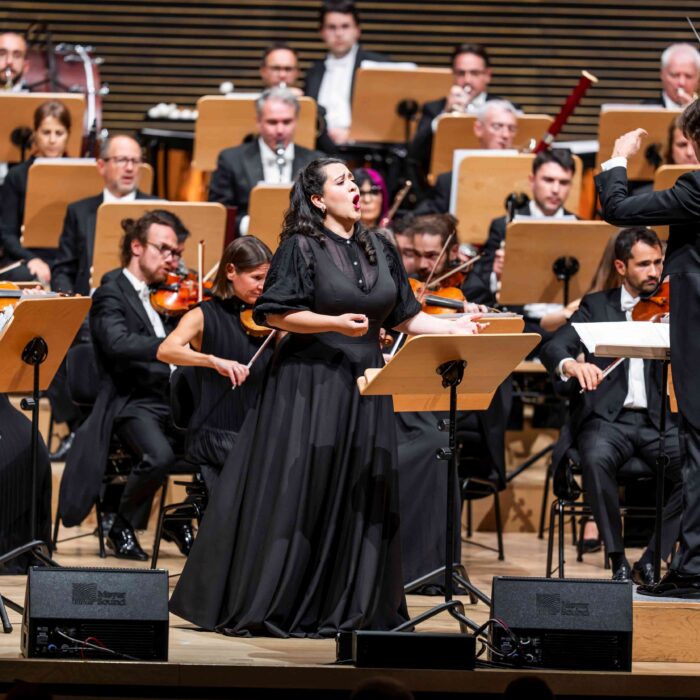
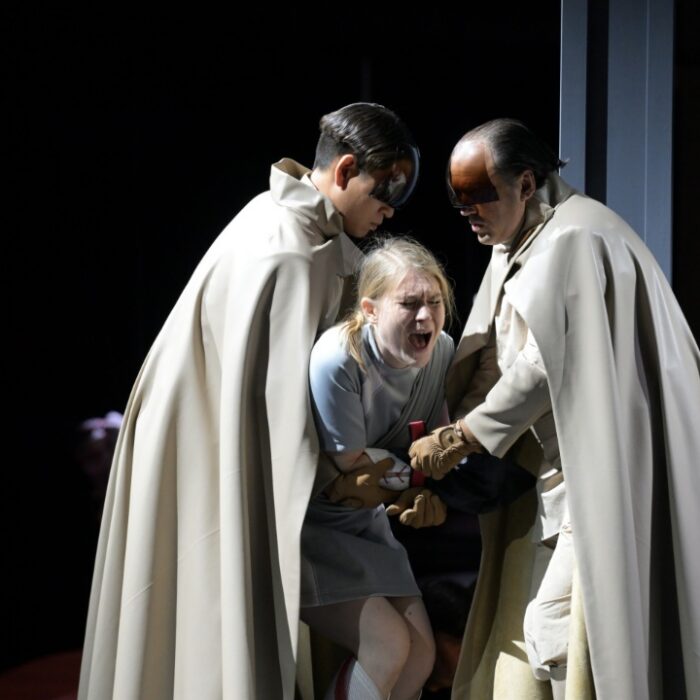
Baritone Michael Volle, one of today’s leading interpreters of Wotan, told us something revealing about performing in this production. He was reported to have told Lobbes, “This is fantastic, the instructions are very clear: I stand here, I sing, I have a blast.” But he also stated, “I found it much more exhausting than I expected. It demands even greater concentration.” Obviously, this type of staging stresses a performer’s mental prowess. Energies build up through prolonged immobility and find no release through physical movement. Yet, Volle’s performance was not apparently impacted, and he remained one of the most vibrant of the the cast, tirelessly questioning himself about his faults. His bickering wife Fricka (mezzo-soprano Anna Kissjudit) and her Goddess of Youth sister, Freia (soprano Evelin Novak) complete the immediate family. Kissjudit’s projection revealed deep, sonorous timbre, its fullness bringing poise and dignity, and her assured intensity was suitably Wagnerian. Novak breathed luminous youth with a luminous soprano timbre, while also conveying her desperation at the hands of the giants. Her desperate shrieking when calling for help was penetrating.
Tenor Klaus Florian Vogt as Loge was history-making. He took on this role as well as Siegmund and Siegfreid, allegedly at the suggestion of Maestro Christian Thielemann. Already reknowned as one of the most lyrical Wagnerian singers, Vogt’s Loge was true to form. Though undoubtedly a personal challenge, he won the game. The musicality and the quirkiness of an erratic, almost comical lawyer serving Wotan came through. Dramatically he could have been more sarcastic, bitter, and hysterical, making us laugh and cry at his predicaments, but this is a trite observation. Vogt always enunciates perfectly with an expressive agility that some critics claim he lacks. He seemed to have welcomed the presence of wings attached to his costume, as if readying to fly away.
As he is “the” Nibelungen whom Wagner refers to, the “Ring” routinely touches upon the notorious dwarf Alberich, older brother of the blacksmith Mime and father of Hagen, who appears in three of the four operas. His cursing of love in return for power is musically and thematically one of the pivotal points in the entire saga. Baritone Jochen Schmeckenbecher vocally interpreted Alberich with acumen and dramatic subtlety, bearing upon his human frailty above all. Yet his anger was readily exposed, seeping upwards from the subterranean depths of Nibelheim, and his resoluteness in throwing away human sentiment for power was as chilling as it should be. His younger brother, Mime, interpreted by tenor Gerhard Siegel, hits upon the character’s habit of being constantly put into predicaments, leaving room for the almost comical. His character possessed great vocal and dramatic range.
The gods representing the elements of nature were animated by Mother-Earth, the Erda of mezzo-soprano Christa Mayer. Mayer is best known for her interpretations of both Erda and Waltraute, the Valkyrie. Her vocal interpretation of the Mother-of-All-Nature comes to us through dark, solemn tones identifying with worldly wisdom, all through suave shifting of register and intervals. She has always been unique in this most unique of Wagner’s music. Flanking her in Wotan’s entourage, Donner the thunder-maker (bass-baritone Alexander Grassauer) and joyful Froh the rainbow bridge constructor (tenor Siyabonga Maqungo) bring us into the fairytale beginnings of the “Ring.” Grassauer’s resonant bass-baritone filled the space, evoking mountain tops, while his manly, fiery accent called to the mists as Maqungo’s vibrantly lyric tenor caressed the a fluid vocal of his expressive hymn to the rainbow bridge leading to Valhalla. The giants Fasolt (bass Mika Kares, who will also play Hunding and Hagen) and Fafner (bass Peter Rose) captured the nuances of their brotherly differences. One is malleably peaceful and loving, the other bent on scheming and a shrewd opportunist. Their interlocking, thunderous bass voices probed the depths of their innermost motivations in an all-too-human way. The three Rhine-maidens, Flosshilde (mezzo-soprano Marie Henriette Reinhold), Wellgunde (mezzo-soprano Natalia Skrycka) and Woglinde (soprano Katharina Konradi) captured our hearts as those forces of innocent and uncontaminated nature. Each was true to the psychological timbre of her voice. They took on an air of noble sobriety as AI images of the 1876 premiere wafted across the transparent tulle screens – Victorian-styled mermaids dabbling time away within the currents of the Rhine’s waters.
And The Musical Universe Flows
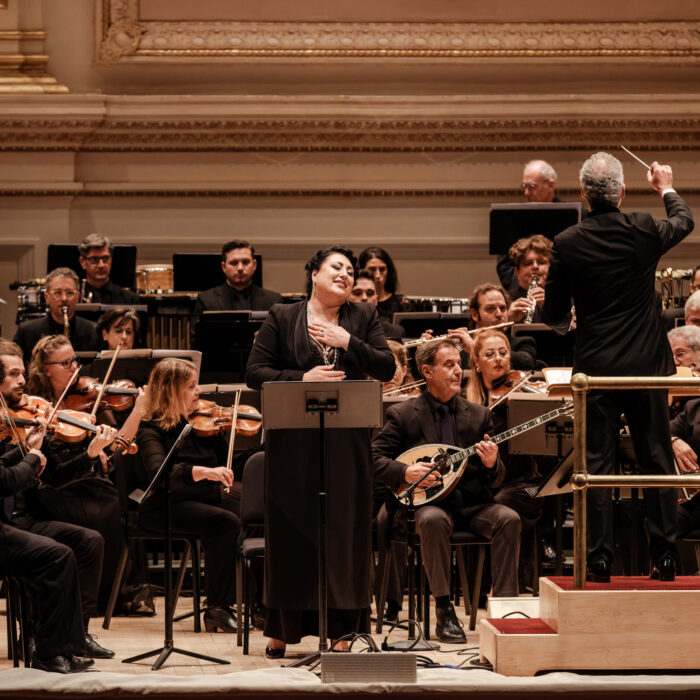
That simple, four-minute lulling world-creation, that “Prelude” to “Das Rheingold” (and to the entire “Ring” cycle in fact), is in many ways Wagner’s greatest achievement. At times it surpasses the mysticism and spirituality of all “Parsifal.” In essence, time flows as caressed by sound and begins to bring to us the dynamics of a legend. If we begin to understand the choices made by Maestro Thielemann as compared to even his own, previous interpretations, the whole of Wagner’s visionary landscape appears. To state that it was the orchestra and singing that carried the almost non-existent stage action onwards would be wrong. Thielemann knew exactly what he was doing, and gave his backing to the ever-present AI ambiance in true Gesamtkunstwerk style. His conducting actively responded to the visual electronic transitions, attempting to make the music and the chaotic imagery fit together. Yet he conducted without fear that he would lead his singers and orchestra astray, submerging them totally within the visual landscape. One suspects he did not ask for the images to follow the rhythms of the music. He did insist that every “Prelude,” “Prologue,” and scene-changing piece of music was carried out with the stage curtain down. This is something rarely done today, often replaced by silly, useless pantomimes that totally change the libretto’s meaning for personal directorial fantasies. However, the closed theater curtains in this AI “Ring” seemed dead weight rather than mystic shrouds protecting the psychological inner sanctums of an oncoming theatrical event.
In itself, Thielemann’s musical visions for this “Ring” will hopefully be repeated – even honed – in the future. It was energetic, refined, and superbly precise. The Wagnerian spectator heard instruments expressing a melody, a leitmotif, a somewhat sketched-only theme as never before. Sonically, it was of chamber opera lightness until, at times, all became opulently Bruckner-like. Singers were seemed to be encouraged to magnify dynamic markings, but not to stand out as imbalanced. They listened to one-another to a great degree. It was truly theatrical.
AI Illuminating Time Gone By
The major warning regarding today’s technology and its uses should not be ignored: AI in the theater is a limited trick, not an illuminating future for theatrical representations. We often admit that its sophisticated imagery disappears from memory rather quickly, while moments from subtle, truly artistic productions of Bayreuth’s past remain fixed in our unconscious labyrinths. One recalls Heiner Müller’s “Tristan und Isolde” of 1993. In the Act two “garden of love” duet, we found the lovers standing inside an arms factory, drifting through rows of Medieval breastplate armor stacked upon the floor. Truly unforgettable. This Bayreuth “Ring” was more than an experiment. It was an accomplishment in many ways for some. Yet, if the quirky reality of a computer does all the work, then we are to become the robots, leaving behind our hard-achieved individual humanity. As faithful members of Bayreuth’s spectators, we are not the audience of the future that Wagner sought to create. It is not Thielemann, nor a staging, nor even Wagner himself that can illuminate Valhalla as an ideal. It is something more than an image illuminating times gone by – it is humanity alone that senses what it symbolizes.