Wexford Festival Opera 2026 Review: Iris
A Beautiful Presentation of Mascagni’s Opera of Lost Innocence
By Alan Neilson(Photo: Padraig Grant)
(***Trigger warning)
Riding the wave of the popularity for all things Japanese, which swept Europe in the late 19th century, Mascagni decided to write an opera about a young Japanese girl who was abducted and sold into prostitution and then died from her mental and physical abuse. Following its premiere at Rome’s Teatro Costanzi in 1898, where it received an enthusiastic reception, it was quickly taken up by opera companies across Europe and the Americas, before fading from the repertoire. By the time of the composer’s death in 1945, it had virtually disappeared. Over recent years, however, the opera has received occasional revivals, including a 1995 production at the Wexford Festival, but it certainly could not be said to have re-entered the mainstream.
A significant reason for its demise has to be the success of Puccini’s Japonisme opera “Madama Butterfly,” which, since its 1904 premiere, has managed to muscle “Iris” off the stage. More significant, however, has to be Luigi Illica’s libretto, which has often been criticized as being relentlessly bleak, misogynistic, and relying on stereotypical impressions of Oriental decadence. These criticisms, while true to a certain extent, can be overcome in the hands of an able director, which was the case for this Wexford production with Rosetta Cucchi at the helm.
What she was unable to deal with, however, was the fundamental structure of the libretto itself. Act one neatly sets out the scene, in which the four major characters, Iris, her blind father, the pimp, Kyoto, and Osaka, a predatory client, are introduced and developed. Iris is an innocent young girl, excited about the outside world. Her father is overprotective, no doubt owing to the fact he is unable to see. Osaka lusts after Iris, and Kyoto is more than willing to make things happen for a price. When the circus comes to town, Kyoto and Osaka take the opportunity to disguise themselves as puppeteers and entice Iris to their performance, which is joined by dancers. Among the excitement and the dance, Iris is surrounded, which Osaka and Kyoto use as an opportunity to have her abducted.
Act two opens in a brothel in Yoshiwara, Edo’s red-light district. It is an exceptionally well-constructed, dramatically intense Act, dominated by Osaka and Kyoto’s attempts to seduce Iris. First they try to flatter her, but when that fails, they move onto bribery and threats of violence, but she still refuses to relent. Eventually, the men give up and throw her out, where she is met by her distraught father, who humiliates her. It is all too much for Iris, who throws herself into a sewer and dies. With that, the curtain falls on Act two.
Unfortunately, Illica now has nowhere to go. The drama has run its course. Act three starts with Iris in a delirious state; she is not dead as first thought, and in her mind she hears the voices of Kyoto, Osaka, and her father. She cannot understand the world in which she lives, so when the sun appears she basically gives up and embraces the afterlife. The Act lasted approximately 25 minutes and felt like an appendage to an opera that finished with Act two. Nevertheless, musically, the finale to the Act was strong. In the final scene, as Iris rises to the heavens, now transformed and at one with nature, a mixed chorus sings the beautiful “Hymn to the Sun,” one of the strongest pieces in the opera, which just about saves the third Act from being a disaster. However, it could not prevent the overall impression of it being a lopsided drama that stumbles to its finale.
Cucchi’s Insightful Symbolic Interpretation
Cucchi directed a beautifully staged production that drew on the expressionistic undercurrents of the work. Her aim was to explore the state of Iris’s subconscious and how purity is transformed into bliss or enlightenment via a path that passes through darkness into light. Everything that takes place on stage is a symbolic representation of her subconscious. Initially, Iris is presented as the Jungian archetype of innocence. She has not yet woken to the real world. She still lives in a world of illusions. She plays with dolls. Everything is good; everything is possible. She is attracted by the puppets and hangs on to her dolls, but then she starts to be attacked by dark images that force their way into her consciousness with the violence of the sexual Act to the fore. She is changing; her innocence is starting to dissolve, and her illusions are evaporating. It is an interpretation that no longer has misogynist connotations, as everything is seen through the awakening mind of a child. Kyoto and Osaka are constructs of her subconscious, carrying the threat that every young girl is eventually forced to confront.
The only excursion into reality during the performance takes place at the beginning of the third Act, when she awakes in the sewer. Her death at the end of Act two was a symbolic reference to her loss of innocence. The sewer is reality, and she is now aware; she is able to see it clearly. Only now can she transcend to a higher state of existence. The finale of the drama is thus turned into a wholly positive one. Like a butterfly awakening from its transformative sleep, she is now able to fly. Whether Cucchi saw this as a literal transformation, in which she dies and ascends to a heavenly bliss, or as a figurative transformation in which it is her old self that dies, enabling her to enter an enlightened state, Cucchi does not specify. Both are possible.
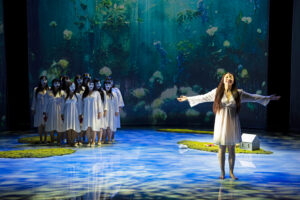
Aided by set designer Tiziano Santi and Thomas Achitz’s videos, Cucchi used symbolic pointers to flesh out her interpretation. Each scene was carefully crafted to allow access to Iris’s subconscious. She struggled to keep hold of her doll even while a prisoner in the brothel. The puppets in the circus morphed into grotesque figures. The golden cage in which she was kept prisoner was in the shape of a crinoline frame that women wore in the 19th century to support their wide skirts, which Osaka and Kyoto entered at will. Videos presented onto the back of the stage shifted between abstract designs embracing color and nature and watery images mixed with more realistic pictures to create a dreamlike backdrop that captured Iris’s changing, partially formed perspectives, which then hardened in Act three to present a brutal, ugly-looking sewer set in a wasteland. Kyoto and Osaka are presented as evil, bad people, so that their attack on Iris, who is pure and good, is actually an attack on beauty itself, which they want “to consume, possess, and destroy.”
It was also a presentation that captured the spirit of the drama. When the circus arrived in town in Act one, the lighting designer, Daniele Naldi, bathed the stage in dark red light to create an atmosphere of excitement and danger. The stage was crowded with dancers, performers, and onlookers, who were dressed in colorful costumes designed by Claudia Pernigotti. The dramatic center of the opera was Act two, for which Santi, Pernigotti, and Naldi combined to create a threatening scene that could easily be accepted as a brothel, dominated by Iris’s golden prison, which was again bathed in red light. A tattooed Kyoto, dressed in aggressive modern-day clothing, and Osaka, costumed as a well-to-do, slick man of means, paraded around the cage while Iris, in a simple white dress, shivered within. It was an unpleasant, vicious portrayal that worked particularly well. The shift to the wasteland in Act three jolted the audience into a bleak colorless reality, which Achitz’s video designs transformed into a colorful idealized picture of nature into which Iris then ascended.
Moreover, it was a staging that worked to overcome the criticism made of the opera. Overt references to Japan were kept to a minimum. This was a drama that could have been played out anywhere. There was no sense that this was a representation of Oriental decadence. It was, however, still a fairly bleak drama, although by staging it so that the color and excitement were played to the full, it mitigated against the violence and gloom that could have been overwhelming. Also by representing the drama as an expression of Iris’ subconscious, it downplayed the misogynistic element that may otherwise have been discerned. Its concluding scene, in particular, which was presented as Iris, free of her childish illusions and readying herself for a new beginning, turns the opera into a wholly positive drama.
Cilluffo’s Interpretation Underpinned by His Intimate Connection to the Music
Mascagni’s “Iris” is the ninth opera to be conducted by the Wexford Festival Opera’s current principal guest conductor, Francesco Cilluffo, eight of which were written within a 20-year period between 1886 and 1905, a period to which he clearly feels attracted. The interpretation he elicited from the Wexford Festival Opera Orchestra certainly confirmed his close connection and feeling for the music, which was presented with warmth, sensitivity, and a sure hand. Not only did he effectively manage its dramatic movements, shifts, and climaxes, but his success in integrating them within the musical arc of each Act was skillfully accomplished. His care in drawing out the work’s rich textures, contrasting moods and melodic beauty was impressive.
Standout Performance From Leyla Gu as Iris
Soprano Leyla Gu produced a flawless interpretation of Iris. Her identification with her character was complete. In Act one, she personified innocence. Her slight build, gentle smile, and naive enthusiasm brilliantly captured her sense of immature wonder, which was reinforced by her reliance on and love for her father and the relationship with her toy doll. Even in the opening minutes of Act two, her immediate response to being in a prison was to assume she was in heaven. When she came under threat from the attentions of Osaka and Kyoto, she reacted with fear, disbelief, and incomprehension. She resisted, but such was her confused and terrified state, she became limp and unresponsive. When Osaka attempted to kiss her, he had to hold her up as she became deadweight in his arms.
It was her beautiful vocal performance that really captured the essence of her characterization. Gu possessed a secure, resonant, versatile voice with a light, bright timbre, which she successfully molded in Act one to give the appearance of naiveté. She sang with a sweet, fresh, and youthful freedom; close your eyes and you could only imagine innocence itself. Yet, when she was confronted by the brutality of Osaka and Kyoto, her voice became more strident, riven with anxiety and fear. It was also a voice that climbed easily into her upper register, where she was able to power above the orchestra and other singers.
It was a delight just listening to Gu; she has a voice of real beauty indeed.
Joseph Calleja as Osaka
Tenor Joseph Calleja played the role of Osaka as a stereotypical predator. He had no redeeming features at all. He was clearly a bully and even wanted Iris to submit willingly to his charms. There was nothing to like about his character. There was, however, more strength and purpose in his voice; certainly more than his character deserved. His singing possessed a confident, domineering, even seductive quality that forced his character into the limelight. He was the man calling the shots, forcing the drama to take the path it did. Yet, there was also a superficiality to his singing, which obviously worked to reinforce Osaka’s character, but it also led to a fairly one-dimensional portrayal. He rarely paid attention to subtleties: the voice was projected strongly and consistently, the tone was fairly homogeneous, and there were few examples of nuanced emotional responses. It was a good performance, but had the potential for more.
Jolyon Loy as Kyoto
Baritone Jolyon Loy blossomed in the role of the pimp, Kyoto. He was aggressive, threatening, and cruel. Iris meant absolutely nothing to him whatsoever, apart, of course, from the money he would be able to gain from selling her. During Act two, he examined her as a farmer would his cattle, prodding and rough handling her. His singing was perfectly molded to reflect his character: it was confident, aggressive, and secure, which he used successfully to develop an emotionally fairly volatile brute.
Jihoon Kim as Il Cieco
Bass Jihoon Kim produced a compelling performance as Il Cieco, Iris’s blind father. When present during the first Act, he sat on one side of the stage, staring uncomprehendingly, directly ahead. Singing with a secure, resonant, and darkly colored, yet warm voice, he quickly established the dependent yet loving relationship he had with Iris, but there was also a lurking insecurity; he was desperate that nothing untoward would happen to his daughter. When she is abducted, he immediately loses his calm demeanor. His voice took on an angry, even vicious, tone as, believing she had abandoned him, he set out to find her so that he could spit in her face!
More Cast Highlights
Soprano Hannah O’Brien played the role of Dhia, the circus performer. She possessed a resonant, expressive voice that was able to capture the attention of the audience. Although she sang with a pleasing tone, her wide vibrato may not be to everyone’s taste.
Tenor Yu Shao was double-parted as a Rag and Bone man and a Merchant. Although both were small roles, he made the most of the opportunities, with confident, well-sung performances that showed off his attractive timbre.
Bass-baritone Meilir Jones and tenor Joshua Baxter produced solid performances in the small parts of Rag and Bone men.
It was by any standards a strong production. Cilluffo’s mastery of Mascagni’s music, together with the fabulous performances from the soloists and chorus, was enough on its own to make a case for further productions of “Iris.” Even Illica’s lopsided libretto proved not to be fatal; Cucchi’s insightful, sensitive reading overcame many of its problems in a colorful, thought-provoking staging that almost managed to camouflage the perfunctory nature of the third Act.