Teatro alla Scala 2025-26 Review: Faust
By Bernardo Gaitan(Photo: © Brescia/Amisano – Teatro alla Scala)
There could hardly have been a better way to bring the 2025–26 season at Teatro alla Scala to a close than with the return of Charles Gounod’s “Faust” after an absence of sixteen years. This is the final production before the eagerly awaited opening of the new season, scheduled for 7 December with Verdi’s “Otello.”
Gounod’s great opera had not been performed at the Milanese theatre since 2010 and, to remedy this, a new co-production was arranged with the Palau de les Arts in Valencia, the Staatsoper Unter den Linden in Berlin, and the Teatro Real in Madrid.
Production Creates a Visual Metamorphosis
The result was a production with a strong visual imprint and solid musical foundations. However, not everything went smoothly: the premiere, scheduled for Tuesday, 20 October, had to be cancelled due to a strike by the orchestra, chorus, technical staff, and theater employees in general, who were demanding a 15 percent pay rise, as well as measures to improve work organization, employee benefits, and reduce working hours. An agreement was eventually reached, and what would have been the second performance ended up becoming the premiere.
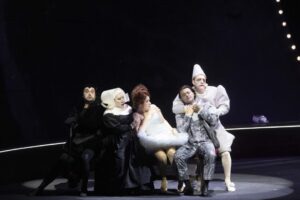
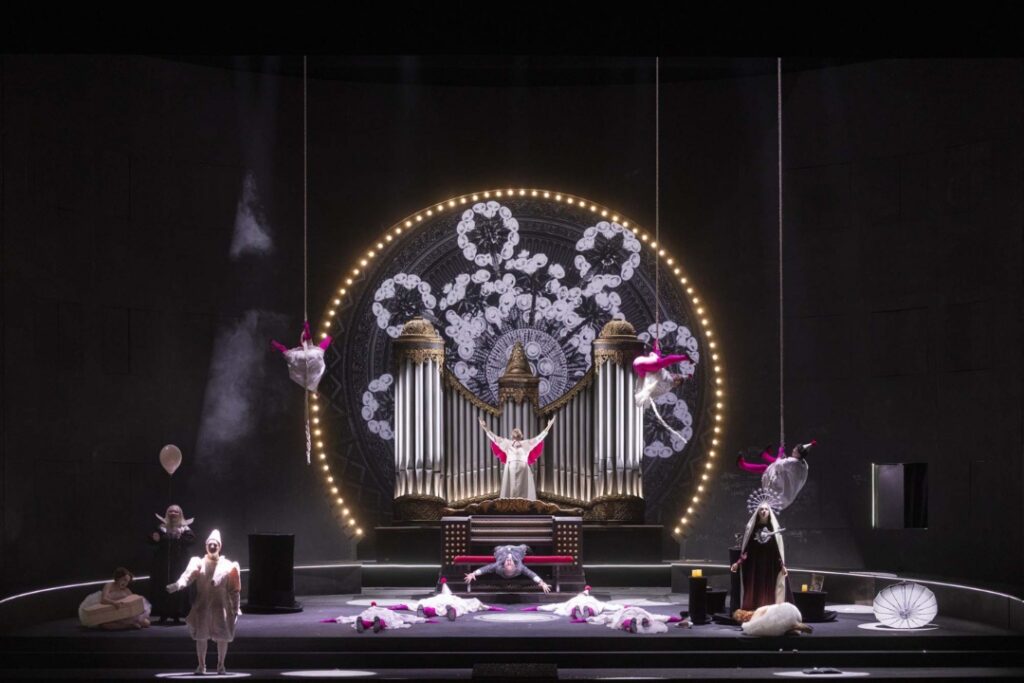
The production bears the signature of Johannes Erath, who made his debut at the historic theater. A musician by training and a former violinist with the Vienna Volksoper, the German director often works with distorted universes, dreamlike realities, and elements of fiction, as we had already seen in his “Maria de Buenos Aires” in Düsseldorf. On this occasion, he sets the action of “Faust” in a circus, conceived not merely as a space for entertainment but as a symbolic stage where opposing meanings coexist and confront one another.
(Photo: © Brescia/Amisano – Teatro alla Scala)
Throughout the opera, a carousel of circus apparitions unfolds, featuring acrobats and tumblers of outstanding visual quality. The performers also stand out for their extraordinary physical and artistic abilities. The accumulation of images maintains a recognizable narrative thread and offers scenes of considerable visual impact, particularly at those moments when the score calls for it. However, exaggerated and striking elements can seem out of place in passages that demand intimacy.
There are directorial choices whose purpose is difficult for the audience to decipher. The concept works, although at times it becomes somewhat confusing; its overall idea is readily understood and offers several successful theatrical touches. The ballet’s finale is apotheotic, while the church scene is extraordinary in its transformation into a ritual with blasphemous overtones: satanic altar boys leap and fly across the entire stage as Méphistophélès, dressed as the Pope and without trousers, accompanies them in this ceremony. The altar boys scatter incense and descend into the stalls to beg for alms. Another effective moment comes when Méphistophélès personally kills Valentin, while a double of the latter, holding a balloon in his hand, leaves the stage as a symbol of his soul in transit. The ending, for its part, possesses a cinematic beauty: amid dark hues, everything gradually fades away, both the opera itself and the protagonist’s very life.
Much of the production’s visual success is due to Heike Scheele’s set design and Bibi Abel’s projections, which contribute to this succession of metamorphosis. From a mysterious black space, a festive, colorful circus emerges, subsequently transforming into a church before returning, towards the end of the opera, to an empty space, with an autopsy table at its center and several corpses in supposedly open refrigerators along the sides of the stage.
Special mention must be made of Fabio Antoci’s lighting design, the true cornerstone of this production. Through the combination of cold lighting and smoke, the desired atmosphere of mystery is achieved; its perfect synchronization with the music and stage movements creates the atmosphere Erath seeks to convey to the audience.
Musical Highlights
In the pit, the situation was optimal: Daniele Rustioni‘s baton was consistently clear, assured, and perceptive. The Milanese conductor demonstrated a firm command of the orchestra and remarkable interpretative flexibility. His understanding of the style and French repertoire, as well as his control of orchestral dynamics, were more than evident. His reading stood out for its transparency, the balance between sections, and his ability to make the most of a rich color palette and a remarkable narrative dimension, which allowed him to highlight Gounod’s stylistic contrasts.
Rustioni constantly looked after the singers, both in terms of volume and intensity, and his command of the orchestra helped enhance the beauty of the arias. In particular, the introduction to “Il était un roi de Thulé” revealed his profound stylistic understanding; the same was true of the dramatic passages towards the end of the opera and the apotheotic conclusion of the ballet at the beginning of Act four.
The Teatro alla Scala Orchestra once again demonstrated its exceptionally high musical standards and its versatility across the repertoire. Equally magnificent was the church scene, where the internal organ made a powerful impression through its sheer grandeur. The chorus, under the direction of Alberto Malazzi, once again confirmed its extraordinary quality with an outstanding performance. One of the evening’s most accomplished moments comes at the end of Act two during the waltz, when the choristers sing and dance simultaneously. This added to the spectacular “Gloire immortelle de nos aïeux,” known as the soldiers’ chorus, in which the voices with their exceptionally powerful volume were entirely justified and beautifully achieved. This moved the audience during Act four.
Vittorio Grigolo as Faust
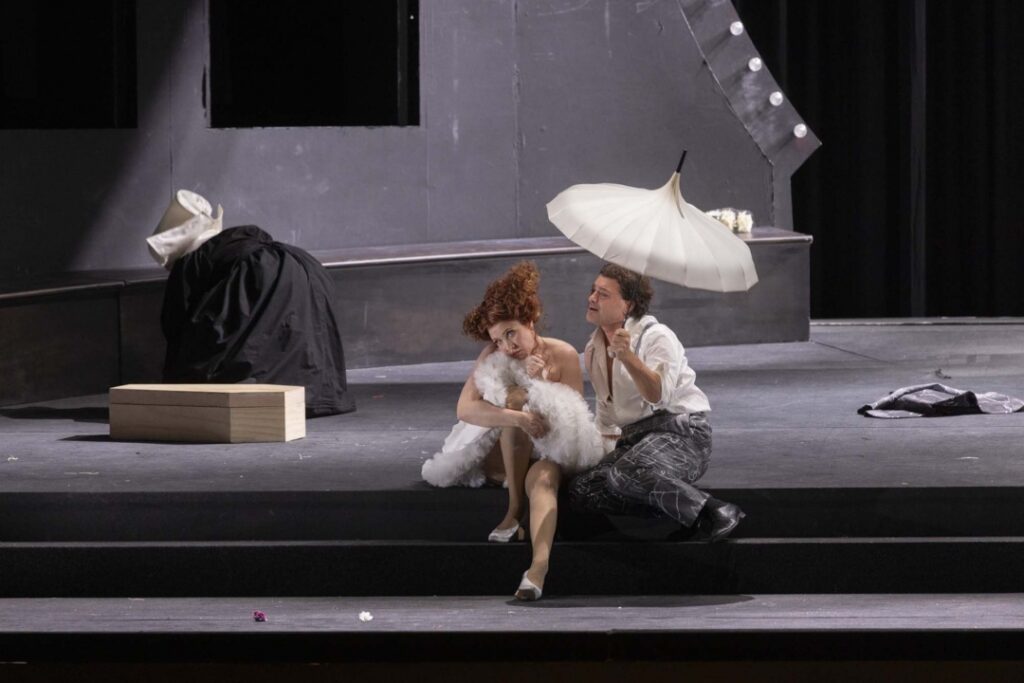
The leading roles were equally satisfactory. In the eponymous role, Vittorio Grigolo delivered a Faust with a splendid timbre, good technique, stage presence, and theatrical temperament. The Tuscan tenor, in addition to possessing impeccable French diction, understands the character and, thanks to his acting abilities and vocal expertise, convincingly portrayed an old man willing to strike a pact with the devil in order to regain his youth, now consumed by evil.
His duets with both Marguerite and Méphistophélès were charged with expressiveness. His “Salut! demeure chaste et pure” stood out for its emotional intensity, featuring a beautiful and secure high note that began in filato and ended in fortissimo, very much alla italiana, a device that works well in the theater.
(Photo: © Brescia/Amisano – Teatro alla Scala)
Alex Esposito as Méphistophélès
The role of Méphistophélès was entrusted to Alex Esposito, who excelled through his many facets: ironic, uninhibited, and master of the stage thanks to his dazzling stage presence. He first appears as a dead man brought back to life in a funeral parlour; then as a lion tamer, whip in hand, to perform “Le veau d’or;” and later as an orchestra conductor, the Pope, the devil, and a surgeon. All these characterizations reinforce his ability to turn every appearance into a genuine spectacle. His performance was supported by a splendid timbre and exceptional technique, particularly in the lower register. His ability to seduce without neglecting the musical aspect, together with the variety of his characterizations, made him one of the production’s greatest successes.
Marina Rebeka as Marguerite
But the undisputed star of the evening was Marina Rebeka, embodying a Marguerite of great class and elegance, capable of combining delicacy, strength, lightness, and dramatic intensity. The Latvian soprano’s voice is currently enjoying one of its finest moments, and this role suits her extraordinarily well at this stage of her career. Her extensive range across all registers and solid technique enabled her to tackle the entire tessitura with confidence, including an immaculate upper register of extraordinary beauty and sonority. Her “Il était un roi de Thulé” was particularly melancholic in character, subsequently giving way to one of her great moments of the evening with “Ah! je ris de me voir si belle,” better known as the “Jewel Song.”
Throughout the performance, she demonstrated a vocal quality ideally suited to the role, elegant phrasing, and impeccable French diction. Her colors and accents revealed an artist of the highest calibre.
More Stellar Cast Details
The cast was completed by Ernesto Petti as Valentin, the soldier and Marguerite’s brother, who delivered a convincing performance, with beautiful vocal qualities and great expressiveness, particularly in “Avant de quitter ces lieux,” when he commends his sister to God with profound emotion. Marcela Rahal also stood out as Siebel, the young man in love with Marguerite, with a particularly accomplished interpretation, especially during “Si le bonheur à sourire t’invite.” The remaining comprimario roles were also satisfactorily performed: Hyeonsol Park as Marthe, Marguerite’s neighbour, and Xhieldo Hyseni as Wagner, Valentin’s friend.
At the end of the performance, all members of the company received prolonged applause. With this production, the Teatro alla Scala season comes to a close, bidding farewell with a title from the French repertoire and paving the way for the following season, 2026-2027, which will include two further works from the French operatic tradition: Bizet’s “Les Pêcheurs de perles” in January and February, and Massenet’s “Don Quichotte” in May and June.