Bayerische Staatsoper 2025-26 Review: Fidelio
Calixto Bieito’s Production Gets Lost in a Labyrinth of Absurdistan
By Ossama el Naggar(Photo: Geoffroy Schied)
Beethoven’s only opera has always occupied a singular and somewhat anomalous position in the repertory. Despite repeated revisions, the composer never entirely reconciled the conventions of Singspiel with the elevated moral and philosophical aspirations that animated the work. Yet it is precisely this unresolved tension that has guaranteed “Fidelio” its enduring fascination. At once a domestic drama, a political parable and a meditation on liberty, it remains one of the supreme artistic expressions of Enlightenment humanism.
Such a work requires, above all, an intelligent stage realization. Calixto Bieito’s production (seen July 12) provided the very opposite.
Production Details
I had encountered this staging when it was unveiled in 2010. At the time, the presence of Jonas Kaufmann as Florestan rendered it easier to ignore its manifold deficiencies. Deprived of such vocal splendor, the production now stood exposed as little more than an accumulation of directorial whims, bereft of any coherent dramatic idea.
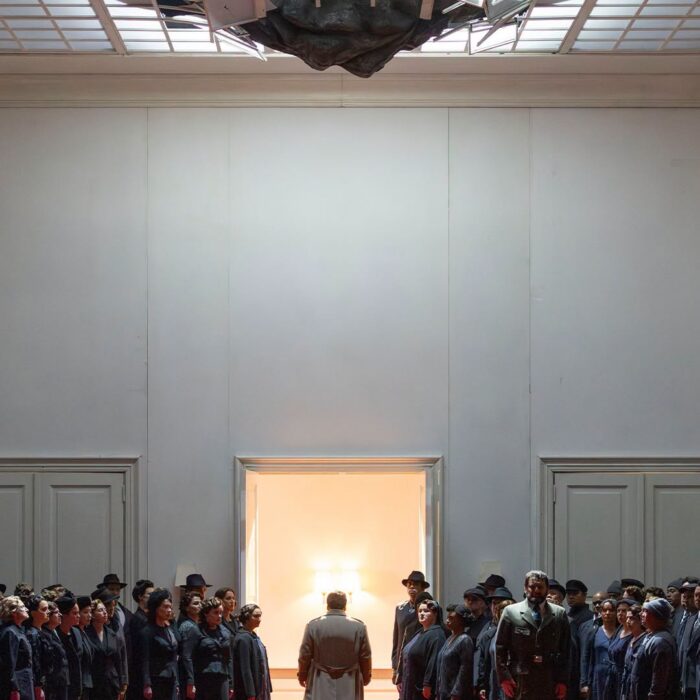
A gigantic steel scaffold dominated the stage throughout the evening. Presumably intended as a prison, it looked more like an abandoned industrial installation or a particularly inhospitable multistory car park. The “co-ed” prisoners wandered through its corridors with surprising freedom, scarcely suggesting men and women crushed by years of incarceration, while their business suits made them resemble middle-ranking civil servants rather than victims of political tyranny. Bieito appeared to believe that incessant climbing, creaking metal and aimless movement constituted dramaturgy.
The overture was accompanied by an extended barrage of strobe lighting. One assumed this was intended to keep the audience in a state of political vigilance, though after several minutes the principal effect was less one of enlightenment than ophthalmological distress. The subsequent elimination of much of the spoken dialogue merely compounded the confusion. The production seemed singularly uninterested in such elementary matters as who these people were, why they had been imprisoned, or indeed why any of us should care.
Its absurdities became progressively more extravagant. Leonore distributed portraits of the dictator whose tyranny she sought to overthrow. Four musicians, suspended in cages, performed an excerpt from Beethoven’s Op. 132 quartet for no discernible dramatic reason. Supernumeraries floated and writhed above the stage like refugees from an avant-garde circus.
The final scene abandoned any pretense of sense altogether. Don Fernando entered not as the embodiment of justice but as Heath Ledger’s Joker, scattering playing cards and looking considerably more malevolent than Don Pizarro. Florestan, having apparently been shot dead, absurdly by Don Fernando, promptly returned to life. One briefly wondered whether Bieito had discovered in “Fidelio” a hitherto unsuspected affinity with Gothic melodrama. One could only admire the director’s determination never to allow logic to impede invention.
Yet the gravest failing of the production lay elsewhere. It never illuminated Beethoven’s drama. It neither deepened our understanding of oppression nor enriched our appreciation of freedom. It merely adorned a profoundly humane work with a sequence of eccentricities.
Musical and Cast Highlights
Musically, the evening proved scarcely more consistent. Yoel Gamzou’s conducting possessed occasional refinement and undeniable care for orchestral detail, but it remained curiously detached from the emotional pulse of the drama. Dynamic contrasts were often restrained to the point of anaemia, climaxes failed to achieve cumulative force, and several abrupt tempo modifications created awkward tensions between stage and pit. There were moments when one felt the conductor was directing a highly civilized concert performance of some rediscovered eighteenth-century score rather than Beethoven’s impassioned hymn to liberty.
This was particularly unfortunate because the Bayerisches Staatsorchester played magnificently whenever permitted to do so. The strings were warm and eloquent, the woodwinds phrased with characteristic elegance and the brass displayed admirable nobility. The orchestra repeatedly hinted at the greatness that the evening might have attained under more inspired leadership. Instead, the performance proceeded with a curious emotional reticence, and the final “namenlose Freude” remained conspicuously short of joy.
The singing proved similarly uneven.
One performance towered above all others. Camilla Nylund’s Leonore was magnificent and, indeed, almost single-handedly redeemed the evening. The Finnish soprano combined heroic amplitude with remarkable vocal security and an uncommon dramatic intelligence. Her “Abscheulicher! … Komm, Hoffnung” was delivered with commanding authority, the upper register ringing out effortlessly while quieter passages retained genuine introspection. She portrayed Leonore not as an abstract emblem of marital fidelity but as a woman of extraordinary courage and vulnerability. In the great confrontation with Pizarro she was genuinely formidable, and her reunion with Florestan possessed an affecting humanity that the production itself never achieved.
René Pape offered another considerable pleasure. His Rocco was beautifully sung, the voice still retaining its characteristic warmth and authority. If the staging prevented him from appearing fully avuncular, the fault lay entirely with the production and not with the artist.
Tomasz Konieczny presented a dramatically convincing Pizarro, a tyrant whose cruelty stemmed from absolute certainty in his own authority. Vocally, however, the instrument occasionally lacked the dark, dangerous resonance that gives the role its greatest menace.
Matthew Polenzani was plainly miscast as Florestan. Once an exemplary lyric tenor, he has ventured into repertoire that sits uneasily upon his present resources. The upper register sounded strained and disembodied, intonation was insecure and the role’s heroic demands repeatedly exposed his limitations. Yet he remained a sensitive actor and brought genuine sincerity to “Gott! Welch Dunkel hier!”
Supporting Cast
The supporting cast was variable at best. Mirjam Mesak’s Marzelline and Samuel Stopford’s Jaquino were both pale and anonymous, depriving the opening scenes of the freshness and youthful charm they require. Ryan Speedo Green, hoarse and oddly cast as Don Fernando, compounded the evening’s eccentricities by appearing as a figure from comic-book mythology rather than a minister dispensing justice.
The chorus, by contrast, sang magnificently and emerged among the evening’s principal honors. Their commitment and sonorous excellence provided one of the few reminders of the greatness of the work they were serving.
In the final analysis, this was a profoundly frustrating “Fidelio.” Beethoven’s masterpiece survived because its essential humanity is indestructible, but it survived despite, rather than because of, what was done to it. The staging was not merely mediocre but fundamentally misconceived, mistaking arbitrariness for profundity and provocation for insight. The conducting was intermittently distinguished yet emotionally uneven and ultimately underpowered. The singing ranged from the exceptional to the inadequate.
Only Camilla Nylund’s magnificent Leonore and Beethoven’s inexhaustible genius prevented the evening from becoming an object lesson in how even the greatest masterpieces can be obscured by directorial vanity and musical inconsistency.