Opera Meets Film: Detailing Pre-Revolutionary Russian Opera Cinema in Vasili Goncharev’s ‘Eugene Onegin’
By John VandevertIn the West, Richard Wagner’s music is by far the most utilized music in cinematic practice. From the Ring Cycle in satirical contexts, avant-garde metafiction, and even para-documentary realism, to comedy drama and beyond, his presence in film is extensive and ongoing. But if we leave both the US and Western Europe for a moment, what does one find? Is there anything to find? Questions like these have motivated the topic of this month’s Opera Meets Film.
During these three summer months, I will be exploring various moments in film history’s convergence with opera which opera film lovers ought to know more about! In part one, we explored one of the first documented uses of operatic music on film where we learned about the forgotten use of the 1877 French comic opera, ‘Les cloches de Corneville,’ by Robert Planquette, in one of the Earth’s first films to coalesce moving images and music. In part two, we’ll be exploring the fascinating world of pre-Revolutionary Russian silent film, but not just silent film, silent film adaptations of opera which were quite the rage up until the late 1910s to early 1920s. After the introduction of sound into film in the 1920s to the 1930s, the landscape changed thanks to works like, ‘The Plan for Great Works‘ (1930).
In the tradition of pre-Revolutionary Russian silent film adaptations of opera, I wish to explore one shining example, namely Vasili Goncharev’s ‘Eugene Onegin‘ (1911). To be honest, the film is an adaptation of Alexander Pushkin’s novel (in verse style), but given the global fame of Tchaikovsky’s contribution, it falls under the opera film category. It’s fascinating to note Goncharev was not a stranger to opera film, two years prior having made the silent film, ‘The Enchantress,’ based on another, lesser-performed, Tchaikovsky opera. One of Russian cinema’s pre-Revolutionary pioneers before well-known names like Sergei Eisenstein and Aleksandr Ivanovsky, Goncharev’s ‘Eugene Onegin’ is a fascinating entrance into the world of pre-Revolutionary opera/film convergence. He helped create many landmarks like the first colored Russian film (‘The Daring Merchant,’ 1909), the first Russian horror film (‘Viy,’ 1909), and the first full-length Russian film (‘Defense of Sevastopol,’ 1911). Thus, ‘Eugene Onegin’ is but one of those timely experiments.
What We Know
Goncharev’s ‘Eugene Onegin’ was made during the very last chapter of his very exciting life, only four years before his passing in 1915. Beginning his career in the 1880s, after a turbulent personal episode, in 1908 he dedicated himself to cinematic art full-time. He became interested in historical epics, but was met with considerable pushback, obstacles, and yet, by the early 1910s, had become a pioneer in the genre. His first assistant was none other than Pyotr Chardynin, another pioneer and opera/cinema creator (‘Queen of Spades,’ 1910). Some time after ‘The Daring Merchant,’ and either before or after ‘The Defense of Sevastopol,’ Goncharev set about working on ‘Eugene Onegin.’ From available records, Goncharev was quite fond of not only Tchaikovsky’s opera, having also created ‘Mazepa’ (1909), but also masterworks of the Romantic Nationalist past, specifically M. Glinka’s ‘A Life For The Tsar’ (1911).
Details around the actual work itself is difficult to find, but what is known is that certain liberties were taken in how the characters were presenting on stage, certain character interactions were rushed, and stylistic idiosyncrasies took the film out of its historical contexts. While starring some of the most important silent film actors of the day (Lyubov Varyagina, Arseny Bibikov, Alexandra Goncharova), the film seems to not have made as big of an impression despite its historical status. However, given its novelty within the landscape of opera themes on the screen, it’s important to know about! One must remember that within the context of pre-Revolutionary Russian cinema ca. late 1890s to early 1910s, there was a nearly global adoption of the cinematic artform, and by 1896, screenings were the new big thing in Imperial Russian public entertainment. By 1911, domestic documentary works were all the rage along with films based on Russian literature, and this latter group is where ‘Eugene Onegin’ emanated from. Within this group, however, were the use of opera in popular narrative films. In 1910, Goncharev created the film, ‘Rusalka,’ while Italian film director Giovanni Vitrotti created the film, ‘The Demon’ (1911), based on M. Lermonotov’s novel, although it was also the plot of A. Rubinstein’s 1871 eponymous book. Thus, we can say, Gorbachev’s ‘Eugene Onegin’ was a work fully of its time.
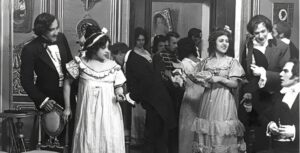
It’s fascinating to note that in review, we come to learn that Goncharev’s cinematic sensibility was that of a scene builder, or quintessential Mise-en-scène. He built paintings with his characters, costumes, and scenes, but this did not necessarily equal a quality cinematic product. Cultural critic Evgeny Proshchin noted that the central issue with taking literature to the screen is the question of what is lost in the medial transformation. Describing Eugene Onegin as a novel, “This isn’t just a novel about characters; it’s a novel about the novel itself, which creates a powerful subtext for everything that happens and is described in the text.” How do you convey this self-referentiality on screen? How do you convey the sense of self-conscious rumination through visuals? If one watches Goncharev’s ‘Mazepa,’ one can get a glimpse of what Proshchin is talking about, namely the way he constructs a cinematic scene just like a painting, and the naturality that the cinematic artform allows is simply not there (yet), replaced instead by pantomimic gesture.
Russia’s Other Eugenes
Throughout Russia’s cinematic history, ‘Eugene Onegin’ has only received two other adaptations. Roman Tikhomirov’s 1959 version stayed more faithful to the operatic nature of the source material. However, Sarik Andreasyan’s 2024 contribution took a far more dramatic, on-site, approach and was richly rewarded despite critical review saying it had superficialized Pushkin’s lyrical style. These two versions provide a fascinating juxtaposition against Gorbachev’s own attempt as all three demonstrate the unique challenges of cinematic adaptation of operatic material. I wish to briefly explore these two versions and give an alternative perspective on how to historically view Gorbachev’s 1911 version.
Firstly, Tikhomirov’s version is an on-site opera film which was hardly his only opera-related film. A graduate of the St. Petersburg Conservatory, Tikhomirov found his way to cinema during and immediately after his violin studies in 1945, and came to work on numerous opera/operetta-related works like ‘Prince Igor’ (1958), ‘Queen of Spades’ (1960), ‘The Serf Actress’ (1963), and ‘Florian Tosca’ (1981). How his version of ‘Eugene’ connects to Gorbachev can be seen in the ways Mise-en-scène is utilized, effectively the stylization of the entire cinematic shot. However, unlike Gorbachev, nuance (and sound) is incorporated which makes his version far more sincere and emotionally uncontrived. Another fascinating polemic was Tikhomirov’s realization that singing actors were hard to come by and his choice to use two casts, one for acting and one for singing. In previous Opera Meets Films, we’ve talked about this exact issue, one particular example being Paolo Gep Cucco and Davide Livermore’s ‘The Opera,’ where frigid acting and adept singing made for a rather unenjoyable visual experience. This exact issue is rife in opera today, on and off the silver screen.
The other Russian adaptation of ‘Eugene’ came two years ago. Produced by Armenian director Sarik Andreasyan, his version put a great deal of effort in maintaining the realism previous version used by filming in the places Pushkin’s novel talked about. One of Russia’s leading directors, he is not far from controversy having publicly castigated the work of Anrei Tarkovsky and director-based film (or art-house films). He’s been collegially chastised for his derivative choices based on Western models of the for-profit cinema style, and is regularly reproached for his low-class sense of humor and unintellectual approach towards bodily actions. His ‘Eugene’ is a highly dramaticised version of the famous story, and takes considerable lengths to use every editorial affordance of contemporary film to heighten the cinematic allure of the story through lighting, close-ups, facial expressions, and locations. Despite this, however, the reviews noted the age disparity between some of the characters, making for a strange experience if one knows the story, along with its trivialization of Pushkin’s novel into a facile story of love rather than a largely disconcerting meta-reflection.
The Last Word Goes To…
As we’ve learned, the ways ‘Eugene Onegin’ were adapted is contingent on the context they emanated from. But how can we think about Gorbachev’s version more critically having seen two versions of Pushkinian douleur exquise?
Firstly, the 1911’s tableau approach works in theory but without audible dialogue and music, it becomes a movie of moving pictures, literally, rather than a moving story on the screen. Next, when it comes to adaptations, while realism is necessary, if one attempts to synthesize the operatic with the cinematic, it takes a certain kind of cast to be able to do both, and often it’s impossible. But the use of real scenes with sound, technicolor, and choreography allowed the characters to gain a multi-dimensionality which was lacking in the 1991 version. However, even here, one sees the silent-film Tableau vivant instinct creeping in, and the difficulties of transmedial storytelling becomes undoubtedly apparent. The 2024 adaptation brings the topic to the present, and demonstrates the difficulties in balancing tastefulness and commerciality, or the director’s desire for art making against the temptations of the market.
Can this be reconciled in a way that preserves source material or must we be content with histrionic overproductions of canonical works? I have no answer but as we’ve seen in the last few months, operas based on films sometimes fail because the director simply does not understand the material well enough. Did Andreasyan understand? You decide.
Watch