Q & A: Composer Jerod Impichchaachaaha’ Tate on His Journey, ‘Loksi’ Shaali,’ & Future Projects
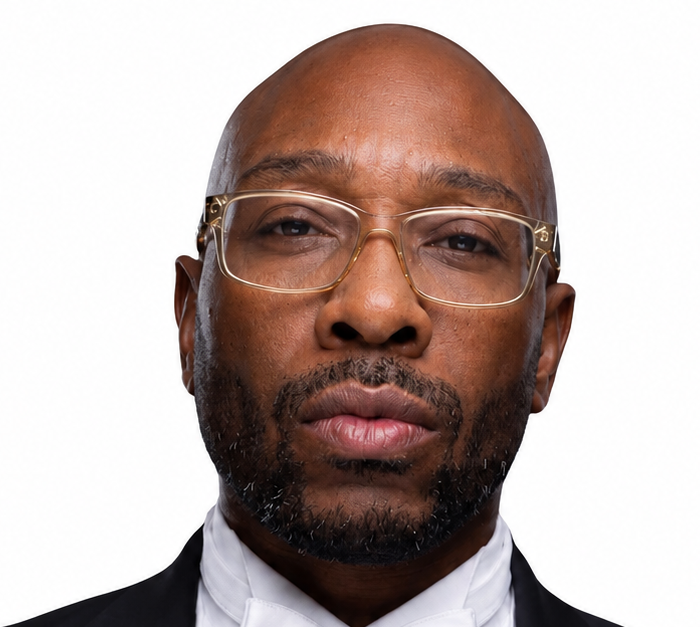
By David Salazar(Photo Credit: Shevaun Williams)
Few voices in contemporary opera carry the weight of history quite like Jerod Impichchaachaaha’ Tate.
A citizen of the Chickasaw Nation and one of the foremost Native American classical composers working today, Tate has spent decades building a singular artistic mission: to bring Indigenous culture, language, and storytelling to the world’s great stages.
His catalog spans a remarkable range of forms, including the theatric orchestral suite “Lowak Shoppala'” (Fire and Light), the ballet “Winter Moons,” the oratorio “Misha’ Sipokni'” (The Old Ground), concertos commissioned by major ensembles including the Dallas Symphony Orchestra, and choral works premiered by the National Symphony Orchestra. All of these works were commissioned by leading North American orchestras and institutions, and performed throughout the world.
But his opera “Loksi’ Shaali’ (Shell Shaker)” — sung entirely in the Chickasaw language — stands as perhaps his foremost achievement in his mission. A sweeping hero’s journey drawn from Chickasaw tradition, the work represents not only a compositional triumph but a profound act of cultural preservation and pride. This spring, it receives a high-profile chamber performance, presented by Wilmington Concert Opera, at Opera America’s National Conference, introducing it to one of the industry’s most influential audiences.
OperaWire recently spoke with Tate to discuss his journey, his inspirations, and what comes next.
OperaWire: How did you know you wanted to be a composer? Tell me a bit about your journey as a composer. What are some of the major experiences that have most impacted your development?
Jerod Impichchaachaaha’ Tate: I started piano with my Chickasaw father, Charles. He is a tribal judge and attorney, and author of our current Chickasaw constitution. He is also a classical pianist and baritone. Dad started me on the piano when I was 8 and I had quickly announced to my family that I was to be a concert pianist. My mother, Patricia, was Manx and a professional dancer and choreographer. Between my two parents I was immersed in North American Indian music, culture, history and law; American theatre and dance; classical ballet and opera.
I finished my BM in Piano performance at Northwestern University and my MM in Piano Performance and Composition at The Cleveland Institute of Music. Just before I went to Cleveland, my mother was embarking on a new ballet based on American Indian legends from the Northern Plains and Rockies. After consulting with her Native colleagues in Wyoming and South Dakota, she created the architecture for the ballet Winter Moons and then asked me to compose the score! After a successful premiere and tour, I received very positive support from my Native and classical communities. Rodeny Grant, the ballet storyteller and famous Omaha actor, insisted that I become an American Indian symphonic composer. Fueled by his faith in me, I contemplated my mission and announced to my family that I was to be a Chickasaw classical composer, dedicated to the development of American Indian classical and symphonic composition.
OW: What does opera mean to you? What are some of your favorite works? Composers? Do any have a major influence on your operatic voice as a composer?
JIT: To me, opera and ballet serve as theatrically epic vehicles for expressing ancient and modern culture. Some of my favorite theatrical works include Ravel’s “Daphnes and Chloe,” Prokofiev’s “Romeo and Juliette,” Bartok’s “The Wooden Prince,” Tchaikovsky’s “The Nutcracker” and Puccini’s “Turandot.” North American Indian stories, the artistic vision of Martha Graham and philosophies of Joseph Campbell are some of the fundamental influences for my artistic expression.
OW: What inspired your work on Loksi’ Shaali’ (Shell Shaker)? What were some of the greatest challenges in creating the work? Who were essential collaborators in its creation and how did they impact the process?
JIT: Loksi’ Shaali’ is a hero’s story of the Chickasaw people, sung entirely in the Chickasaw language. It perfectly fits the canon of heroes’ stories expressed in thousands of years of world fine art. I had already included a much shorter version of this story in my work “Lowak Shoppala'” (Fire & Light) and I knew that it had all the ingredients to be a full-length, grand opera. There were absolutely no challenges in creating this work – it is simply magnificent and perfect for the world stage! Lokosh (Joshua Hinson) was the critical translator for my libretto. I am not a fluent speaker, I am an adult learner of our language, and Lokosh is the language director for The Chickasaw Nation. His collaboration, grace and intelligence are critical in my works that feature our tribal language.
OW: In reading the story, there is a constant motif of the little girl connecting with her grandmother. How do your past, your ancestors, your relationship with opera’s past affect your creative process in general but also this work?
JIT: My Grandmother Foshi’ was a pillar in my life. She deeply believed in my talent, and she was extremely proud of her Chickasaw family and history. This relationship of Loksi’ and her grandmother is a direct expression and homage to my relationship with my grandmother. The entire opera is born out of my desire to honor my family and ancestors.
OW: How has your relationship with Loksi’ Shaali’ (Shell Shaker) developed since its premiere?
JIT: Well, it is exactly the opera I intended it to be; however, I have had time to reconsider what needs to be adjusted for a final version. This chamber version for Opera America was a welcome surprise, and I now see this as capable of being performed in smaller iterations.
OW: How does it feel for this opera to get such a high-profile performance at Opera America’s Conference? Why is this important for the industry at large?
JIT: I feel like Forest Gump! Like, how in the world did I end up in the company of these epic people?? I feel entirely eclipsed and I am arriving to this conference with great humility. Opera (and the entire world of fine art) begs all humans to infuse their identities and human experiences into such beautiful discipline and expression. Chickasaw culture has an equally exciting seat at the drum with the fine arts, and it is my honor and privilege to proudly present my beautiful and powerful ancestry and tribal language to the world stage.
OW: What are your next opera projects?
JIT: The next opera project is “The Talking Leaves,” the story of the Cherokee legend Sequoya, and his daughter Ayohka, sung entirely in Cherokee. Sequoyah created the Cherokee syllabary, and his daughter helped him demonstrate it to their tribal council, leading to the approved adoption of their new written language. The opera opens with the two finalizing their preparations for the tribal council. Before they depart, Sequoya relates three important stories to Ayohka, creating three beautiful and rich operatic scenes. The opera ends with their grand departure to deliver the new written language.