Q & A: David Morales on Founding & Building Cantare Con Vivo
By Lois Silverstein(Credit: Spencer Smith)
How can we connect people, transforming separateness into unity? How can we create cohesion within our communities? How can a united community create a more harmonious society?
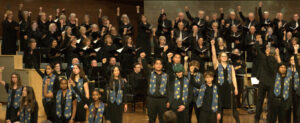
David Morales, founder and artistic director of Cantare Con Vivo, believes that all this can happen through music: through the sounds of our hearts and our best intentions. When Morales first started singing he felt it bring him close to others. This, in turn, made him realise that the world was actually a wonderful place. Music was the source of goodness and truth. Music was harmony writ large. Music enabled Morales to embrace others with open arms. Many years later he has turned this vision into Cantare Con Vivo, the Choral Community Choir of Adults and Children, based in Oakland, California.
OperaWire: Tell us about the birth of your love of music.
David Morales: We moved from Mexico to Los Angeles. By the time I was five I was taking piano lessons. I loved it. Since we attended the Mexican Church, I heard and sang music with the congregation there too. I loved that. When I heard the pipe organ, with the Brahms Requiem, I was thrilled. My mother was an aeronautical engineer – she was the oldest of ten children – and she was thoroughly supportive as I grew up and gravitated toward music as a career. I began directing and conducting choirs. I directed my first choir when I was 19. Neither of my parents interfered with that process.
Of course I worked – we all did. All throughout my life. For instance, delivering furniture and doing all sorts of church jobs. Eventually, I moved toward teaching. I always had it in me to teach. Even now I reach into our various communities, here in California, to give musical opportunities to populations that hunger for it but may not have the chances to express it. Over the years I have met many different musical leaders who have taken me under their wing and helped me move forward and deal with the inevitable obstacles that such projects have.
OW: These musical leaders – they guided you?
DM: They gave me support, helped me when I wanted to work with the Mexican-American Church, when I wanted to go into the community and help people who didn’t have much, such as people from El Salvador. We shared values and it was natural to bring them into music.
OW: During your musical journey – did you continue to study?
DM: Yes. I went to college and then went on to earn a master’s degree in music from the University of Southern California in 1973 under Dr. Charles C. Hirt. Later, in 2003, I received a Minister of Music degree from the Oakland School of Creation Spirituality.
OW: When did you move to Oakland?
DM: I moved from L.A. in 1974, mainly to start a choir, the Oakland Youth Chorus. It was an important time in Oakland, when the issues surrounding racism, the police, and the community brought forward old and long-standing quarrels, such as equal opportunity in education. We needed to bring these issues into public discourse and change things. The work of Marcus Foster came into the limelight. It was the time to start the choir.
OW: How did that move affect your work and artistic life?
DM: The move was vital. I got involved in giving performances and spreading music and musical ideas throughout the Bay Area. We gave our first concert in Mills College. Black Gospel had been coming to the fore in the late ’60s and early ’70s. We did some of it, but we also sang classical pieces and folk songs. People really responded well to it. I left the church largely because the kinds of music I wanted to play extended beyond the church structures. I wanted more of the world of music and to have it reach out into the larger community. That’s what I believed the community yearned for and needed.
OW: Around this time you started to teach?
DM: Yes, I taught wherever I was directing choirs, and then at Merritt College in Oakland. I taught Music History and Music Theory. I think I always wanted to teach. I believed that was the heart of change and I reached out to the very community that had been left behind. I began part-time, adjunct teaching, although eventually it became full-time. It was through the teaching at a community college that I connected with people who cared about music, but may not have had a lot of opportunities up until that time to learn about it or to play it. That was vital to me. That was part of what drove me. I wanted to bring them to music. I wanted them to have and live music. My teaching load steadily increased. I taught full-time, in fact.
OW: What kept you directing choirs?
DM: Directing choirs was crucial to me. That was the way to spread the word that music counts, singing counts. Everybody can sing, regardless of whatever they told you in high school, or camp, or church. I wanted everyone to try it and find out for themselves. All the time I was teaching and working, I was directing choirs, some auditioned, some not. That was important to me, as well as inspiring. I continued at Merritt until 2014. I also served as Minister of Music at the First Presbyterian Church of Berkeley and the Lafayette-Orinda Presbyterian Church. I developed music programs at each of these.
OW: What about Cantare Con Vivo? What was your vision for it?
DM: I started it in 1987. I wanted to develop a choir to sing traditional, contemporary, and ethnic styles of music. I wanted a choral group to perform with full orchestra. I wanted to share music with people of different communities, as well as inspire the singers to want to do that as well. Cantare aims to teach and to help educate those who want to reach further than themselves. I directed Cantare and also WomenSing, among several others organisations, until 2004.
OW: You received the Jefferson Service Award in May 2022. This award was for inspiring Bay Area communities to innovate through your musical leadership and talent. What moment in your career gave you the sense that you were living your musical vision?
DM: To me, success was bringing people to sing. If people sing, they are connecting. If different people sing with each other, we are connecting significantly to one-another and the audience. Through that connection, we have the best chance of making harmony out of differences, and bringing harmony into our daily lives. Diversity is key for me. Different ages, cultures, religions, types of music, and different voices, of course. I love to teach that in everything I do.

Stories you may also like…
Q & A: China Now Music Festival Artistic Director Jindong Cai on Celebrating America’s 250th Anniversary Through Chinese-American Experience
Q & A: Victoria Frances Young on Her Fixed-Media Operatic Work ‘Breaking News’