Opera Meets Film: Duplicitous Love Behind Enemy lines in Hans Gefors’ ‘Notorious’
By John VandevertJoining the ranks of other screen-to-stage operatic adaptations, Swedish composer Hans Gefors and his eighth opera, “Notorious,” can be considered a contemporary grand opera. Spanning five acts — a number usually seen in French grand opera but also seen in Italian verismo including “Don Carlo,” “Robert le diable,” and “La muette de Portici” — the opera details the complex love affair between a US and German agent during World War Two. Much like grand opera, it deals with issues to which there are no innocent parties, no glib happy endings, no real justice served for wrongs incurred, and only multi-dimensional conflict and ruptured existences. The film starts with misunderstandings, continues to develop them, and ultimately ends with betrayal and happiness, although also showing the looming hand of an action’s consequences, whether or not they are deserved.
Gefors’ opera is an adaptation of Alfred Hitchcock’s 1946 film of the same name. Starring high-profile stars like Cary Grant and Ingrid Bergman, the film came from a moment in Hitchcock’s life defined by a deluge of misfortunes. The death of his mother in 1943, followed shortly by his brother’s passing from an overdose, had led to a complete lifestyle change. On top of this, his role as external advisor for the German Concentration Camps Factual Survey (1945-2014), exposed him to the atrocities humankind is capable of inflicting upon itself for no greater reason than ideology and power. Hitchcock’s biographer Donald Spoto argues that “Notorious” was chiefly about his grappling between “private desire and public duty, between passion and pretense.” The many layers of the film only grow more intricate when one explores Hitchcock’s relationship with his mother — a truly complex affair.
I wish to explore Gefors’ opera, Hitchcock’s film, and the ways this complex story of beleaguered espionage went from screen to stage. Director Keith Warner, in charge for the opera’s 2015 premiere at Göteborg Opera, noted the film’s theme was a universal one; “all of us fighting our psychological lives with some overseeing person controlling how we think, what we do and how do you get free from that.” The dichotomies at the heart of the film revolve around relations like duty and pleasure, obligation and liberation, collectivity and individuality, independence and dependence, and family, country, and love. Gefors’ opera, however, trimmed much of what made it great. As reviewers like Yannick Boussaert noted, the film focused on the love triangle more than the story, “preferring to delve into all the psychological motivations… the love triangle spied on by a demonic and possessive stepmother.”
Taking X, Y, Z and Making It A, B, C
Like so many screen-to-stage adaptations before it, Gefors’ unfortunately fell into the trap of doing exactly what not to do: simplifying a convoluted and rather enigmatic cinematic narrative by taking out what made it great. Other adaptations of seminal films like Charles Wuorinen’s “Brokeback Mountain” (2014), William Bolcom’s “A Wedding” (2004), and Mikael Karlsson’s “Melancholia” (2023) have all had to deal with this exact issue — “what to keep and what to change?” Just like other fraught adaptations, such as Poul Ruder’s “Selma Ježková,” taking out too much from the film actually harms the operatic product.
Given the opera’s five-act form, taking out material almost seems unnecessary, especially as the film only had a runtime of 101 minutes. As Boussaert continues, “to characterize their characters, the duo wanted to return to the essence of opera, ‘to amaze people through song,’ thus making the aria… the basic unit around which the orchestration unfolds.” Employing various 20th-century post-Wagnerian recit-like techniques, along with sounds of late Romantic and early Modernist imitations of lyrical opera, Gefors also reaches for mise en abyme in the presentation of Gluck’s “Orfeo ed Euridice,” specifically the “Dance of the Furies.” But the opera has more than stylistic heterogeneity — it also featured a rather misunderstood characterization of Hitchcock himself.
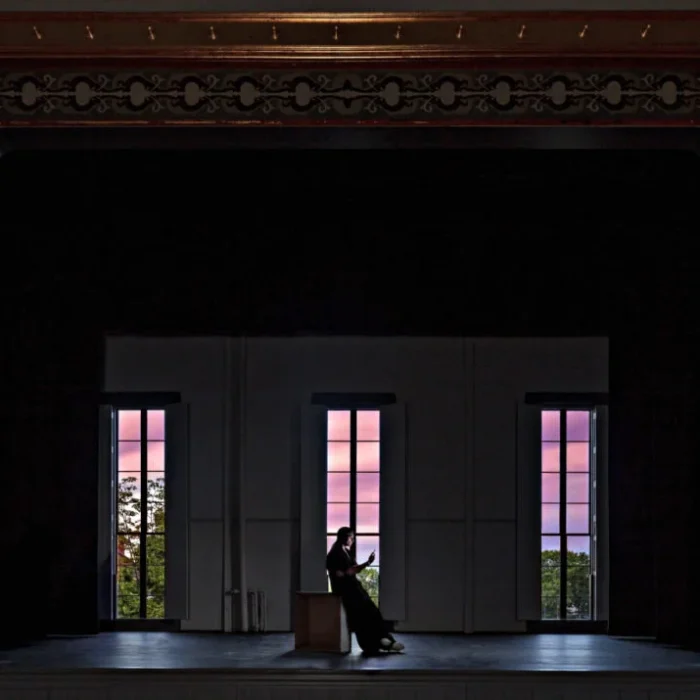
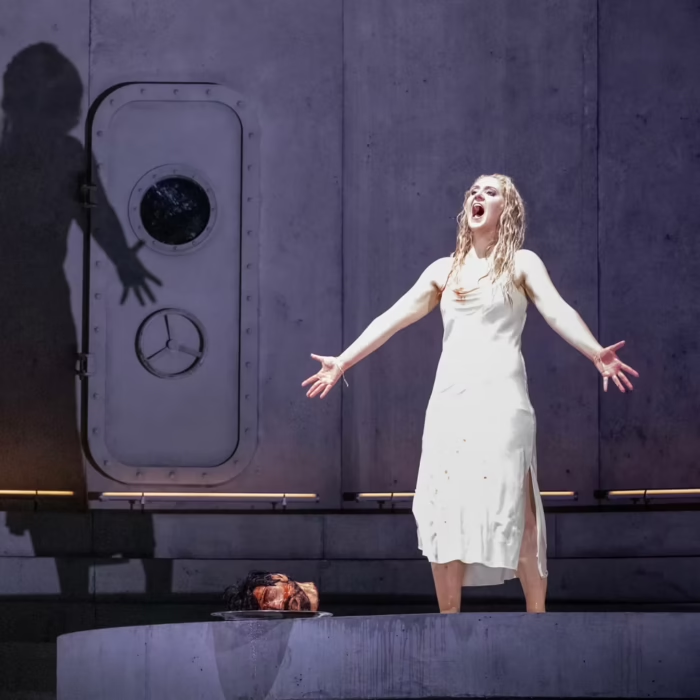
Reading Guy Dammann’s review, one becomes aware of another issue with “Notorious,” which is the collision of artfully polysemous nuance with borderline patronizing superficiality. As he notes, the opera utilizes the stereotypically Hitchcockian trope of the knife from “Psycho” (1960) and the blackened silhouette from many photos of Hitchcock from the 1950s onwards. Clips of the film confirm his interpretative critiques of the oversaturation of Hitchcockian tropes, the compatibility of which with the opera-qua-film appear only in name. The opera’s worst mistake, to Dammann, was its lack of pacing and strategic balance of forces. “The opera’s submerging of the romantic dimension in the psychoanalytical, political and cinematic contexts constitutes a fatal flaw.” However, this is far from abnormal. With many operas today a monotone color pallet and regietheatre atmosphere are standard.
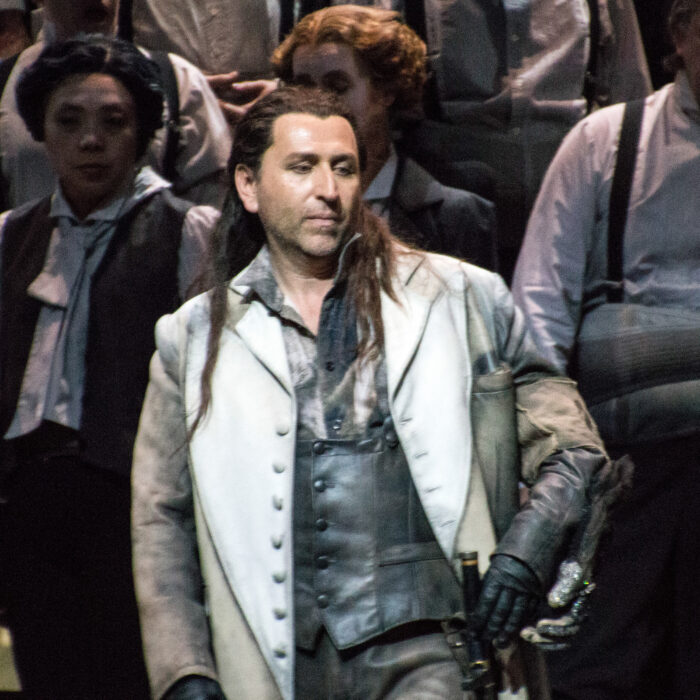
Others in the audience for the 2015 premiere were equally as disappointed in Gefors’ opera. As Jim Pritchard of Seen and Heard International wrote, “At various points a choir, denoted as ‘dark figures’, appears on stage commenting on what is happening with hisses and clusters, without adding much else.” This superfluous role is hardly the effect Gefors probably intended, most likely attempting to utilize the chorus in a Grecian manner, as the mirror to the characters, omniscient spectators, or even a participatory force in their own right. In this vein, the dramaturgical choices, scenography, and costume all seemed paltry recreations of the film, not through inventive means but rather half-finished means where seams still showed and edges were left frayed. To Pritchard, “almost every scene is illustrated with sequences or stills from the movie, and gives the impression as if the movie has somewhat clumsily been reenacted on stage.” Hitchcock was there, but only his corpse was moving.
Some Errors and Some Critique
Following “Notorious,” Gefors has not written another opera. Perhaps there are lessons to be learned. George Loomis of the New York Times noted these lessons in his reading of the premiere. The trend of screen-to-stage adaptations found contemporary popularity thanks to works like André Previn’s “A Streetcar Named Desire” (1995) and Kevin Puts’ “The Manchurian Candidate” (2015), yet Loomis notes that a major hurdle is battling against audience expectations. A production must offer a work that both reflects the source material yet equally the composer’s unique outlook. These two forces are among the most complicated topics in operatic discourse today — regietheatre vs. werktreue. Loomis reminds us that “Mr. Previn’s version of ‘Streetcar’ was questioned for not having a distinct enough rationale for making an opera out of the Tennessee Williams play.” One can say that a central polemic for screen-to-stage adaptations is an anxiety of justification: the opera must defend its very right to exist.
The requirement to validate its significance and legitimacy is a serious consequence of adaptation culture itself, where the arguments against them are based on ostensible claims of inauthenticity and inaccuracy. In the now famous essay by film theorist Robert Stam, “Beyond Fidelity: The Dialogics of Adaptation” (2000), this debate hinges on three elements: fidelity, translation, and dialogue. Much of the reason why the operatic adaptation of a well-known film seems to fluctuate so greatly is because of these three components and the misunderstanding of their relationship to each other. Fidelity is not exclusively based on the prima facie rearticulation of the source material into a new medium based on a distillation of the material’s “essence.” To be great, it must also convey how the medium itself compliments this “essence.” Actors, dramaturgy, and cinematic direction — all these attributes confer meaning that a novel, for example, may not have. With an opera this tension is invoked. Thus, a dialogue unfolds in the act of translation. As Stam writes, “Film adaptations can be seen as a kind of multileveled negotiation of intertexts [texts talking to other texts]. Therefore, it is often productive to ask these questions: Precisely what generic intertexts are invoked by the source novel, and which by the filmic adaptation?”
Loomis ends his critique by noting Gefors’ intentions, “to deepen the film’s psychological dimension,” and to focus more on Alicia’s internal dilemma between being a self-assured individual, a love interest, and a victim to circumstance, focusing on the unique challenges deriving from her feminine positionality. But as we have seen, this was not entirely successful, with Gefors’ intentions veiled by excessive cuts and ineffective staging. Another attempt in the annals of operatic adaptations, “Notorious” was an ambitious project with flaws that proved too great.
Listen