When Operetta Is Downgraded
On a ‘Fledermaus” in Vienna, and What Happens When the Score Stops Governing the Stage
By Dr. Zoran Milosevic(Photo: W.Hoesl)
I have gone back to Vienna’s “Fledermaus” several times since it was broadcast at New Year, and each viewing has left me more certain about what troubles me in it. What was shown was the famous Otto Schenk production from 1979, long regarded as a model of traditional operetta staging: elegant, theatrical, and musically alert. It is still the same production. The sets are the same. Much of the stage world is recognizable. What has changed is what now lives inside it.
Restless Production
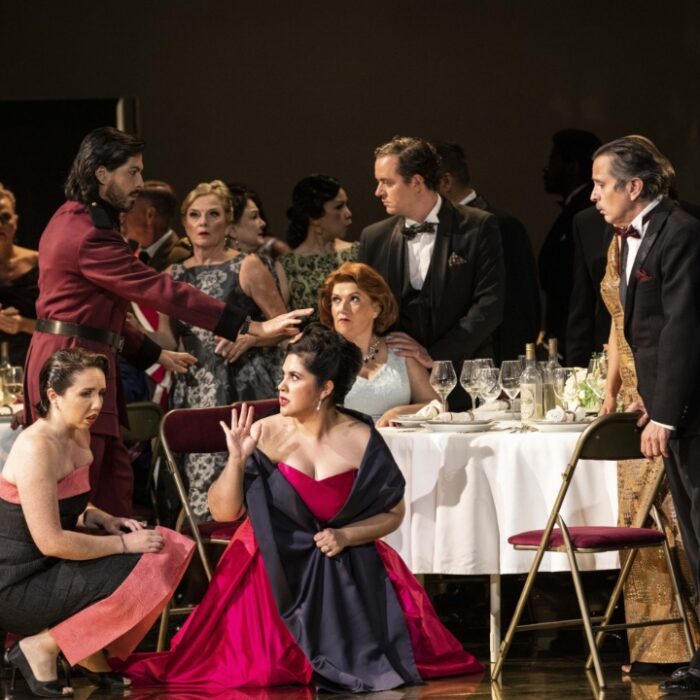
What struck me was not the age of the production, but its restlessness. The stage was always busy. People were constantly doing something: moving, signaling, underlining every moment. Jokes did not seem to grow out of situations so much as arrive already packaged. Sexual humor was shown rather than suggested. There was very little stillness, and very little sense that a phrase might be trusted to carry a moment on its own. The music was well played and well sung, yet more and more it felt as though it were accompanying the stage rather than leading it.
What unsettled me was not style. It was the order of things. The eye was being fed continuously. The ear much less so. Comedy seemed to come from what people were doing rather than from what was happening in the orchestra. Strauss, who is usually such an active presence in the theatre, began to feel like part of the scenery. His hesitations, his teasing delays, the way a waltz can charm and then gently turn ironic — all of that was there in the music, but the staging no longer seemed to be guided by it.
This is what made the experience disturbing. Not that a new concept had been imposed, but that an old one had been hollowed out. What was once a musically intelligent production now seemed to have been taken over by a different acting culture. The stage language remained, but the musical sensitivity that once animated it no longer organized what happened on stage.
And this raises a more troubling question than whether one likes a particular staging. What happens when productions outlive the artistic habits that created them? What happens when style remains, but the musical intelligence that once shaped it quietly erodes?
Musical Intelligence
Operetta is often described as light opera, but that phrase is misleading. It suggests something thin, something that needs help. Strauss’s operettas are not light because they are empty. They are light because everything in them is in motion. Their theater is not built on collision or catastrophe. It is built on movement: on the sway of the waltz, on rhythmic flexibility, on small delays and gentle pushes forward, on the way a melody leans ahead and then slightly holds back. Their dramatic life lives in tempo and phrasing, in the way the orchestra comments, interrupts, and quietly redirects what the characters seem to be doing.
Listen to “Fledermaus,” especially to its introductions and transitions, and one hears a form of stagecraft already taking place. The orchestra sets up situations before anyone enters. It sketches relationships through rhythm. It creates social space through movement. When a singer appears, the voice does not arrive on an empty stage. It steps into something that is already flowing.
Strauss did not write background music. He wrote the action. The orchestra in “Fledermaus” is not there to support what happens on stage. It is what happens.
This is why operetta has never needed much external agitation. When the musical pulse is alive, standing can be enough. A small shift of weight can change a scene. A glance timed to a cadence can release a laugh. The elegance associated with good operetta performance is not visual polish. It is what happens when the body quietly follows musical sense. The stage feels alive because the music is alive.
When this rhythm is really felt, comedy almost takes care of itself. A phrase held a fraction too long already hints at a joke. A waltz that becomes just a little too sweet already suggests irony. An ensemble that breathes together already creates a social situation. Nothing has to be forced forward for effect. The score is already busy.
This kind of operetta only really works when that confidence is there: confidence that sound can hold attention, and that timing can create theater. When it is present, very little needs to be added. When it is missing, a great deal suddenly seems necessary.
In many contemporary performances, that confidence no longer seems to be assumed. The stage is organized as if the score were not quite enough on its own, as if theater had to be supplied from somewhere else. Instead of beginning from what the music is already doing, productions increasingly behave as if they must first decide what should happen on stage, and only then fit the music around it.
When that happens, the singer’s role quietly changes. The voice is no longer the main carrier of what is going on. The body becomes it. Performers are expected to produce visible events almost continuously. Gestures multiply. Situations are underlined. The eye is kept busy, often at the expense of the ear.
This is often described as making operetta more lively. In practice, it often produces the opposite sensation. Activity becomes constant. Motion loses contrast. When everything moves, very little actually dances. The orchestra continues to offer its small surprises, its hesitations, its gentle pushes and pulls, but the stage no longer seems to be listening to them. It answers with its own rhythm, which is often faster, heavier, and less supple.
At this point something more than style has changed. The place of music in the theater has shifted. It is no longer where the action lives. It becomes something that accompanies action.
Operetta depends on musical taste not as ornament, but as structure. Taste here means knowing how much is enough. Knowing when a phrase can stand on its own. Knowing when a pause is already doing the work. Knowing that elegance is not emptiness, and that restraint is not lack of imagination. When these things are understood, comedy has air around it. When they are not, the stage fills up very quickly.
What is striking in many contemporary performances is not only how much movement there is, but what kind of movement it is. The stage is not simply busy. It is often exaggerated, grotesque, pushed outward. Faces work hard. Bodies bend, sprawl, thrust, grimace. Gestures are enlarged beyond what the music seems to ask for. Even within traditional productions, a different acting culture has taken hold.
When music is no longer trusted to carry theatrical life, the tools that remain are simply rougher. Gesture and physical business work through instant recognition. A lifted skirt, a slap, an exaggerated walk, a sexual joke are understood immediately. A harmonic delay or a rhythmic hesitation are not. They only work if one is listening.
Substitution Versus Innovation
Once listening is no longer assumed, the stage has to speak in a language that works even when the ear drifts. That language is necessarily simpler, bigger, and more literal. This is where superficiality begins to enter. Music can hold several things at once: charm and irony, sweetness and distance, seduction and quiet commentary. Physical acting has difficulty sustaining that mixture unless it is closely tied to musical timing. When that link weakens, subtlety becomes risky. So gestures grow. Effects are underlined. Vulgarity appears not because it is admired, but because it cannot be missed.
Here the problem is not innovation, but substitution. Musical wit is replaced by louder signals. Inner movement is replaced by visible activity. What once arose from sound is now supplied from outside.
And this is where the downgrading becomes visible. A score of extraordinary refinement is being served by a theatrical construction of lesser intelligence. And that construction is increasingly governed by an acting culture of still lower expressive means. A first-class musical intention is filtered through second-class theatrical thinking and finally realized through third-class stage behavior. The result is not modernity, but a reversal of artistic order.
This reversal becomes especially evident when great singers are drawn into it. When musicians of the highest calibre are required to deliver cheap physical comedy, the issue is not their ability. It is the hierarchy they are asked to work within. They carry phrasing, proportion, and musical intelligence in their voices, yet they are placed inside a theatrical language poorer than the one they are singing in.
There was a time when great singers were protected not by celebrity, but by the form itself. They were bearers of style. They embodied traditions of timing and taste. A production worked around that. Today, even within inherited stagings, that protection has weakened. The production remains, but the musical culture that once governed it does not necessarily survive.
Operetta reveals this loss faster than opera because it has so little else to hide behind. Opera can absorb a great deal of theatrical overlay. It has tragedy, orchestral weight, harmonic gravity, vocal extremity. Operetta lives almost entirely on surface, timing, and social rhythm. When those are displaced, there is nothing underneath to mask the loss.
This is why so much modern operetta feels tiring rather than light. It is not that too much is happening. It is that too little is being carried musically. The ear senses that it is no longer essential, and the eye is forced to work harder. One may laugh, but one rarely floats.
Something important is being lost here, and it is not a museum style. It is a way of making theater out of sound, and a way of trusting that timing, phrasing and elegance can do real dramatic work. When a production outlives the musical intelligence that once shaped it, it does not remain the same production. It becomes a shell, and what has gone out of it is not a manner of staging but a form of respect for the music itself.