Carnegie Hall 2026-27 Review: Opening Night Gala, Featuring Berlin Philharmonic & Jonas Kaufmann
By David Salazar(Credit: Rob Davidson)
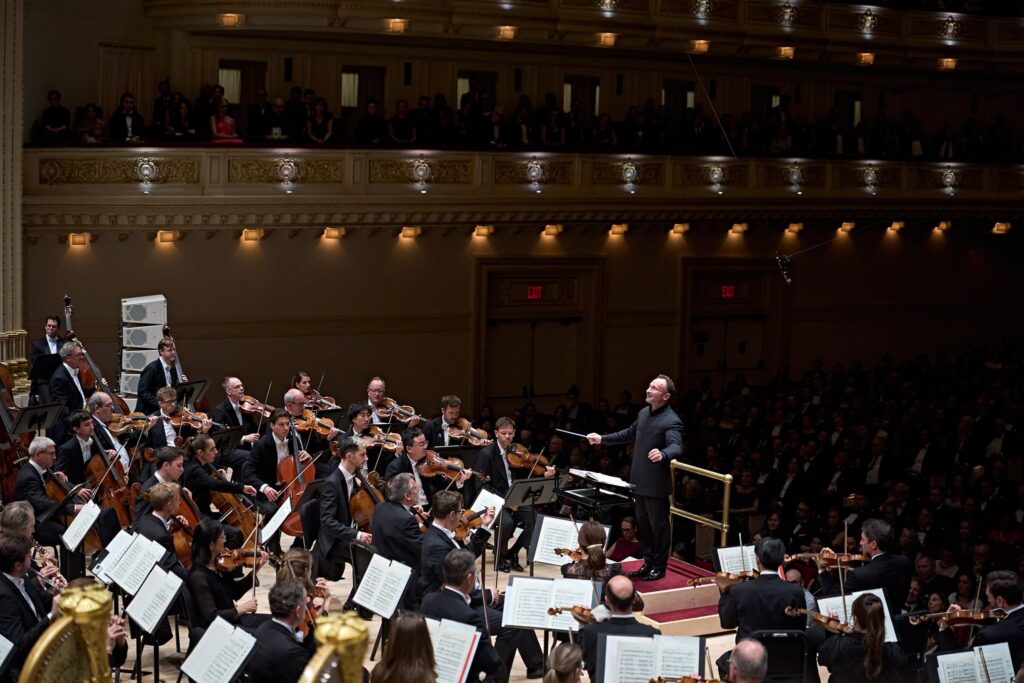
Carnegie Hall opened its 2026-27 season with a performance headlined by the Berlin Philharmonic under Kirill Petrenko.
The concert, which ran approximately 75 minutes was dedicated to Italian music with opera alternating with two Respighi classics.
Petrenko opened the concert with the famed overture from “La Forza del Destino,” the potent, borderline overwhelming opening chords, setting the tone for the entire performance. The tempi were a bit on the slower side with Petrenko seeming interested in building the momentum of the piece and its tension and unrest gradually. Moreover, throughout the overture, he pushed the orchestra to its extremes, to mixed effect. The explosive climaxes could be a bit overbearing, the conductor trading the orchestra’s polish and clarity for force, the percussion particularly ear-splitting and repetitive. The central melody that later in the opera accompanies the final duet between Carlo and Alvaro was interpreted with an interesting rallentando at the end of each phrase, often with a slight pause before the final note. The buildup to the climax with the violins playing a repeated rhythm on an ascending line was notable for the lack of clarity in the violin’s line, the pickup notes barely audible. But the coda itself was thunderous and vivacious, the strings really digging into the music and the brass thundering. It was exciting and visceral and probably one of the highlights of the night. But by the end of the night, another moment would shine brighter.
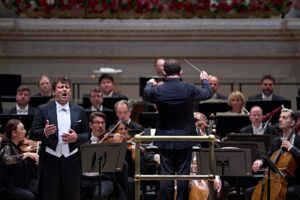
Following the overture, tenor Jonas Kaufmann took the stage at Carnegie Hall in his New York return. The tenor last performed in New York at the Park Avenue Armory in 2023 and his most recent Carnegie Hall appearance was in 2021 when he did a lieder recital. The tenor has been vocal about not having any interest in returning to the Metropolitan, where he last performed in 2018. In sum, this concert represented the first time in eight years that he has performed in New York City with an orchestra of any kind.
Rob Davidson
The tenor performed four arias on the evening, opening with the prologue from “Pagliacci.” Written for baritone, there have been some cases where tenors have opted for singing the aria as well. Kaufmann himself did it during a production in Vienna in 2025. The decision had people wondering whether the tenor would move to baritone roles, speculation which he quickly put to rest via social media. While the aria sits low for Kaufmann and the lower notes didn’t quite have pristine resonance (he did have some raspiness in his voice throughout) compared to his voice in the middle and upper registers, his phrasing was elegant and fluid as ever, with every note and phrase leading gracefully into the next. This has always been one of Kaufmann’s signatures and it remains the case. His greatest moment in the aria came during “E voi, piutosto” where his voice rode the Andante Cantabile line gloriously, rising up to the interpolated E flat. After nailing the moment, he put up his hand to stop the audience from breaking out into applause so he could deliver one final potent moment to end the aria. Petrenko continued the bombast from the “Forza” overture here, but this time used it to build the opening of the passage to great dramatic effect. The orchestra also tended to cover Kaufmann at junctures in the aria, particularly when the tenor was in his lowest register.
Following the Prologue came the intermezzo where the string sections were at their finest. Lush gets thrown around a lot when talking about string playing but I can’t think of another word more apt to describe the playing here. There was a thickness to the texture, an aural creaminess that radiated in the space, the phrasing fluid. Some of the best string playing I have heard in a while.
Kaufmann returned to the stage for “Vesti la giubba,” which was perhaps the tenor’s most polished rendition on the night. He sang “Recitar!” recitative with forcefulness, climaxing in a potent “forse un uom!” and a bitter cackle. The ensuing “Vesti la giubba” was well-phrased, the tenor managing a solid climax on “sul tuo amore infranto!” The final “Ridi del duol che t’avvelena il cor!” was appropriately forceful and accented. The orchestra was strong throughout, working well with the tenor to build the aria. It was a solid performance overall.
Later on, Kaufmann delivered his most fascinating interpretation on the evening, singing Federico’s lament from “L’Arlesiana.” Kaufmann opened the aria with hushed piannissimo singing on “È la solita storia del pastore,” his voice rarely rising above a mezzo piano. He retained his softness even on “Anch’io vorrei,” building incrementally. But even as the voice gained strength throughout this first half, “Il dolce sembiante” was floated gently. From there, the tenor began to allow the darkness and grittiness of his voice to take over. By the final lines, “vision mi lascia!” his voice was its most aggressive and here he decided to do the customary high B interpolation. Unfortunately, he seemed to be struggling with phlegm, cut the note short and audibly cleared his throat before finishing up with impassioned “Mi fai tanto male! Ahimè!” As the audience showered him with the most applause he would get all night, he bowed with appreciation. The orchestra was at its finest here as well, creating a gentle soundscape that supported and then built the drama alongside the tenor.
Then he delivered his final aria, the brief “Amor ti vieta” from “Fedora,” with fluid and elegant legato line. The voice was well-supported by the orchestra throughout.
In the middle and at the end of the performance, Petrenko graced audiences with two Respighi works. In the middle of the performance, audiences were treated to the “Fountains of Rome” and at the close of the night was “Pines of Rome.” Both pieces presented elegant soundscapes to shift attention away from the operatic drama in between. Petrenko leaned into the extremes of sound in both, the eruptions in “Fountains” resplendent. But nothing was more cathartic than “Pines” with its dream-like and meditative atmosphere. It was in this piece that the entire performance seemed to come together, the orchestra’s pristine sense of balance allowed to shine. As the piece built to its sublime climax, the intensity ratcheted up, Petrenko pivoting constantly between the orchestra and the brass players in the balcony, the momentum seemingly building with each of his physical turns. The finale of the piece, the orchestra exploding into the space was ear-splitting but in the best possible way, lifting the listener up into what can only be described as ecstasy. You could almost hear every instrument clearly and yet they were a cohesive whole.
The adulation that followed was duly deserved, the mesmeric effect difficult to shake off. Petrenko treated the audience to one final encore, Shostakovich’s “The Hornet Suite, Op. 97a, No. 3: Folk Festival,” which was relenting in its pace and virtuosity. The rhythmic melody that gets passed around the orchestra and at one point gets shared with the brass section, which pulled off the virtuosic passage with aplomb.
While I felt that Petrenko could be a bit heavy-handed in the opera arias and passages, it ultimately fit with his vision for the Respighi, thus creating a consistent musical tapestry. Kaufmann’s appearance felt brief but effective. This was a night that reminded us why Carnegie Hall is one of the greatest artistic institutions in the world.