San Francisco Opera 2026-27 Review: Simon Boccanegra
Eun Sun Kim Conducts an Atmospheric Tapestry of Intrigue, Power & Haunting Loss
By Lois SilversteinWhen Verdi sat down to write “Simon Boccanegra” in the mid 19th century, what did he want to express? What audience was he trying to reach? What has kept the opera in the background of his more popular operas?
San Francisco Opera’s Claus Guth’s Hamburg production directed by Katherine M. Carter answers these questions. Especially welcome after the labor strike which delayed opening night for nearly a week, SFO’s “Simon Boccanegra” emphasized lust for power and the consequences of it in the world of 14th century Genoa, Italy. This is a story about its rulers, its lovers and its families. Throughout the production we watch the intrigue, the secrecy and the lies, unfold largely through the musical expressiveness of the score.
Illuminating Production
San Francisco’s “Simon Boccanegra” soaks us in the atmosphere that emerged from complex subjects so as to keep us alert to a world that inevitably suffers from consequences.
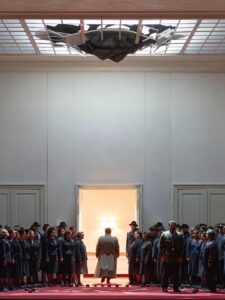
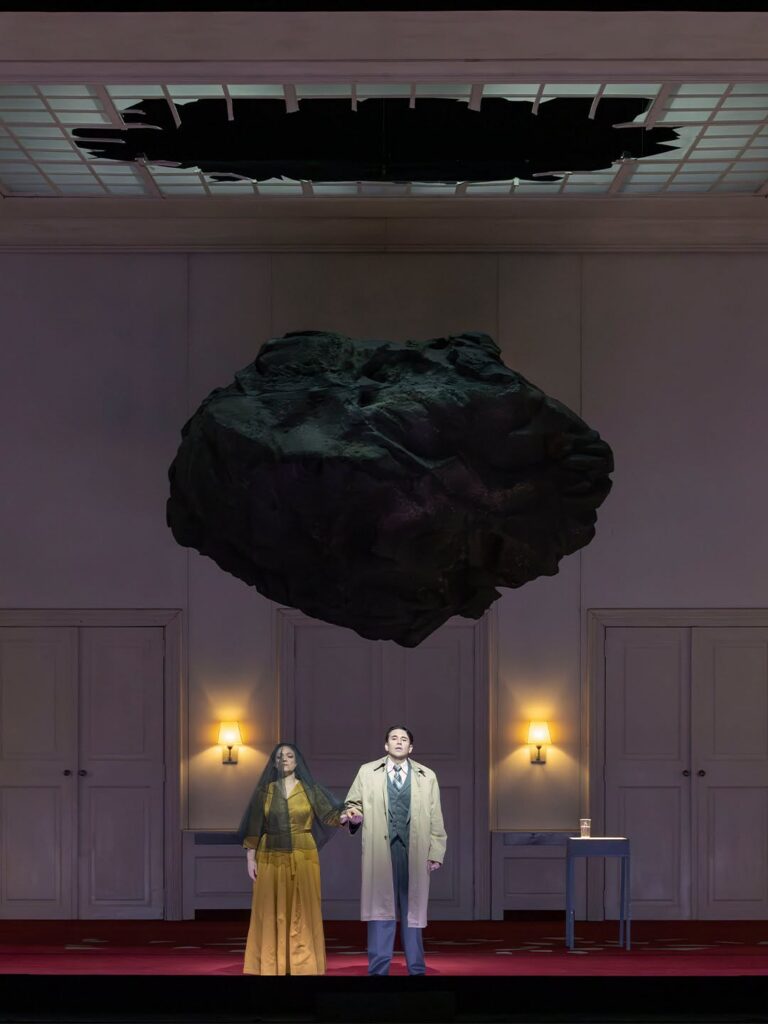
The production itself enhances this idea starting with the dark meteor imbedded in a cage-like enclosure on the palatial ceiling, gradually descending over the course of the drama, and landing on the floor by the opera’s end. It both signifies and symbolizes the trajectory of the moral tale. Simon, hailed as Doge of Genoa post Prologue, hands over his power to his future son-in-law, Gabriele Adorno, at the end and just before he dies. Both narratively and morally, the wheel comes full circle. The cast surrounds the dead Doge at the opera’s end, just as they did in the Prologue. Here is a bitter victory. Once again, Verdi succeeds in creating an atmospheric gem and it’s a wonder why this opera doesn’t get produced more often.
Musical Highlights
The singing of the principals was moving and resonant, at times, resplendent. The chorus provided a strong backbone. The orchestra conducted by music director Eun Sun Kim was terrific, more so since they and we were threatened by their absence during the labor strike that halted week one of the Fall season and three productions of the work. Needless to say a big round of applause greeted them at the outset and at the end of the performance, more kudos and recognition.
Eun Sun Kim led the whole masterful score with her usual energetic thrust, emphasizing the atmospheric contrasts throughout, and deftly marking the pauses and entrances with specific clarity and strength. It was such a deliberate and clean performance.
From the Prologue and Act one through the final scene, the dark voices of Fiesco and Boccanegra, plus the chorus, enabled the subject to rule from its depths as Verdi wished. The voices, color, backdrop and lighting created a dark-on-dark effect. We were surrounded with intrigue, sorrow and loss. So notable were Verdi’s expressions here, even if there were was no action occurring on stage, one could have been swept into its melodic richness and beautiful and haunting sound.
Stellar Cast
The principals led the way. Simon Boccanegra himself, was sung with outstanding beauty and finesse by Mongolian baritone Amartuvshin Enkhbat. It seemed like he could perform all day and all night, and with the same strength, beauty and power. What richness. To put it into words is almost to spoil it. Round, resonant tone, lustrous was his sound. If a voice could be generosity, then there it was.
Enkhbat’s Simon Boccanegra carried Verdi’s paternal longing and love throughout as well, not with what he said but in the deep, dedicated vocal commitments to his daughter, with his respect and fortitude driving his singing. No one could come near his human dignity as he sang. It was in his singing that the story sank in, not his acting, though no doubt that also hung on the directorial imperative of the production. Further, the narrow range of overlapping feelings and tones with his foils and his allies, heightened the struggles he underwent as well as theirs.
Bass-baritone Christian Van Horn as Jacopo Fiesco performed “Il Lacerato Spirito” with stately dignity. His voice was dark and resonant, lamenting a soulful expression that paralleled Boccanegra’s suffering.
The chorus amplified this as well, both in the score, and in their execution. They shimmered throughout.
This also rang true for Toni Marie Palmertree as Amelia, making her debut in this final San Francisco performance, although in a different way. The glories of her voice rose after the opening bars when it warmed and filled the house. At times it communicated as though it were in different realms. “Come in quest’ora bruna” beginning with high violins and fluttering winds created suspense, which was then followed by both brass and then full orchestra, providing a definitive declamation. Here we had lyricism and longing, violins continuing with plucking, creating and enhancing the watery background, intensifying place as well as mood.
The Council scene evoked the clash of ruler and his minions. Enkhbat showed his vocal power flawlessly. Again, the strength of his performing here came through the continuous line of the melody and sonority rather than his acting.
“Orfanella il tetto umile,” the duet between Adorno and Amelia, showcased a touching expression of mutual grief and loss. The legato swept us along as did their sharing of both tenderness and yearning.
Joshua Guerrero as Gabriele Adorno sang with ardor, felicitous beauty and robust power. His voice, especially in the upper register, glowed. It seemed as if it could grow and deepen even more. His lustrous top notes were round and luxurious. He was a good match when in duet with Amelia. He pleaded and made his declaration alternatively. Here was a passionate outburst that showed both Amelia and the audience exactly why his love was worthy—Verdi’s lyrical power.
Aleksey Bogdanov as Paolo Albioni and Gabriel Natal-Báez as Pietro added their talents to the blooming sound.
Honoring Verdi’s Legacy
Claus Guth’s Hamburg production came with a particular vision that both worked and detracted from the unfolding human drama. The artifice stretched our understanding from the complicated story of a particular time and place to a larger view of human beings and their lust for power. This was an idea that kept it separated from the strength of the story, even when elaborately explicated. The mirror, the meteorite, the movement in stasis as well as the contrived relating, the parallel positions of the singers as they proclaimed their ardent feelings, contributed to Guth’s ideas and detracted from the compelling human drama.
Here was today’s fashionable approach and its faultiness. Instead of heightening feeling, it stretched our intellectual vision. The parallel movement particularly detracted. The old-fashioned wish to see lovers and fathers and daughters gazing at each other rather that standing like monuments side by side without touch failed to convey some of the richness of Verdi’s intention. Not quite the singing furniture of once upon a time, but this is a further dimension of Verdi and today a worthwhile and thought provoking endeavor. Dante’s “Divine Comedy” can be read on multiple levels, indeed, one paralleling and heightening understanding another. Where we land is far-more important as a result rather than which one is true, is the key. If one heightens the whole more than another, that seems a success.
The lighting seemed awkward and garish at times, at home with the production design, yes, just as did the costumes, raincoats and tuxedos, hats and chest ribbons, high hats and long dresses and tailored suits—macrocosm and microcosm, time past and time present at one and the same time pulled attention from the actual moments while telling us they both exist. It resembled a computer or a TV showing us multiple tennis matches at the same time. You either like it or you don’t.
An opera of our time and our ideas, “Simon Boccanegra” brings Verdi’s music of the heart well-seasoned by life and lit by darkness and longing, beauty and loss—our perpetual legacy.