Wexford Festival Opera 2025-26 Review: The Magic Fountain
Francesco Cilluffo’s Sensitive Reading Fires the Imagination
By Alan Neilson(Photo: Padraig Grant)
Interest in Frederick Delius’ operas has never been particularly high; even his best-known opera, “A Village Romeo and Juliet,” receives only the occasional performance. Wexford Festival Opera‘s decision to stage a production of “The Magic Fountain,” his second of six operas, written between 1893 and 1895, was therefore a welcome, if not a surprising, choice for the company, which is dedicated to exploring neglected and forgotten works.
Although the opera has received a couple of productions over the past 30 years, it was never performed during Delius’ lifetime. In fact, the first fully staged performance took place over a century after it had been completed, in 1997 at the Landesbühne in Kiel.
Delius’ inspiration for the opera came from a business trip to Florida during the 1880s, where he came into contact with Native American culture and, in particular, the Seminole tribe that forms the backdrop for the plot.
Delius Fails to Exploit the Potential of the Narrative
The libretto, which he wrote himself, concerns a Spanish explorer named Solano and his search for a fountain of eternal youth. The opera opens on a ship lying idle in the calm waters off the coast of Florida. While Solano dreams of the fountain, his crew becomes increasingly restless, which changes when a storm suddenly erupts, drowning everyone on board apart from Solano, who is washed ashore. He is discovered by Watawa, a young woman of the Seminole tribe, who, although hating white men for killing her entire family, takes him to her village, where its chief, Wapanacki, listens to Solano’s story of his quest for the magical fountain. He orders Watawa to take Solano to the seer Talum Hadjo, who may be able to help him find the location of the fountain, if it exists, which it indeed does! However, Watawa discovers that those who drink from the fountain for selfish reasons will die. Watawa is now conflicted, for she has fallen in love with Solano, despite her hatred for white people. In the final act, as they stand before the fountain, she pleads with him not to drink from it, and in her desperation to save him, drinks the water herself and dies. Solano, overcome by grief, takes his own life by drinking the water and brings the opera to an end.
It is a very simple plot, yet one with plenty of dramatic potential for creating a successful opera, but unfortunately Delius did not always exploit its opportunities. Scenes were often cut short, not least the finale, which offered itself up for an extended duet between the doomed lovers or a heartfelt aria for the distraught Solano. Characters were not imaginatively developed in all cases: Wapanacki was portrayed as ‘the noble savage’ of colonial literature, and Solano’s transformation from romantic daydreamer to passionate lover was unconvincing. There were also problems with Delius’ text, which was often leaden and too learned, with lines such as “water frozen what they should have vivified.”
There were, of course, positive aspects. The overall structure of the libretto was clearly crafted into three distinct, cohesive acts that were easy to follow and neatly set against a changing seascape in Act one and the wilds of the 16th-century Florida swamplands in Acts two and three. There were two dance interludes, which were imaginatively choreographed and added local color. The character of Watawa was convincingly developed to bring out her conflicted attitudes and behavior towards Solano. However, the overall impression was of a narrative with little interest and that lacked dramatic tension.
A Beautiful Musical Performance that Sidesteps the Weaknesses of the Libretto
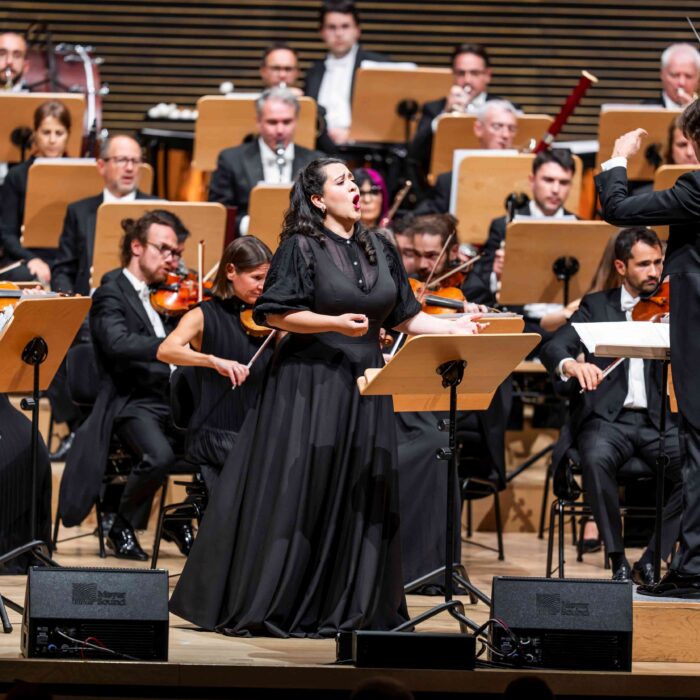
If the dramatic side of the opera fell short, that was not the case with Delius’ music, which encouraged the listener to immerse themselves in the beauty and terrors of the natural world and almost storybook depictions of native culture, which the Wexford Festival Orchestra, under the direction of Francesco Cilluffo, wonderfully brought to life. Each act was sensitively shaped so that the musical arc was coherently maintained while bringing out the score’s beautiful coloring and emotional relationship to nature, the culture of the native peoples and the camaraderie and boredom of the sailors. Cilluffo’s refined management of the orchestral sections ensured a pleasing balance that often allowed for delicate passages to emerge, notably so from the strings and woodwind. It was all very beautiful and compensated for the opera’s dramatic weaknesses by reflecting upon the mood and atmospheric aspects of the work.
On the negative side, the composer’s setting of the text was not convincing. Too often, the line contained too few or too many syllables, leading to some awkward-sounding lines in which the singers seemed uncomfortable; it was notable that, on occasions, they simply ignored some words completely in order to manage the line.
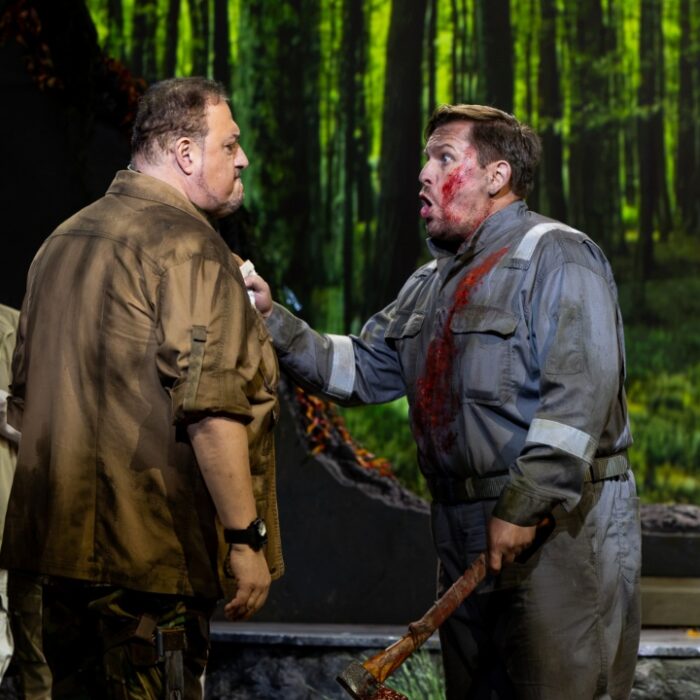
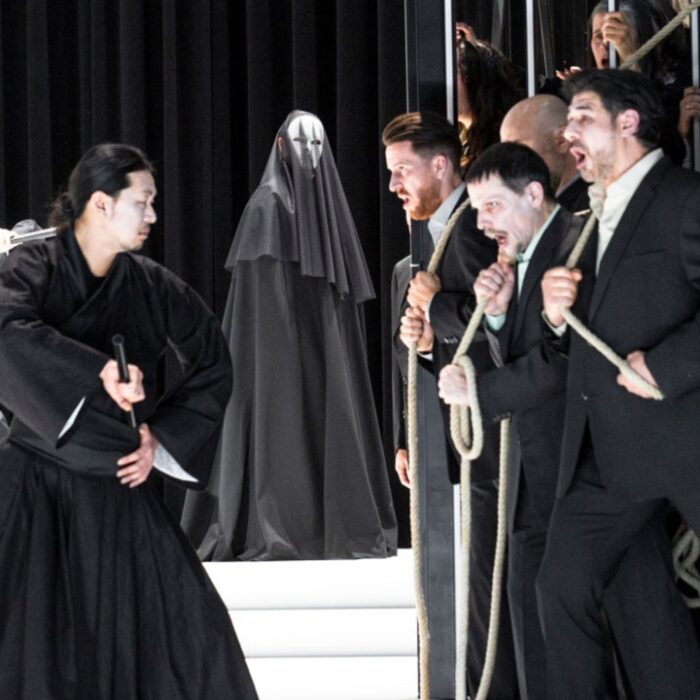
The director Christopher Luscombe, along with the set and costume designer Simon Higlett, created a reading that focused on the work’s strengths, namely the atmospheric and beautiful musical pictures invoked by the score. And while they certainly did not turn their backs on the dramatic aspects, they did not interfere with the narrative or attempt to sharpen its impact. The result was three beautifully visually developed acts. The first was set aboard the ship that lay languishing off the coast, in which the scenery consisted of a deck strewn with ropes and wooden steps with plenty of room for the bored sailors to lie about, doing nothing. The storm saw the crew move quickly into action as they attempted to save the ship. It was all very well staged and caught the situation convincingly. Acts two and three were set in the Everglades, which were primarily defined by thin, green-toned pieces of material hanging from the ceiling, creating the impression of a dense, dark and mysterious forested area, containing much that is unknown. The scene could easily be changed by opening it up to reveal a campfire around which the Seminole sat or Talum Hadjo’s hidden abode. The magic fountain that appeared in Act three was imaginatively constructed with white streams rising upwards from a small pond. Visually it was quite impressive and captured its otherworldly nature.
Overall, it was a colorful and suggestive staging that supported the music perfectly. The only rather brash addition was a path that rose upwards towards the moon that looked like Elton John’s yellow brick road; fortunately, it was quickly replaced.
The costumes added to the impression of pre-colonial America with its use of traditionally inspired dress that blended sympathetically with the scenery and contrasted with Solano’s Western alien clothing.
It was a relaxing staging that lay easily on the eye, in which very little happened but nevertheless supported the thin narrative as well as could be expected.
More Cast Highlights
Tenor Dominick Valdés Chenes, cast in the role of the Spanish explorer, Solano, rarely moved beyond a two-dimensional characterization; he was a typical Romantic figure, inspired by dreams of love and eternal youth, although, hampered by the opportunities provided by Delius, he was unable to produce the extremes of passion one would normally expect. His singing was resonant, focused and clear, yet his underlying lyricism was frequently compromised by the composer’s awkward text. It was, nevertheless, a fine attempt to deal with a character that had not been particularly well crafted.
Baritone Kamohelo Tsotetsi as the chief, Wapanacki, certainly looked the part. His splendid costume gave him a fierce, authoritative demeanor, which he embraced with a domineering acting performance, which contrasted nicely with his underlying decency and honorable behavior. He possesses an alluring voice with a richly colored timbre that he used well to reflect his emotions. On the negative side, he too struggled with Delius’ text, which was exacerbated by his unclear pronunciation.
Mezzo-soprano Axelle Saint-Cirel, playing the part of Watawa, produced the most satisfying performance of the evening. Not only did she manage to bring a greater degree of nuance to her character, in which she successfully developed Watawa’s conflicting emotions and determined personality, but her singing possessed a beauty and expressivity that gripped the attention. Her voice has a firm, rich tone and a flexibility that allowed her to mould the vocal line to communicate beyond the words that promoted Delius’ picturesque musical visions.
Bass-baritone Meilir Jones was a fierce-looking Talum Hadjo but was unable to bring the necessary authority or gravitas to the role. His singing was pleasant, and he enunciated the text well, but apart from his physical appearance, he did not capture the significance of his character.
Baritone Seamus Brady made a good impression in the relatively small role of the Spanish Sailor.
The Wexford Festival Opera Chorus, under the direction of Andrew Synnott, was in good form, engaging successfully in their roles as sailors and members of the Seminole tribe. Their murmurings around the camp were delightful, while the raucous chorus they delivered during the storm expertly captured both their camaraderie and their struggle to survive.
The performance lasted approximately 90 to 100 minutes, excluding the interval, and I must say it was very enjoyable; Delius’ music is very beautiful and has the ability to transport one to the world of the imagination, and I would definitely go to further productions in the future. However, if one expects an opera with an exciting, gripping or provocative drama, then you will be disappointed. Under the circumstances, the director and stage designer’s decision to focus on the visual rather than the dramatic proved to be correct, as it complemented the music beautifully and allowed the imagination to take to the wing.