Teatro Municipale di Piacenza 2026 Review: Carmen
By Bernardo Gaitan(Ph. Rolando Paolo Guerzoni)
An “immoral” woman who ends up stabbed by her lover was by no means the image that the Parisian audience attending the premiere of “Carmen” at the Opéra-Comique in 1875 had in mind as a proposal from a 37-year-old Georges Bizet. It is said that no one is a prophet in their own land: in France, “Carmen’s” debut passed almost without notice, and it was in its Austrian premiere that the character of the Andalusian gypsy finally began to impress audiences. Today, within the international operatic repertoire, few works retain a theatrical vitality comparable to this title. The fate of its composer, however, had already been sealed: Bizet did not live to witness the redemption of his masterpiece, having died on June 3rd while performances were still underway.
The recent production presented at the Teatro Municipale di Piacenza, in co-production with the theaters of Modena and Ravenna and in collaboration with the OperaLombardia circuit, confirms how, more than 150 years after its creation, Bizet’s work continues to fill theaters and captivate audiences through the enduring relevance of its plot.
Production Details
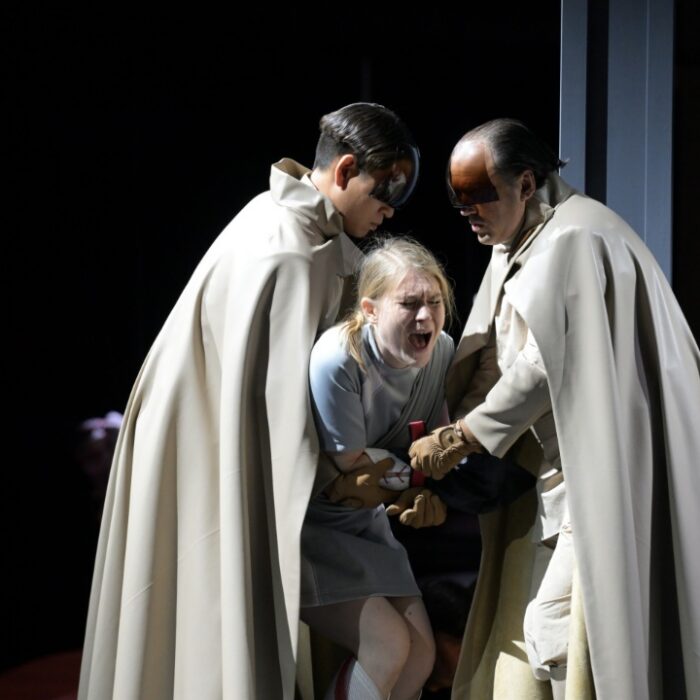
The outstanding staging by Stefano Vizioli, alongside Pierluigi Vanelli, unfolds within a deliberately abstract and essentially timeless scenic concept. The stage director bases his approach on the idea of fate as the sole leitmotiv underpinning the score. His work with the performers is evident and of the highest quality: subtle, almost imperceptible reactions provide the full emotional context of each character. Meanwhile, Emanuele Sinisi’s set design creates a space dominated by abandoned, shattered walls in a brutalist aesthetic: an abstract urban environment that transforms into a square, barracks, camp, and bullring. Despite the scarcity of visual elements, those that appear lend a touch of Spanishness and strong semiotic value. A carpet of red roses functions as a metaphor for the “Flower Aria;” certain costumes unmistakably situate one in Spain; and crates of oranges in the square clearly evoke Seville as the setting. Anna Maria Heinreich’s costumes successfully recall Francoist Spain, while Vincenzo Raponi’s inventive lighting helps define a chiaroscuro atmosphere consistent with the staging concept. Undoubtedly, one of the most striking moments is the card scene, where everything unfolds within a completely dark black box, while a powerful overhead light casts a dramatic effect on Carmen as she discovers the ominous message revealed by the cards. Nevertheless, certain weaknesses persist, particularly in Vanelli’s choreography, which at times appears naïve and poorly integrated, undermining the effect or diminishing its seriousness.
Musical Highlights
Musically, Audrey Saint-Gil’s conducting stood out as one of the production’s strongest assets. The French conductor offered a balanced and dynamic reading, capable of sustaining dramatic tension effectively without sacrificing any detail. Her conducting was extremely precise and rigorous; she avoided inconsistency, consistently attended to phrasing, and unfolded a richly nuanced orchestral palette, always mindful of balance with the voices. The orchestral passages -especially the entr’actes and the overture- were particularly successful. It is hardly surprising that, during his recurrent depressive episodes, Bizet contemplated devoting himself to symphonic music or a pianistic career: here, Saint-Gil seemed to vindicate his honor through her instrumental interpretation. The Orchestra dell’Emilia-Romagna Arturo Toscanini responded solidly to the conductor’s demands, displaying notable flexibility in following her baton. Likewise, the Coro Lirico di Modena, prepared by Giovanni Farina, and the children’s chorus directed by Paolo Gattolin (setting aside the rather ridiculous choreography) provided effective support to the sonic and, above all, visual fabric.
Stellar Cast
The cornerstone of the production is Annalisa Stroppa as Carmen, an interpreter of notable artistic maturity. With solid experience in the role, she delivered a firm vocal performance, supported by a velvety, homogeneous, and well-projected emission. Her elegant and carefully shaped phrasing allowed her to portray an introspective, fragile, and contemporary Carmen: a free, impulsive woman eager to live. She proved extremely reliable both vocally and scenically.
Alongside her, Joseph Dahdah constructed a Don José that was profoundly convincing on the dramatic level. The Lebanese tenor’s voice, with its bronzed and mellow timbre, though not always possessing the power required by the role, stood out for its homogeneity and clear diction. The character’s psychological trajectory: from infatuation to jealous obsession; was clearly defined, aided by Vizioli’s direction. The aria “La fleur que tu m’avais jetée” was staged in a way that could move one to tears, though vocally it passed without particular distinction. His performance improved considerably in the third and fourth acts, where he projected fully, delivering a finale of great dramatic intensity.
Jaquelina Livieri as Micaëla stood out for her musical sensitivity and tonal quality. The soprano brought forward the character’s sweetness and innocence through carefully controlled dynamics, a fluid vocal line, and strong high-register emissions. Her interpretation prevailed in the most lyrical moments, winning the audience’s favor, particularly with her sincere rendition of “Je dis que rien ne m’épouvante” and the touching duet with Don José, “Parle-moi de ma mère!”
More uneven was Gianluca Failla’s Escamillo: elegant and gallant on stage, he convinced through his interpretation, though he did not always appear fully centered vocally. The much-anticipated aria “Votre toast, je peux vous le rendre” succeeded largely thanks to the presence of the chorus. The baritone’s timbre was pleasant, bright, and warmly colored in the middle register; however, he would benefit from further developing his stage charisma.
Among the supporting roles, the convincing Frasquita and Mercédès of Donatella De Luca and Elena Antonini stood out, well integrated alongside Matteo Urbani’s lively Remendado and William Allione’s effective Dancairo. Tiziano Rosati (Zúñiga) and Matteo Torcaso (Moralès) complete the cast with solidity.
The prolonged final ovations confirm that this Piacenza production stands as a performance of undeniable merit.