UNCSA Symphony Orchestra 2025-26 Review: Mahler’s Symphony No. 4 & Malek Jandali’s Symphony No. 5 (U.S. Premiere)
A Vision of Heaven & Symphony for Peace at Washington National Cathedral, Washington D.C.
By Arnold Saltzman(Photo: Scott Jati Lindsay)
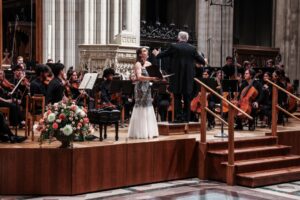
University North Carolina School of the Arts concert was so thoroughly professional that one had to remind oneself that this was a conservatory orchestra. The program, brilliantly conducted by James Allbritten was both ambitious and stunning in its quality. The free program at the National Cathedral was one of the season’s high-points for me, offering the U.S. premiere of Symphony No. 5 by Syrian composer Malek Jandali and Mahler’s Symphony No. 4: “A Vision of Heaven.” Maestro Allbritten serves as music director and conductor of the school’s Cantata Singers and Symphony Orchestra, and is music director of the Fletcher Opera Institute.
Symphony No. 4
Claire Griffin, soprano soloist in the Mahler, is a singer and actress from Brevard, N.C. and a graduate of UNC Greensboro (2022). Her shimmering voice fulfilled the wonderful fourth movement of Mahler’s Symphony No. 4. For 2026-27 she will be with The Florentine Opera’s Baumgartner Studio Artist program singing Nella (“Gianni Schicchi”) and Papagena (“The Magic Flute”). Recent roles include Adina (“L’elisir d’amore”) Polly Peacham (“Three Penny Opera”) Mag (Richard Wargo’s “Ballymore”) and many more appearances and roles.
Her singing complimented the fine playing of the orchestra, with a lyrical line and perfect portamento ascending up the scale on the lyrics “Sanct Peter im Himmel sieht zu!” The text from “Des Knaben Wunderhorn,” a collection of German Folk Songs, published in 1806-1808 with the music mirroring the steps upward to heaven, repeating a number of times as the music follows the form of the text and its sectional design. This theme acts as a ritornello with some modification.
From Mahler’s “Des Knaben Wunderhorn:”
We revel in heavenly pleasures,
So we shun all that is earthly,
No world turmoil
Is heard in Heaven,
Everyone lives in sweetest peace…
(English translation by Richard Stokes)
While the text is meant to be a lullaby, it expresses our yearning for a peaceful world which currently is elusive.
Symphony No. 5
Malek Jandali’s Symphony No. 5 is a major work in the traditional four movement form, including sonata-allegro, slow movement and a scherzo. It is both tonal and dissonant and at times disturbing, reflecting the devastation in Syria during the Assad regime, and the destruction of the historic region of Aleppo, Syria and the hundreds of thousands of Syrians who died in the conflict.
The music is based on Jandali’s development of Arabic maqams, the scale and modal patterns specific to Arabic music, and also shared in the liturgical music by eastern Mizrahi communities. The composer held up a small stone tablet replica of the oldest music notation in the world, on which he based much of his thematic material in his symphony.
In an interview for WETA’s James Jacobs, Maestro Jandali said: “The symphony remains powerful because it offers something rare: time and space for deep listening, reflection, and unity. It reminds us that it is always better to be together, in a symphony for peace.”
This is contrasted by the war-like, disturbing opening movement in sonata allegro form in the key of C. He describes the first movement as powerful. The second movement has an air of melancholy. The second movement, “Nocturne,” evokes the beauty of nature with a sky full of stars and a gentle breeze. The oboe solo introduces the main theme borrowed from Tatyos Efendi, a composer of Turkish classical music. In the scherzo, themes return from the first two movements in a lively rhythmic contrast to the opening themes. The final movement provided a solo to the gifted concertmaster.
A composer of symphonies, concerti and opera, he makes extensive use of Syrian cultural music themes, and treats these with a gifted knowledge of orchestration and symphonic tradition. His music made a powerful statement placed on a program next to Mahler’s popular Symphony No. 4. Malek’s work is authentic and poetic. He is also an Alum of UNCSA.
The orchestra had numerous fine soloists, with the outstanding soloist and Concertmaster José Sequeira, who demonstrated the kind of rich sound and panache associated with great concert violinists.
The 92 members of the orchestra in their superb playing, affirmed that UNCSA is among America’s great conservatories.