Metropolitan Opera 2025-26 Review: Eugene Onegin
By David Salazar(Credit: Evan Zimmerman)
Tchaikovsky’s “Eugene Onegin” is one of the most intimate experiences one can have at an opera house. It’s a story of regret that comes with throwing away the only people that ever loved you. It’s got some of the most heart-piercing music in the canon and an impeccable pacing throughout. It’s a work that almost plays itself.
Which is why the Met Opera’s revival of Deborah Warner’s production is such a frustration. Despite a solid cast on paper and often even on stage, this team’s performance lacked a sense of cohesion and direction.
Loud But Not Strong
It all starts in the pit where debutant Timur Zangiev, a Russian conductor, managed one of the most disconnected interpretations of this score. Tempi felt erratic, especially in the opera’s opening act with Tatiana’s letter scene in particular feeling rushed. While there was nothing objectively wrong with the playing here, the overall execution from all parties came off as overly cold and calculated and in a hurry to move on.
Playing was smoothing throughout this opening act and dynamics were appropriate. There’s a beautiful crescendo after the letter scene which was appropriately delivered, but the orchestra’s sound overall felt glossed over with the volume building but never quite arriving anywhere emotionally. As the night unfolded I increasingly realized that the orchestra’s playing was either too light overall or too loud. Whenever accents were called for the emphasis was on volume over character with the brass getting the lion’s share of the tapestry, making the sound big but never strong or imposing. This was particularly noticeable in the opera’s most dramatic moments, especially Lenski’s outburst at the party where not only was the orchestra running roughshod over the singer, to the detriment of the moment, but its punctuated chords lacked bite or any character outside of being deafening. The entire result was frustrating because it was so clear that tenor Stanislas de Barbeyrac was delivering the most emotionally compelling moment of the entire night to that point (and as it turns out, the entire night), but a lot of times, you struggled to hear him over a seemingly inflexible orchestra.
Other moments, like the agitated string runs that climax in the gunshot lacked a crescendo and thus any sense of direction, undermining the moment, and the final duet was muddied in its textures. Balance on the whole was a problem in the ensembles and coordination with the chorus was sloppy. At almost the start of every choral number you felt the two completely off from one another. They would eventually find even footing for the remainder of the passages, but when it’s a consistent occurrence, then it’s not a coincidence. The opening quartet was also unfortunate. While Tatiana and Olga sing off-stage, the two older women patter on. In this instance, it would be hard to call the dialogue as being rhythmically imprecise and lacking in intonatoin because it didn’t even sound like there was any kind of rhythm or pitch to begin with (per the score, Larina and Filippyevna have alternating eighth and sixteenth notes between them on varying pitches). It sounded not so much under-rehearsed as not rehearsed at all and simply throw together. How this passes muster at the Met is questionable at best, unacceptable at worst.
Zangiev’s best moments were those where the orchestra was on its own, mainly the dances and the Polonaise at the top of Act three. While the balance of the ensemble tended to favor brass and winds, giving a hollow feel, there was greater flow to the musical build. He was also a solid supporter of the singers during big arias, especially Lenki’s “Kuda Kuda vi udalilis” and Gremin’s “Lyubvi vsy vozrasti pokorni.” Here the conductor managed to match the singers’ dynamics allowing them space to build their lines without having to sacrifice an ounce of vocal artistry. These were undeniably the musical highlights of the evening. Sections that involved a sustained pizzicato in the orchestra were also, interestingly enough, quite enjoyably memorable.
Strange Directions
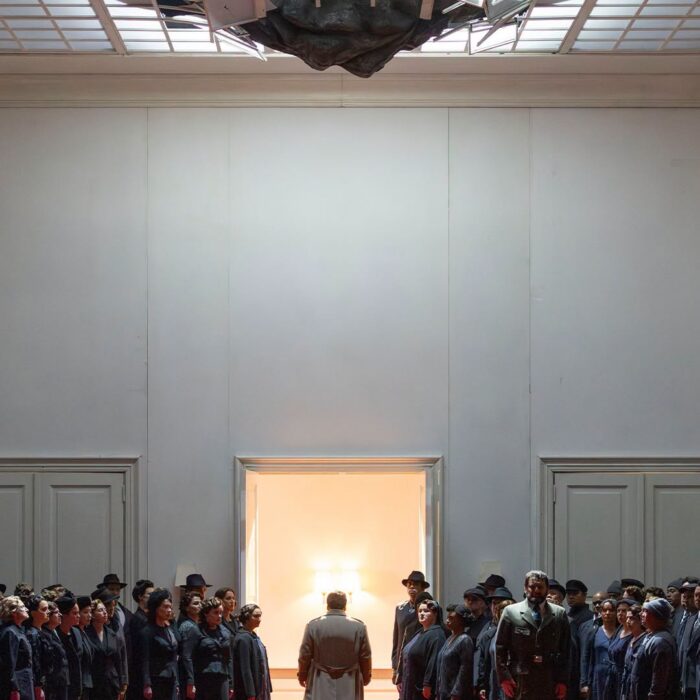
Stage direction for a revival is usually a hit or miss situation. Often times artists do their own thing and others its clear that people are going through the motions of what happened last time. But it’s not often that the stage direction is so strange. For this “Eugene Onegin,” Paula Williams was charged with reviving Warner’s mis-en-scène and choices were made that felt very out of place in the world of the opera. At the start of her letter scene, Tatiana grabs a bunch of chairs to jam the door shut. Then she grabbed a mattress and piled it on top of the chairs for good measure. That was not in the original direction of the production and the inclusion here, while clearly intended to “up the stakes” and show Tatiana’s innocence and need for privacy, felt overwrought, especially the mattress bit which was clearly intended for a laugh.
Then there’s body language. Poor performances are not always the result of an individual performer’s skills or choices, but a reflection of how they fit or don’t fit into the overall visual and performance language onstage. If this is a traditional production with some modern anachronisms in terms of body language, then it needs to be there the entire time. During the ball scene, Lensky throws Olga to the ground not once but twice, the latter moment coming off as completely out of character. The first time is understandable (if not justifiable) and prompts Onegin to accept Lenski’s petition for a duel. The second time, when Lenski is saying goodbye to Olga for the last time, doesn’t make sense at all. The original direction had him leaving her and then Olga collapsing to the floor. Why does he throw her again? Additionally, the fact that we saw the same action moments ago diminishes this one as a stock gesture made less for dramatic purpose but more for shock value (which, again it isn’t because of its frequency within moments). There’s nothing wrong with trying to change original directions in a revival to suit a new set of interpreters, but the characters come first and in this instance, the choice went against the character and moment.
Then, at one point in the final duet, as Onegin once again lectures Tatiana and asks her if she understands what it means to long and love, soprano Asmik Grigorian pointed at him and then herself in a manner that did not fit the staging whatsoever (her gestures reminded me a bit of that meme where the cartoon Spider-men point at each other). The gesture was understandable dramatically, but given that she was wearing 19th century Russian wardrobe, it looked completely out of place and hence, out of character. It might have been an in-the-moment choice by her, but it came at the tail-end of performances lacking in any kind of clearly defined characterizations.
Baritone Iurii Samoilov seemed confused about his Onegin and would shift from overly passive and casual to overly aggressive throughout most of the final act, with little in between. As such, that final scene came off as teetering on the edge of violence for his character and how he grabbed Asmik Grigorian’s Tatiana made the internal conflict feel lacking in believability for both of them. I recently saw a performance of “Carmen” at the Met where Don José’s violence is developed and transformed over the course of the night so that by the end of the performance, his murder feels believable. The characterization of Samiolov’s Onegin in that final scene felt a lot like that Don José in “Carmen,” but without the buildup to make the payoff believable. That’s not something that the baritone came up with on the night. That’s something he was crafting in rehearsals and it’s on the director to manage. Perhaps the idea was to make him more abusive (same with Lenski and his choice to throw Olga to the ground twice) and thus draw up a larger picture about men being abusive toward women, but the production and opera itself is not designed around this idea at large (like “Carmen” is, for example) and just throwing these ideas into the mix does not suddenly re-contextualize the whole story. Instead, it feels forced in.
The kiss that this production adds at the ends of Act one and three as plants and payoffs is effective in theory and in original executions because of what it signified. For Onegin, he was taking advantage of Tatiana’s vulnerability to get a “taste.” It’s awful behavior but revealing of the character. When she returns the favor at the end, it’s almost an act of vengeance. Both times in this performance, the moment came off as overly casual. That works for Onegin’s kiss but for Tatiana there’s so much more at stake and the choice to do it and get it over with so quickly undermines the stakes altogether and thus the impact. This is a very specific decision the production’s director made that should be translatable in subsequent revivals. This is the first time I saw it executed in such a blasé manner. Again, the performers are responsible here, but it’s also at the hands of the director, whose job is to ensure that there is dramatic cohesion and direction.
One final piece of direction here which came off as strange was during the Polonaise. As Onegin walks around the party, he notes the Prince and waves to him. The Prince looks at him in a manner best described as annoyed, and then runs off ignoring him. Onegin’s response? Storm off, only to come back a few seconds later. It made no sense in the context of the story, especially because moments later, the Prince is opening up his soul to Onegin. Again, completely out of character for everyone involved.
It’s a revival, but some choices were made that should have either been developed further in rehearsal or cut out altogether. Hopefully, as the run progresses, the staging is re-evaluated. That HD performance deserves it.
Not Fully Inhabiting the Stage
Based on my impressions of the musical and stage direction, you might be inclined to think that I disliked the interpreters. I didn’t. In fact, for the most part, this cast featured strong singers overall. Samoilov possesses a beautiful baritone that is consistent throughout the range. He has a creamy legato and rich texture, which was evident throughout his Act one lecture to Tatiana. He also managed truly pained emotion in his final notes, holding the high G through most of the orchestral coda. And there were moments in the duet with Tatiana where his voice took on a more jagged edge, emphasizing his desperation. However, these moments of emotional intensity were often few and far between with the baritone’s singing polished and elegant, but lacking in overall color or character. It often seemed overly careful and calculated in execution. At the climax of the first scene, when Onegin realizes he’s fired up by newfound love for Tatiana, Tchaikovsky gives the baritone a melody we last heard at the start of the letter scene. Onegin is meant to sing passionately over the orchestra and while Samoilov managed the passage well, he was overpowered by the larger ensemble, especially in the lower reaches of his voices.
It didn’t help that, as noted, his body language and characterization didn’t really give Onegin any sense of definition. The character was bored with society and trivialized everything, but there was no sense as to why in any of his choices. No deeper anger or even sense that toying with others was a hobby. There was no range to his reactions or behaviors. Everything was nonchalant and as such felt detached of specific perspective on the character. You could tell he was trying in certain moments to play the character, especially when he hugs Lenski before killing him, but it never felt like he was inhabiting it fully. It is worth noting that Samoilov recently replaced the originally cast Igor Golovatenko in this role, and one might feel inclined to take consideration of the circumstances, but then again, presumably the Met Opera chose Samoilov because he was the most suitable to take on the role.
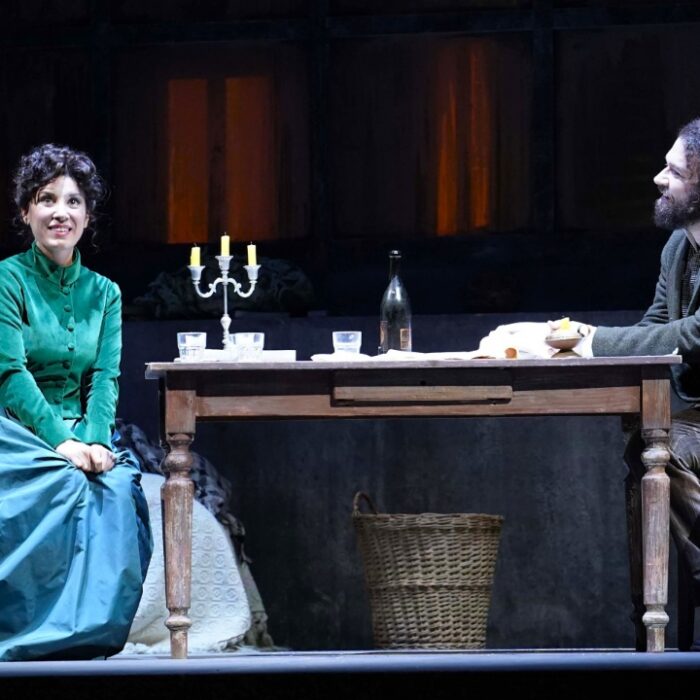
As Tatiana, Asmik Grigorian gave a vocally refined take. She sang beautifully in the opening sections of the opera and played up Tatiana’s timidness. During the letter scene, she managed passages well, the legato refined, and the high notes clear and brilliant, but the entire passage moved along without a feeling of reflection. During the gentle section of the aria, “Who are you — my guardian angel,” Grigorian’s piano singing was gorgeous but the forward movement left the segment feeling lacking in a sense of reflection. The overall scene came off as cool. This temperament was better suited for the final duet where she has to maintain a certain distance from an increasingly intense Onegin. Grigorian managed this quite well overall, allowing certain cracks in the armor to come through, such as a gorgeous dimineundo on the A flat, a tearful lament, before saying “I love you.” Musically, she managed a strong push and pull between Tatiana’s desire for Onegin and her rejection of him. The previously noted acting choices here and the overall staging unfortunately undermined the moment.
Stanislas de Barbeyrac gave the most compelling performance of the night as Lenski. It wasn’t the smoothest of openings for him. While the legato was elegant throughout “Ya lyublyu vas, Olga,” the high notes were not. The tenor’s high notes can best be described as overly covered at times, making them pale in comparison to the rest of his register. As such, they often sound strained and he never sustains them for long. The high A at the peak of this arioso was very grainy and subsequent Gs sounded similarly uncomfortable.
But then he took over the party scene, the only performer the entire night who threw caution to the wind emotionally and vocally. Despite having to compete with the orchestra, de Barbeyrac was emphatic, expressing Lenski’s pain and anger all at once and keeping you on edge. He built it up so well that that first throw of Olga to the ground was shocking, but also believable. But then you could see the immediate horror on his face, the remorse at what he’d done. As he said his good bye, the tenor managed a solid and pained high A, emphasizing the sense of loss. To see him throw her aside like a piece of dirty laundry did not match up with how he’d managed the rest of the scene and was deeply unfortunate.
But it’s all about the Act two, scene two aria “Kuda kuda vi udalilis” and here de Barbeyrac, Zangiev, and the Met Orchestra combined for the most magical musical moment of the entire evening. He sang those opening lines with a gentle piano before delivering a glorious crescendo on the F at the apex of the phrase; one of the finest such crescendoes I have heard any tenor manage in this aria. The entire first verse of the aria was fluid and passionate, making his decision to go full pianissimo on the recapitulation all the more powerful. The extreme of dynamic allowed for the crescendo to high A flat on the Andante mosso at the climax and the subsequent forte singing to have greater impact and sense of desperation. From there, he scaled back the sound to finish off with a hair-raising piano sound in those final moments. This extreme of contrast gave the aria a tremendous sense of intimacy and the fact that the orchestra managed such levels of delicacy made me question Zangiev’s overall attention to detail on a macro level. The fact that it also felt much more flexible with the tempi, in comparison with the letter scene for example, allowed the piece to have a greater sense of dramatic depth and introspection.
The other major vocal highlight of the evening Alexander Tsymbalyuk’s interpretation of “Lyubvi vsy vozrasti pokorni.” The bass handled the long lines with grace and suaveness, the vibrato controlled and flexible, particularly as he crescendoed the B flat leading into the “Piu mosso, quasi allegro” section. There was a robustness and solidity in this interpretation that I often find lacking in other performances I’ve witnesses. The contrast between the gentle piano singing, especially in the second half of the aria, and sturdier sounds in the middle, emphasize Gremin’s heroic and tender nature all at once.
Maria Barakova was also solid as Olga, her aria in Act one delivered with charm and fluidity of line, even though the orchestra tended to be a bit overbearing throughout it. There was grace and playfulness in her overall characterization with contrasted nicely with Grigorian’s more stoic embodiment, but also played perfectly with the more nervy Lenski by de Barbeyrac.
Tony Stevenson’s Monsieur Triquet was well-sung, particularly, his contrasting “Briller,” the first ones with full-bodied voice and the latter with gentle pianissimo singing. The overall musical approach was balanced and refined, even if the piannissimo second verse was a bit flat in its intonation.
Elena Zaremba and Larissa Diadkova did their best as Madame Larina and Filippyevna, respectively, but their passages, especially the opening one, often sounded sloppy. Diadkova is also a recent replacement for the originally cast Stephanie Blythe.
On the whole, this might have been the most disappointing evening I have experience at the Met Opera this season. On paper, the cast is solid and a fresh new Russian conductor should breathe some vitality into this glorious work. Unfortunately, the first performance felt undercooked and not ready for prime time. Subsequent performances should presumably see improvements.