Theater Lübeck 2026 Review: Les Contes d’Hoffmann
By Ossama el Naggar(Photo: © Theater Lübeck – Olaf Malzahn)
The idea of this abridged “Les Contes d’Hoffmann” (seen June 5) may alarm some opera lovers, yet this two-hour, intermission-free version proved surprisingly convincing. The cuts were mostly judicious, streamlining secondary material without seriously damaging the dramatic flow, though the absence of the Venetian septet “Hélas! mon cœur s’égare encore!” remained a real loss.
Production Details
In Philipp Himmelmann’s imaginative staging, Hoffmann becomes less a sequence of supernatural episodes than a journey through the poet’s imagination. The three heroines appear as projections of Hoffmann’s inner world, reinforced by the recurring image of each woman singing from pages handed to her by Hoffmann himself. This play made the arias of all three women seem like sponanteous sight reading of Hoffmann’s poetry. A revolving stage and atmospheric lighting compensated for limited resources, creating an unsettling, almost expressionist mood. Particularly striking was the shadowy visual language, which gave the production an eerie psychological intensity. The elongated shadows created by Falk Hampel’s lighting evoked cinematic masterpieces of the horror genre, Murnau’s “Nosferatu” (1922) and Dreyer’s “Vampyr” (1932). If Giulietta’s Venice lacked the sensual opulence one might expect, the production’s introspective focus remained compelling.
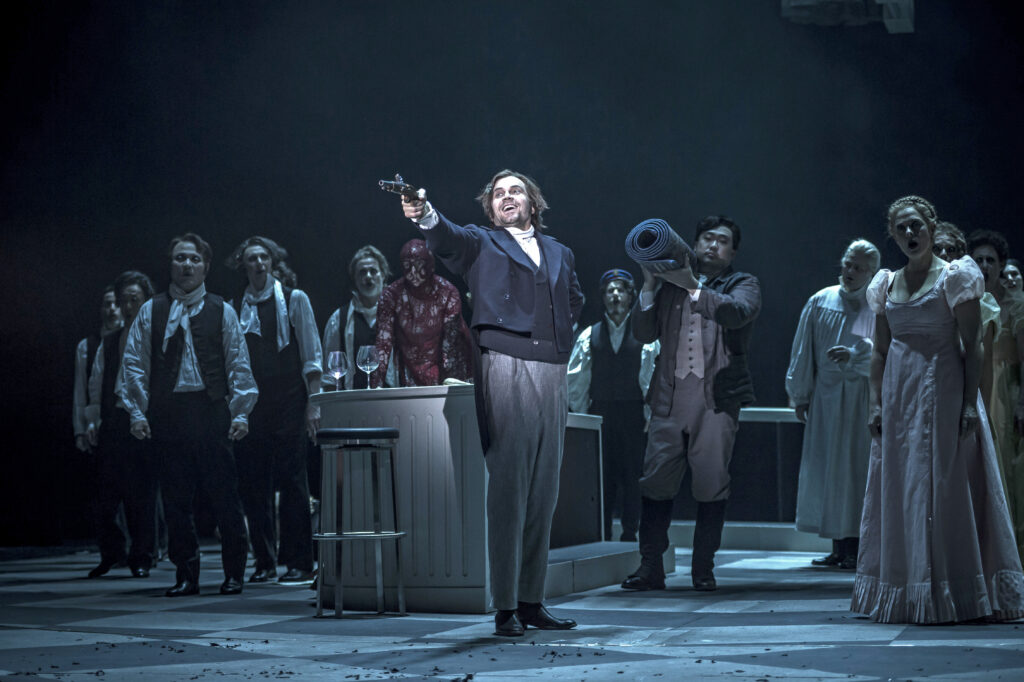
Foto: © Theater Lübeck – Olaf Malzahn
Illuminating Cast
Greek tenor Konstantinos Klironomos offered an intensely committed Hoffmann. His warm, lyrical tenor moved easily through the role’s demanding tessitura, while his clear French diction and natural stage presence conveyed both the poet’s romantic ardour and vulnerability. Klironomos had the greatest quality an interpreter of Hoffmann can have: ardour. Of course, this is in addition to a beautiful timbre and superlative technique. Amazingly, his booming high notes were as solid by the end of the opera as at its beginning.
The evening’s true triumph, however, was Canadian soprano Sophie Naubert as Olympia. Having already impressed me greatly as Zerlina in Montréal last September, she was one of the main reasons Lübeck entered my travel plans, and she fully justified the trip. Himmelmann replaced the familiar porcelain doll stereotype with a mysterious Olympia veiled in red lace, making the character genuinely uncanny. Naubert’s physical acting was superb, her sharply mechanical gestures perfectly timed to Offenbach’s humor. Himmelmann staged the doll’s song differently. As Naubert read the sheets Hoffmann gave her, she brought a comic touch totally different from the conventional antics associated with this aria. This was due to the doll’s abrupt movements and confusion.
Vocally, she was exceptional. “Les oiseaux dans la charmille” sparkled with agility, precision and gleaming high notes, all delivered with immaculate diction. As a native French speaker, she brought unusual textual clarity, but beyond technical accomplishment, she infused Olympia with wit, charm and personality, elevating the role beyond mere vocal display. Unsurprisingly, hers received the evening’s warmest ovation.
German soprano Andrea Stadel offered a fragile, emotionally vulnerable Antonia, making her tragedy particularly affecting. For some reason, the director made this Antonia both physically and psychologically afflicted. This augmented the pathos in the role.
Dutch soprano Aditi Smeets brought vocal richness and elegance to Giulietta, even if her portrayal leaned toward emotional reserve. Her rich soprano blended perfectly with Nicklausse‘s mezzo in the opera’s most popular tune, “Belle nuit d’amour” (The Barcarolle).
More Cast Highlights
American baritone Jacob Scharfman was highly effective across the four villains, combining vocal authority with charisma and theatrical flair. Though these roles are usually sung by a bass-baritone, a register that emphasizes the characters’ menace, Scharfman compensated with his superb portrayal. Tall, slim, and unmistakably athletic, he twisted and moved with an almost acrobatic agility, evoking the spirit of actor Philippe Clay’s quintessential French cabaret performer in the legendary (magic related) film “Bell, Book and Candle” (1958). His diction was so impeccable and idiomatic that I took him for a native speaker. Both “Je me nomme Coppélius” and “Scintille, diamants” were delivered with irresistible flair. Across all four villainous incarnations, he appeared to delight in wickedness, heightening the opera’s delicate balance of comedy and tragedy. Had Klironomos not been such a superb Hoffmann, Scharfman would unquestionably have stolen the show.
German mezzo Frederike Schulten made for a dramatically convincing Nicklausse, singing with warmth and ease.
Under Takahiro Nagasaki, the orchestra played with energy and sensitivity, maintaining strong momentum despite the extensive cuts and supporting the singers attentively throughout.
This “Hoffmann” demonstrated how imagination can compensate for modest means. Through Himmelmann’s intelligent staging and, above all, Konstantinos Klironomos‘a ardent Hoffmann and Sophie Naubert’s memorable Olympia, Theater Lübeck delivered a compelling and highly rewarding evening.