Royal Ballet & Opera 2025-26 Review: I Puritani
By Mike Hardy(Credit: ©2026 Tristram Kenton)
The death of Vincenzo Bellini at just 33 years of age was unequivocally a tragic loss to the world of opera. The libretto for his final work…not so much.
After a 35 year absence, Bellini’s “I Puritani” has made a return to Covent Garden. The opera is rarely performed in any house, and the reason is universally cited as being the difficulties involved in sourcing singers capable of reproducing the extremely difficult, long, smooth and high vocal lines. The score demands remarkable agility, breath control and ludicrously high notes. A “punishingly high tessitura” for the role of Arturo, the tenor, pinpoint accurate coloratura for Elvira, the soprano and almost equally taxing hurdles for the bass and baritone to navigate.
Conversely, I have no doubts that contributing towards the reluctance of some houses to stage the opera is the pretty puerile, incoherent plot. Of course, one could rightly argue that most opera flies in the face of all realms of credibility, but so long as you know what you’re getting, you can play along to a degree. That’s not so much the case with Carlo Pepoli’s libretto. Pepoli, a poet, journalist and politician, was not Bellini’s usual librettist, and for “Puritani,” he produced a rather confusing and spurious tale of the English Civil War as seen through Italian eyes, infused with a measure of nationalist Pepoli’s revolutionary notions. It makes for a rather disjointed, nonsensical tale that poses problems for any director to adapt and portray.
Director Richard Jones’s approach appears to be to just run with it; paying lip service to the tale, such as it is, and electing to throw in a couple of perturbing modifications, one of which I shall refrain from describing so as not to have to write a spoiler alert. In fact, as is my customary means of reviewing, I’m going to let the reader discover or unravel the plot for themselves. Suffice to say that, in this instance, the synopsis enclosed in the program bears not a lot of resemblance to the one acted out on stage. In brief, however, the story envelops the time-honoured operatic Potpourri of forbidden love, unrequited love, jealousy and treachery. Throw in not one but TWO brides, one who is an escaping exiled Queen, the other who is, literally, left standing at the altar and whose subsequent descent into madness is both rapid and all pervading, and which forms the principal conflict section of the plot.
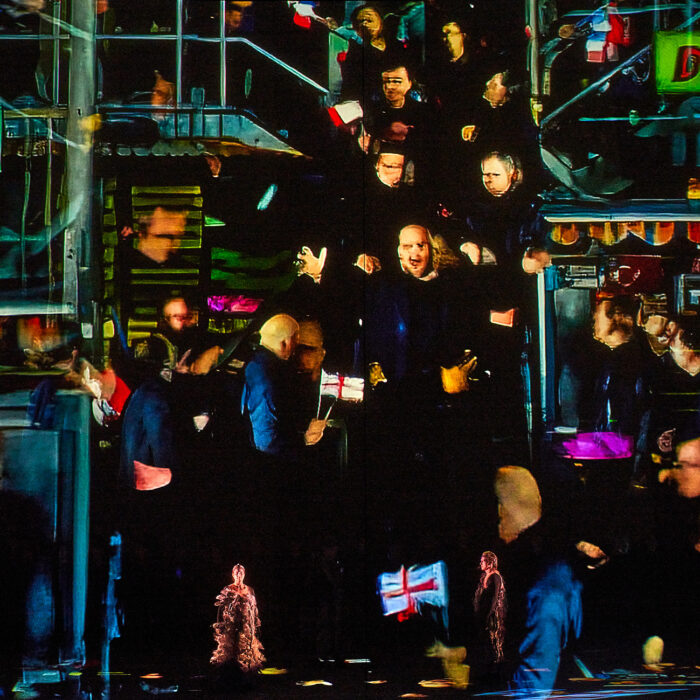
One of Jones’s hallmarks is his preference for minimalist staging and bleak backdrops, ensuring a greater focus on the performer and, in that respect, he delivers here. A solid, slate grey wall provides the occasional backdrop for cleverly projected, animated ‘written script’ to flow from the pens of the on-stage protagonists as they write their respective love letters. Aided by set designer Hyemi Shin, the main stage setting is a sandbag lined stronghold. A cannon is carried on stage, piece by piece, assembled and wheeled around the stage in a meaningless manner, conducted by a melodramatically gesticulating guide. A mobile “pop up” display box is frequently wheeled on and off, serving as, in turn, Elvira’s private quarters, a chapel or church, a crypt and a prison cell. A huge, searchlight/spotlight on wheels is the centerpiece for later scenes, presumably to further illustrate the fact that the on-stage character was being hunted. The townsfolk undertake almost comedic, curious, repeated marching approaches to the edge of the stage and back, lending a bizarre pantomime feel at times.
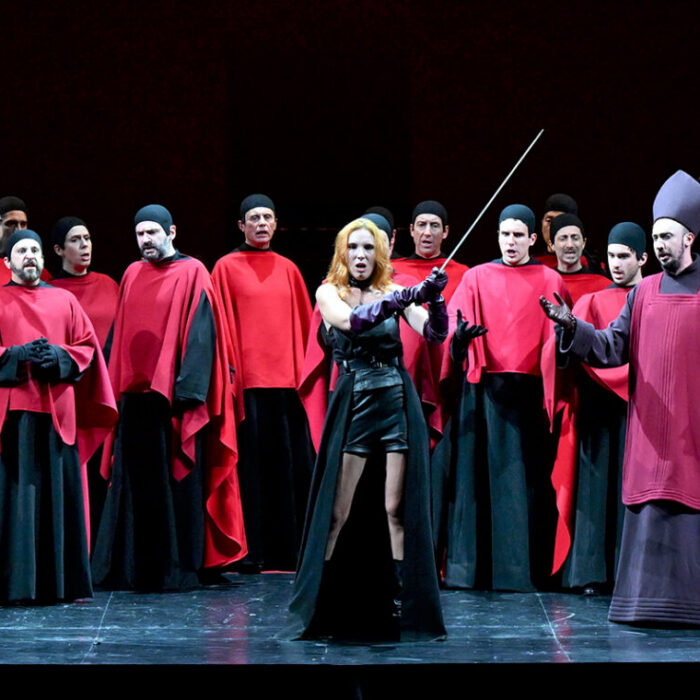
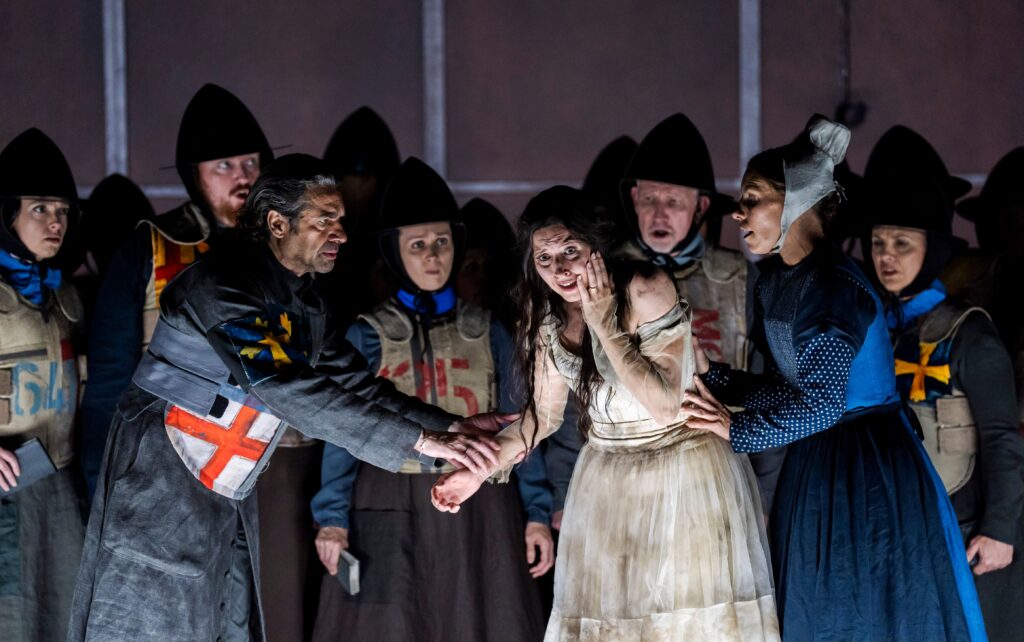
This lackadaisical method extends to the wardrobe also, where costume designer Nicky Gillibrand appears to have opted to use whatever cast-offs she could find in the opera house storage vaults. Certainly, the troops don’t resemble any military unit in history with their weird attire, some in flak jackets and helmets, others looking more like something from the wild west. Arturo is dressed in candy-striped trousers and a maroon waistcoat and wouldn’t look out of place in a circus troupe.
I frequently write that opera should be all about the music and the singing. In fact, I write it so frequently that I recently stated that I would hitherto refrain from writing it again. Alas, if ever a work needed that truth to be reinforced, this is unquestionably it. Fortunately, Bellini wrote an exquisite score, despite the vocal athleticism required to sing it. Conductor Riccardo Frizza does a superb job, eliciting beautiful sounds from his orchestra and guiding the cast through their paces.
Having alluded to the fact that the scarcity of this opera is down to the difficulties in sourcing a cast proficient enough to sing it, and that it is performed only when a stellar group of artists are available to undertake it, I can at least assert that in that respect, this performance is a resounding success.
©2026 Tristram Kenton
Lisette Oropesa sung this role to great acclaim in Paris and at the Met last year, and I have no doubts that Royal Opera quickly secured her services to replicate the same in London. She is a soprano gifted with remarkable talents. She is lauded as the best lyric coloratura of her generation and on this showing, that is indisputable. One does not need to be a coach or musicologist to appreciate her flawless technique. Her rapid trills, runs and vocal ornamentation are a sight and sound to behold. Her upper register is robustly secure and her top notes crystalline in their precision. She sang a wonderful “Son vergin vezzosa” in the first Act where she is joyous at the arrival of her beloved Arturo. “Her Sai com’arde in petto mio” dripped with emotion, a duet with her uncle, where she expresses her despair at being forced to marry another.
The operas famous “Mad Scene” is actually a sequence of arias, rather than a single piece, and it forms the showpiece for Elvira’s role. Of note “Qui la voce sua soave” and “Vien, diletto, è in ciel la luna;” were totally sublime and Oropesa produced here some of the most divine bel canto singing I have ever heard. Not just an astonishing voice but a consummate actor also.
In the Royal Ballet and Opera’s notes for the production, it states: “Some of the characters in this production experience the challenges of mental health.” I have to say, in all honesty that I had reservations for my own mental well-being, watching Oropesa’s descent into madness here. Bright and chirpy at the start, visibly distressed at what she perceived to be her betrayal and utterly convincing in her detachment from reality; wide eyed, frantic and frenetic, darting to and fro, rambling in her hallucinatory conversations, utterly compelling in her mental turmoil and misery. There is a particular scene where the villain of the piece, Riccardo, traps her and her molestation is strongly alluded to. She is trembling violently, shaking with fear and I found it most perturbing to the point that I felt a trigger warning for this would be as equally appropriate as the mental health one. Oropesa is, unquestionably, a supreme artist.
In a recent interview with OperaWire, she stated: “Elvira is the absolute peak of a career.” I have not had the good fortune to appraise all of her works, but on this showing, I would be inclined to agree.
Of course, “Puritani” is equally famous for its grueling tenor role. Bellini wrote a ridiculous high F, (F5), in the aria “Credeasi, misera,” although its use was intended to be optional. He wrote it, seemingly, as a stunt because his friend and star tenor of the time, Giovanni Battista Rubini, (who was apparently as famous in that time as Caruso would later become), could effortlessly produce one. Many tenors elect to avoid the high F, either transposing down to a D sharp or simply dropping an entire octave. In his tole of Lord Arturo Talbo, Sardinian tenor Francesco Demuro happily took the option to sing the F5. In all honesty, it wasn’t a pretty sound but then, in my opinion, a male high F never can be. To me, it can only sound unnatural and forced because force or a collection of forces, is effectively what is required to produce it. Non-the-less, Demuro’s effort was an astonishing vocal accomplishment and the whole aria was superbly well sung.
Conversely, his C sharp in the famous “A te, o cara” love aria and quartet from the first Act was superb, as was the rest of this very taxing piece, a very difficult ask for an opening aria.
His finest work, alas, was reserved for the later acts, where his “La mia canzon d’amore!,” when he escapes his captors and returns to his homeland, was sung with fine, expansive emotion and feeling. I found Demuro to be a very sound, limpid, bright tenor with a wonderful bel canto line.
The villain of the piece, Sir Riccardo Forth, was played by Polish baritone Andrzej Filończyk. He strutted around the stage with superciliousness and menace in equal measure, but he sang with a stunningly rich and expressive instrument. His Act one romanza, “Ah! per sempre io ti perde” where he sings of the pending loss of Elvira to his rival Arturo was genuinely poignant. His Act two “Il rival salvar tu dêi” duet with Giorgio, Elvira’s uncle, where they discuss the fate of Arturo, was rousingly stentorian, yet sung with passion.
Bass-Baritone Ildebrando D’Arcangelo played the role of Sir Giorgio Valton, Elvira’s uncle. He is a bass-baritone of sublime quality, his voice treacle rich throughout the registers with opulent timbre and velvety resonance. His Act one interaction with Elvira was most endearing, “Odi! Qual suon si desta?,” where he informs her of his persuasion of her father to permit her to marry Arturo. But his finest work was in the “Cinta di fiori” aria, from Act two, where he sings of his Nieces distress and loss of sanity. He infused the piece with almost tangible empathy, his mellifluous tone caressing his every word.
Enrichetta di Francia, the deposed Queen, was performed by Marcela Rahal who sung a splendid duet, “Sulla verginea testa” with Arturo and left me wanting to hear more of her fine, luxurious mezzo.
As always, whenever I hear Blaise Malaba I am hoping for bigger roles for him. He sang the part of Elvira’s father, Lord Gualtiero Valton, and made all too brief appearances where he displayed his magnetic stage presence and deep, resonant bass.
It goes without saying that the Royal Opera Chorus were magnificent, where almost certainly very few, if any of them, would have ever worked in this role. Their combined majestic voices always play such a pivotal role in every opera and their efforts here are to be lauded. It was just a pity that their actions, set by movement director Sarah Fahie appeared somewhat superfluous and perfunctory.
I would urge everyone who loves beautiful music and singing to see this opera, not least because one genuinely can never say with any degree of conviction when one may have the opportunity to see it again.
But go for the music…and if you are fortunate to see Lisette Oropesa’s astounding portrayal, the strange, disjointed story won’t matter a bit.