The Atlanta Opera 2025 Review: La Belle et la Bête
Glass’ rescoring of Cocteau’s ‘La Belle et la Bête’ calls attention to the film’s mythic power
By Benjamin TorbertPhilip Glass is a living national treasure. Many of his projects innovate in strange ways. Likewise, The Atlanta Opera (TAO), under Tomer Zvulun’s direction, has displayed a knack for enticing opera audiences in novel fashions. This has included a run of “La Bohème” interlaced with its heir “Rent,” seen last year, and a slightly operatic presentation of the Broadway musical “Fiddler on the Roof” in collaboration with Atlanta’s Alliance Theatre only last month. The latter broke attendance records for both companies. No surprise, then, that TAO would get around to Glass. If opera audiences are used to oodles of Puccini — TAO performs “Turandot” later this season on its centennial birthday — Glass qualifies as something quite different. TAO’s entire prior season, themed on the transcultural monomyth of The Hero’s Journey, engaged with the question of what constitutes opera. The four mainstage works numbered a Singspiel (Mozart’s “Die Zauberflöte”); an opera that surely ranks as Verdi’s screwiest as it moves in at least three directions with subgenre simultaneously (“Macbeth”); a Musikdrama (Wagner’s “Siegfried”); and, finally, Handel’s “Semele,” which he specified to “be perform’d after the Manner of an Oratorio.” All are operas, more or less, but none in quite the same way as, say, Bellini’s “Norma.”
Accordingly, when TAO selected Glass’ “La Belle et la Bête” (1994) for a one-night-only presentation at Cobb Energy PAC, their regular audience had already received a year of preparation, already wondering “what exactly is opera, anyway?” Other than employing operatic voice, it is not blindingly evident what makes this work an opera. Glass said so, and opera companies present it — that may suffice. But this work feels as much like a replacement for a film score as it does an opera and, of course, Glass has accomplished much in the film score arena.
Un cour pleine de rires et musique
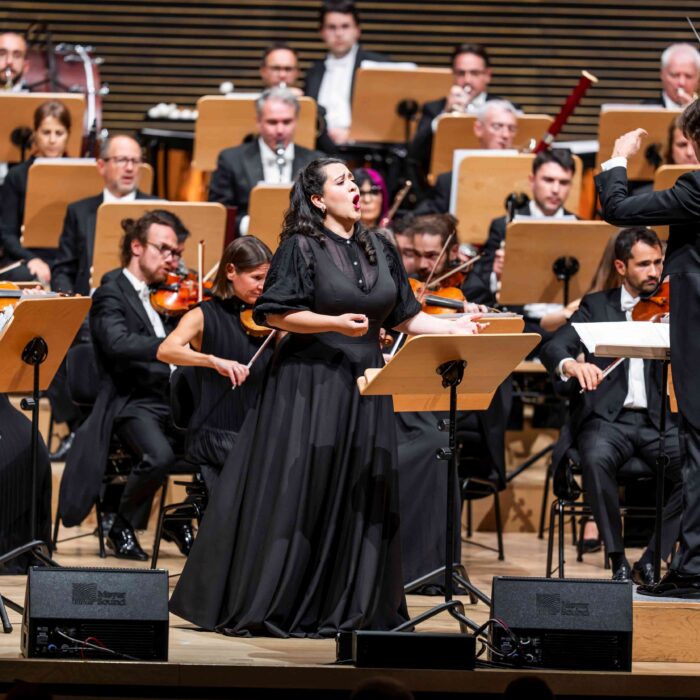
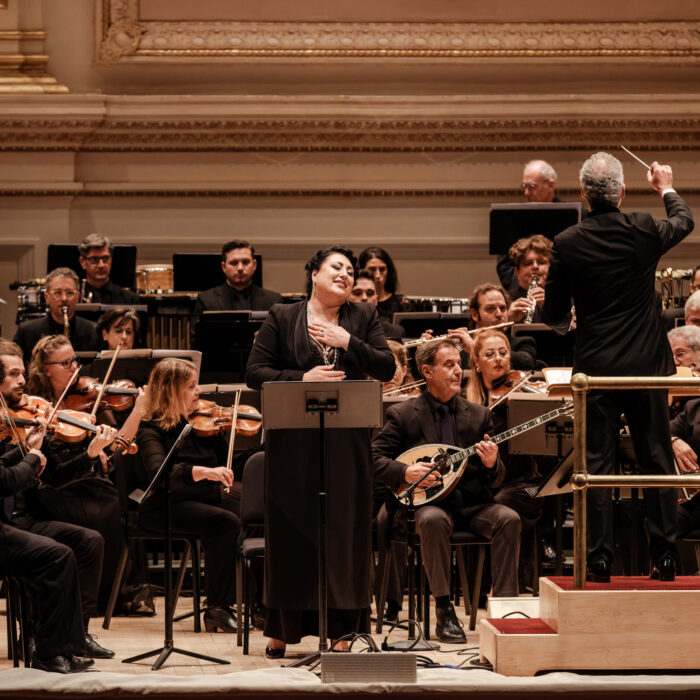
Glass set his score as a live-to-film presentation of Jean Cocteau’s creepy quasi-Gothic masterwork, the 1946 film “La Belle et la Bête,” although Glass’ score can also be purchased for performance without the film. TAO projected Cocteau’s movie on a flat stage curtain, with the English subtitles you usually see in American screen presentations on streaming services, and they stationed Glass’ four singers at music stands, two apiece, stage right and stage left. A medium-sized orchestra occupied the pit: strings, flute, piccolo, two oboes, two clarinets, a bass clarinet, one saxophonist on both soprano and alto, two bassoons, three horns, two trumpets, trombone, bass trombone, a harp, and two percussionists, one of whom worked a marimba. These forces comprised neither a chamber ensemble like that for Glass’ “Galileo Galilei,” nor a maximalist army of instrumentalists like those specified by Wagner and Strauss. When the Criterion Collection released the movie on DVD and BluRay in the 2000s, they included the opera as an alternate soundtrack.
OperaWire readers will likelier require an introduction to the film rather than to Philip Glass, so much of this review will concern itself with the former. Glass’ score replaces the film’s soundtrack, composed by Cocteau’s frequent collaborator Georges Auric. Born in 1899, classical music enthusiasts may recognize his birth year as identical to his countryman and fellow composer Francis Poulenc. The two men formed a third of Les Six, a loose grouping of composers monikered by the critic Henri Collet and including Arthur Honegger, Louis Durey, Germaine Tailleferre, and Darius Milhaud, who noted scant stylistic unity between the sextet. Friends all, they sometimes collaborated. Auric maintained the closest ties with Cocteau, scoring 11 films for him. Auric’s orchestral score, I daresay, works better as an accompaniment to the film than Glass’. But this consideration ignores the fundamental move Glass makes, which is to replace the spoken dialogue with sung (pseudo-) recitative. Though not exactly traditional recitative, it is similar to how people sing in Glass’ other operas of the 1990s and early 2000s. Les Six were a generation younger than Ravel and Debussy, and viewed as reactants against Impressionism and the specter of Wagner before that. Strangely enough, Glass’ replacement of Auric’s score for “La Belle et la Bête,” although never departing from Glass’ inimitable musical language, emits a vague aroma of what it would be like if he had more forcefully recomposed Debussy’s “Pelléas et Mélisande,” or perhaps if he had composed “The Umbrellas of Cherbourg” instead of Michel Legrand. Indeed, nearly every recent opera that principally features through-composed sung dialogue rather than singy “numbers” owes much to Debussy: there is a case to be made for “Pelléas et Mélisande” as the most influential 20th century opera.
If this all sounds like a tasty but slightly confounding bouillabaisse, that is precisely because it is. When your reviewer writes up a contemporary opera, he usually attends multiple performances. We know how “Rigoletto” is supposed to go, but this is not so for the new ones. TAO’s one-off presentation made that impossible, but one may re-watch the film to one’s heart’s content on Tubi — for the modest price of enduring some commercials — or on HBO Max — for money. You should, because the film is stunning. One suspects that this was lost on much of the audience, many of whom guffawed their way through the entire picture, frequently at moments meant to evoke sympathy rather than laughter — as Josette Day’s Belle put off Jean Marais’ Bête a second time, when questioned about marriage, a man directly behind me shouted “Friend zone!” A reasonable surmise is that much of the audience were familiar chiefly with Disney’s anodyne 1991 animated rom-com version of the tale, or perhaps its 1993 Broadway realization by Alan Menken, both of which sand the myth’s rougher edges to nubs.
Seul un regard d’amour pouvait fair de moi un homme
Cocteau’s film — referred to by Glass as a “scenario” — is so visually striking as to defy verbal description, but here goes… Though shot in 1946, and a “talkie,” it retains some of the gestural poetry of monochromatic silent film. Indeed, the experience of Glass’ opera feels like watching a silent in a cinema presented with live music. Last summer I enjoyed seeing F.W. Murnau’s “Faust” (1926) in the old style, a keyboardist accompanying the movie. At moments during “La Belle et la Bête,” I accidentally tuned Glass out, so affecting was the experience of seeing such a beautiful film projected large without its dialogue, or rather, with its dialogue represented in text.
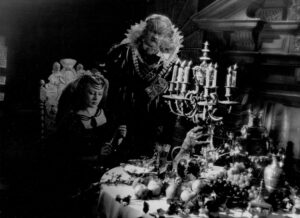
Henri Alekan’s cinematography employs soft light and gauzy grayscale saturation. Alekan’s work will be familiar to regular viewers of Turner Classic Movies, from pictures such as “Anna Karenina” (1948), “The Wages of Sin” (1956), and especially “Roman Holiday” (1954). Scenes in Bête’s world recall Gustave Doré, especially the forested approach to his castle, which looks much like Doré’s etching “La Belle au Bois Dormant.” Bête’s castle’s interior is very dark, except in those areas where it is very intentionally light. In a masterstroke, candelabra lighting affixed to the walls by seemingly disembodied human arms line Belle’s approach to Bête’s banquet hall. Creepy child-sized faces lodged in the walls stare at her, one of them installed atop a pedestal shaped like a coffin. Roger Ebert described this well:
“Those familiar with the 1991 cartoon will recognize some of the elements of the story, but certainly not the tone. Cocteau uses haunting images and bold Freudian symbols to suggest that emotions are at a boil in the subconscious of his characters. Consider the extraordinary shot where Belle waits at the dining table in the castle for the Beast’s first entrance. He appears behind her and approaches silently. She senses his presence, and begins to react in a way that some viewers have described as fright, although it is clearly orgasmic. Before she has even seen him, she is aroused to her very depths, and a few seconds later, as she tells him she cannot marry – a Beast! – she toys with a knife that is more than a knife.
The Beast’s dwelling is one of the strangest ever put on film – Xanadu crossed with Dalí. Its entrance hall is lined with candelabras held by living human arms that extend from the walls. The statues are alive, and their eyes follow the progress of the characters (are they captives of the Beast, imprisoned by spells?). The gates and doors open themselves. As Belle first enters the Beast’s domain, she seems to run dreamily a few feet above the floor. Later, her feet do not move at all, but she glides, as if drawn by a magnetic force (This effect has been borrowed by Spike Lee.) She is disturbed to see smoke rising from the Beast’s fingertips – a sign that he has killed. When he carries her into her bed chamber, she has common clothes on one side of the door and a queen’s costume on the other.”
Were the Freudian undercurrent (or indeed the current) not clear enough, in commuting between town and castle, Belle rides an autonomous white stallion. The ghostly white horse providing her conveyance is named “Magnificent.” Forgive your reviewer if his mind’s ear then supplied the Lana Del Rey song “White Mustang!” The opera opens with an archery contest between the young men, during which Marais’ Avenant accidentally fires an arrow into a room occupied by the women. Boing!
Votre regard me brûle
Since Greta Garbo had retired by 1946, choosing a better subject as Belle for Alekan’s photography than Josette Day would be impossible. Indeed, the lighting in scenes where the two protagonists approximate themselves recall William Daniels’ photography and lighting of Garbo and John Gilbert in “Flesh and the Devil” (1926). Day’s lambent eyeballs seem to warm the entire frame in a Petrarchan mist, paradoxically both filmy and crystal clear. Beneath acres of softly lit blonde tresses, she flows through every scene, even the ones back in town where her insufferable family and her human suitor live. No less lucent, though in a glassier way, are Marais’ eyeballs in his Beast costume. Day puts those peepers of hers to poleaxing erotic effect in a scene where Marais drinks water from her hands; she has previously spied him lapping from a pond in feline manner. A hazy closeup of her face radiates sublimated desire. We feel her thrill at listening to Bête’s voice, whisky poured over gravel, like Tom Waits but en Français — that is, if you have the benefit of the movie’s original audio. The least special of all the effects occurs at the end when Marais rises from the ground, above the Beast’s crumpled body, clearly with the film running backwards (Atlanta’s audience howled). Now metamorphosed into Prince Ardent (still looking like Avenant, her suitor from town), he questions Belle if she loved Bête (“oui”) and seems aware of her apparent disappointment that it is now him, rather than Bête. Her “oui… no” convinces no-one of the latter half of that utterance.
Marais’ Ardent, a nearly plastic-looking French Ken doll, exudes a who-cares handsomeness beneath a salon of coiffed hair. Long-term opera fans might see in him a vague resemblance to Hermann Prey, but more sterile. Though Belle manages to muster some woo for princely Ardent as he carries her, bridal-threshold style, before they levitate away into a cloud, the viewer cannot help but feel a loss at the Beast’s evaporation. Again one is reminded of a musical movie that looks sort of like an opera if you squint at it: Jacque Demy’s “The Umbrellas of Cherbourg.” Concerning this film, Jim Ridley asked, “Is this the saddest happy ending in all of movies, or the happiest sad ending?” The “happy ending” for Cocteau’s Belle contains powerful but unexpressed sorrow. She is going to miss that scraggly half-lion for the rest of her life. And how disappointing it must be for Belle to be expected to couple physically with such a sterile-looking specimen after weeks of acclimating to eye-copulating with his raggedy leonine double. Prior to the close, she weeps when telling her dying father how intrinsically good Bête is, her tears falling as diamonds. And just wait till the mirrors get involved! Your reviewer has commented before on a through line of Zvulun’s opera stagings: a nearly obsessive concern with vision as a motif. No staging here occurred, but Glass’ operatic delivery of Cocteau’s movie continues the idea. Belle sees Bête’s soul and rates it even lovelier than everyone else views her extremely pleasing face.
Cocteau’s film, which makes Disney’s look like “See Spot Run,” vibrates with the mythic resonance of the fairy tale: that story both more recent than you may think and also ancient in its DNA. In 1740, Gabrielle-Suzanne Barbot de Villeneuve anonymously published its oldest variant, before it was semi-lifted and abridged 16 years later by Jeanne-Marie Leprince de Beaumont. The social work the story was to perform was easing the anxieties of previously sheltered young women who had been herded into arranged marriages and abruptly confronted with male sexual desire. Unlike most of its mythic predecessors, Belle’s family are fiscally illiquid merchant class, not peasants. But the basic form of the legend grows in the mythic soil of many cultures, classed Aarne-Thompson type 425C, a subtype of “The Animal as Bridegroom,” among whose antecedents’ include the famous Cupid and Psyche myth of Greco-Roman antiquity, most famously rendered in Apuleius’ “Metamorphoses.” The Metropolitan Opera’s color commentator on radio, William Berger, argues that opera’s fundamental artistic action is transformation, and here “La Belle et la Bête” passes the operatic litmus test with flying colors. Glass’ opera enacts transformation, though it depends on Cocteau’s film to provide it.
Belle, écoutez-moi
TAO’s presentation of the music pleased the ear. Classical music lovers apply the same quip to Glass’ music that one hears too of Mozart: “too easy for the amateur and too difficult for the professional.” Maestro Ryan McAdams commanded well the paradoxically hyper-ordered chaos Glass puts on the page, all the counting and additive voicing. The live-to-film synchronization worked perfectly, which has just as much to do with Glass’ mathematical how-to as with the conductor’s. Orchestral balance reached the first balcony, and breathed life into Glass’ orchestration, which you have to communicate with verve to make it breathe. Sometimes, one wonders if Glass’ detractors have mainly heard stillborn renderings of his music. Every time I’m in the audience, Glass’ music slaps.
Just four singers populate this work, only one of them singing a single role — The Girl. A mezzo-soprano — not a soprano, which is interesting and perhaps a nod to Debussy’s Mélisande by Glass — Kayleigh Decker portrayed Belle. Her sunny timbre enlivened a character who is supposed to act as a Petrarchan angel, lighting Bête’s dark, forested world. Her vocal production was superb, audible in the balcony, though it often seemed marked piano. She offered nearly weightless sopranistic float in Belle’s closing declarations of love for her human beau.
Soprano Alexis Seminario has had to carry two roles back-to-back-to-back recently. This “La Belle et la Bête” was bookended, both the night before and the following afternoon, by TAO’s delivery of Francesca Zambello’s “La Traviata,” where Seminario plays Annina. Between these performances, Seminario portrayed Belle’s transparently wicked not-even-step sisters, Félice and Adèlaïde, who flirt with her suitor Avenant, dump all the housework on her, bleed their father for fancy clothes and jewelry, and eventually steal the magic key Bête has given Belle, planning to access his castle and sic their brother on him. Seminario thus skillfully executed quite a change of gears from patting a dying Violetta on the head in “La Traviata!”
Baritone David Crawford ably played the rest of Belle’s cartoonishly malign family, like Seminario also performing the Verdi-to-Glass pivot: he also serves as Violetta’s Dr. Grenville. Glass requires the baritone to play three positions: Le Pére, who’s horticultural larceny incarcerates Belle in Bête’s castle in the first place; her pugilistic brother Ludovis (Ludovic in the film); and a minor character called “L’Usurier,” who transacts the insolvent family’s furniture.
Baritone Hadleigh Adams, like his colleagues, also made a stop in Paris, playing Verdi’s Marchese D’Obigny, before arriving wherever in France “La Belle et La Bête” is supposed to take place. He racked up two minor roles in addition to Avenant and Bête. Adams often sounded refined in the manner of chanson (art song). His main role is tough. It was seemingly easy for Glass to make Belle sound beautiful. Making Bête sound beastly apparently made for a harder lift.
The opera probably works better if one has not heard the film’s original audio. Glass’ music sometimes works with the film and sometimes does not. In general, one can apply a Justice Potter standard for “meh” Glass versus “magical” Glass: you know it when you hear it. Scenes in town receive a more pedestrian “Glassian” language, while those in Bête’s kingdom sound more magical, which makes sense. But even then there are strange disjunctures. As Le Pére approaches the castle, the music sounds more majestic but less stormy in the stormy forest than it does at the castle itself. But there are always characteristically Glassian moments that thrill, like the descending brass figures that introduce Bête’s proposal that Belle to come stay with him instead of his mauling Le Pére in punishment for theft. Perhaps the best moments in Glass’ entire score occur when the opera meets water — because this is Glass, encountering water was only a matter of time. Other than perhaps Debussy, no-one writes music that portrays water better than Glass, such as the closing track of “The Hours,” which ushers the Virginia Woolf character to her aquatic suicide. Chromatic whirlpools swirl as Bête slakes his thirst, whether from the pond or from Belle’s hands.
Outre que je suis laid, je n’ai point d’esprit
For your reviewer, the overall effect of Glass’ opera was to rekindle interest in Cocteau’s film. Perhaps my own obtuseness obscured Glass’ point, which his website helpfully explains in a synopsis that refrains from synopsizing a story that many people probably know in one form or another:
“A subtle reflection on the life of an Artist, Philip Glass’ second opera based on works by Cocteau, in its original version performed in conjunction with the projected film (with the original version soundtrack eliminated entirely). Presented as a simple fairy tale, it soon becomes clear that the history has taken on a broader and deeper subject – the very nature of the creative process. Through an extraordinary alchemy of the spirit, the ordinary world is transformed into a world of magic. The power of the creative and the raw world of nature, represented respectively by Beauty and the Beast, finally emerges and allows the world of imagination to take flight.”
This might emerge more clearly in presentations of the opera that do not screen the film. The Freudian over- and undertones of Cocteau’s movie and its delicious visuals overwhelm any allegory about “the very nature of the creative process.” If this was lost on your reviewer, it is probably a safe bet that it also eludes patrons who shout “friend zone” in the middle of the opera.
Pouvez-vous me jurer de revenir dans une semaine
TAO producing this work is nevertheless deeply appreciated. Glass approaches his 89th birthday early next year, and completist approaches to his body of work should not wait until we lose him. Every chance to hear his music should be acted upon. Zvulun, usually visible in the lobby or the donor lounge, was away in the Sunshine State with his staging of Kevin Puts’ “Silent Night” at Florida Grand Opera. But in a prerecorded video address to the audience, he directly made the case for first time attendees at “La Belle et La Bête” who came for the fairy tale to stay for one of TAO’s mainstage productions of conventional opera. Surely TAO’s ticketing data can track whether that occurs, and “Turandot,” appearing in April 2026, contains a hit song Luciano Pavarotti made familiar to everyone and their dog. To this day, Pavarotti’s “Nessun Dorma” counts the most views of any classical music video on YouTube. The Atlanta Opera remains such a fun place to experience the artform and its step sibling, musical theater, whether Guiseppe Verdi, Giacomo Puccini, Jerry Bock, or Philip Glass. Let us run it back in 2026, with the close of TAO’s “Ring Cycle.”