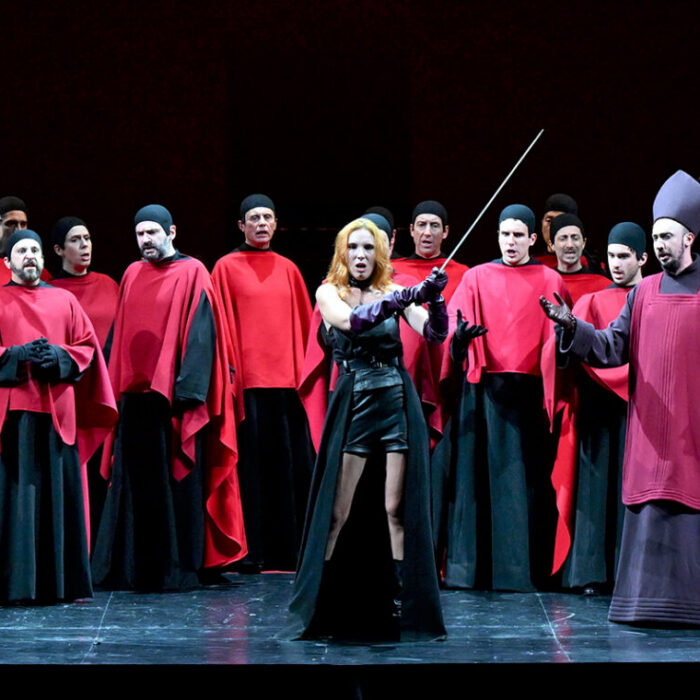
Opéra de Montréal 2025-26 Review: Carmen
By Ossama el Naggar(Photo: @Vivien Gaumand)
“Carmen” is one of the most perfect operas in the repertoire. It features an inspired setting, a marvelous orchestration, spirited vocal parts, and most of all, intense drama. It was highly admired by no less than Gustav Mahler, who championed the work while Director of the Vienna Court Opera. It’s thought of as an indestructible work, a glorious stage success, no matter how it’s served: a mezzo or a soprano Carmen; spoken dialogue or sung recitatives; set in its authentic Seville; during the Spanish Civil War, the Mexican Revolution or even the circus. A case in point is Otto Preminger’s powerful film, the musical‑comedy adaptation “Carmen Jones,” set in the segregation‑era Southern U.S.
Production Details
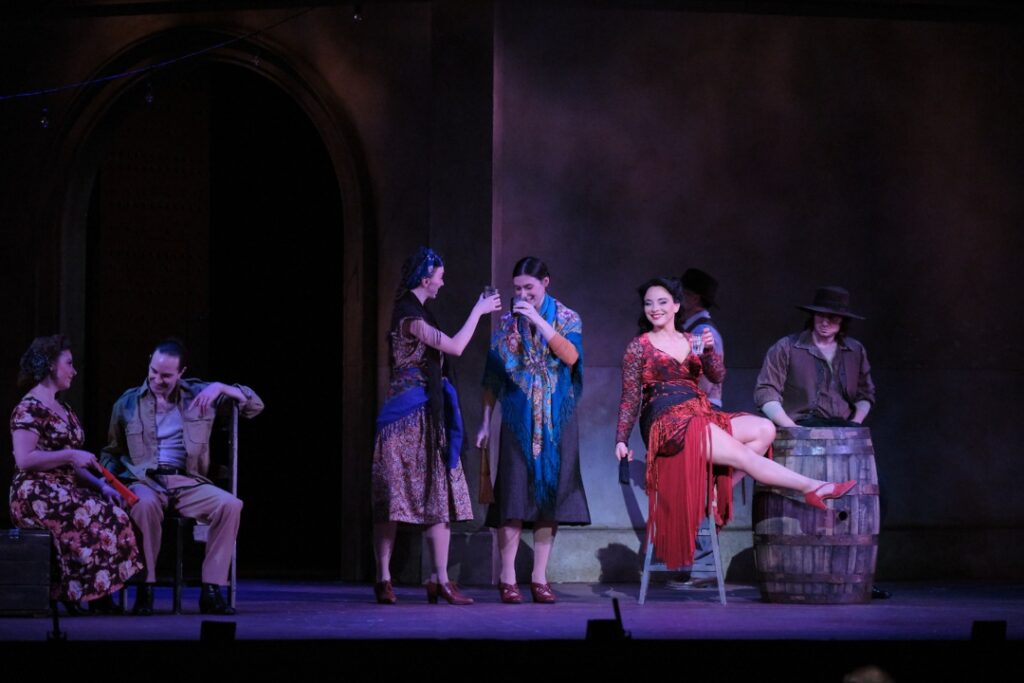
The staging of “Carmen” is problematic, as directors have variously designated Carmen as overly liberated, a dissolute criminal or even a prostitute. Such portrayals are neither true to the opera’s libretto nor its source, Proper Mérimée’s 1845 novella. These choices can result in a protagonist hard to sympathize with. Moreover, the mutual attraction between such a Carmen and a naïve Don José fresh from the countryside becomes implausible. The ingénu Don José may well lust for such a Carmen, but is unlikely to fall madly in love. Fortunately, Anna Theodosakis’s staging (seen May 12) was a sober one that was true to the opera’s libretto. Carmen is a strong woman who does not want to feel subjugated in a violent, oppressive male-dominated society. Being a woman of Greek (Mediterranean) background may have informed Theodosakis to create one of the most credible productions of Bizet’s opera that I’ve ever seen. The Toronto-based director chose to transpose the setting to Franco’s Spain of the 1940’s, but did not use the production as a political manifesto to condemn authoritarianism, as Calixto Bieito did in his Paris production.
(Photo: @Vivien Gaumand)
One aspect was Theodosakis’s emphasis on the solidarity between Carmen and her two friends Mercedes and Frasquita. Thanks to the excellent and natural acting of the three, this alliance was convincing, even touching. It also seemed natural, like much of the opera’s action. For example, rarely have I seen crowd scenes, replete with children (in the first act and at the beginning of the fourth) acting so well, and with such natural movement. The director’s gift with the crowd in turn helped enhance the qualities of the main characters. The way the soldiers and Carmen’s cigarette factory co-workers reacted to her boosted her charisma. Likewise, the women falling for Escamillo in the second act established the toreador’s charm. Another intelligent idea was to divide Act three’s card trio into a light-hearted duet between Mercedès and Frasquita and a somber solo for Carmen, with the former at the extreme right of the stage and the latter at extreme left.
The most glorious part of the staging was left to the very end. The placing of the arena centre stage with the crowd viewing the corrida giving their back to the Montréal public assured us we weren’t distracted; one could only focus on the action in the front of the stage below the walls of the corrida. At the extreme right of the stage, one had a view of the corrida and occasionally Escamillo. When the confrontation between Carmen and Don José occurs, one is riveted by their interaction. Nothing else is of importance, yet it’s clearly there. This was truly a “coup de théâtre.”
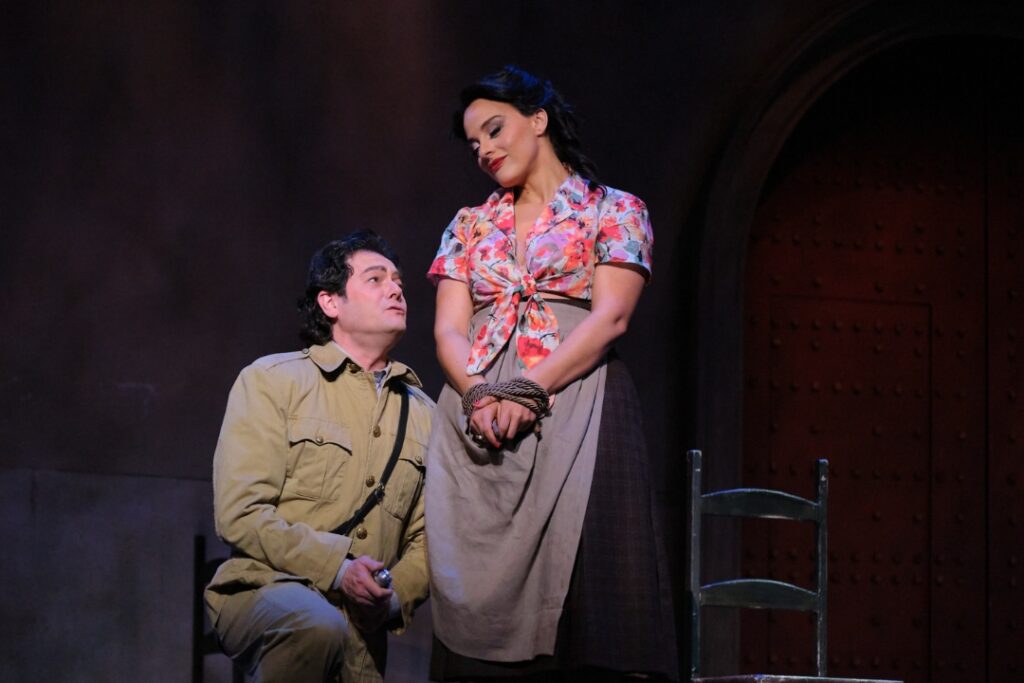
Crucially, Theodosakis understood the nature of the romance between Carmen and Don José. This is what distinguishes a great stage director. According to the libretto, and especially Mérimée’s novella, Carmen had a difficult life. She used charm as a survival skill, to fulfill her needs. She was used to being desired rather than loved. Then comes the naive country boy from Navarra who falls in love with her. When he comes to see her at Lilas Pastia’s tavern after he was freed from prison, Carmen was planning a tryst with yet another admirer. As this one went to prison for her, she intended to pay a debt. However, when he sings the “Flower Song,” there is a transformation; Carmen falls in love, and possibly for the first time. Even after their turbulent relationship was over, isn’t she still wearing his ring in the final scene? Theodosakis is one of very few directors who understands the nature of Carmen’s love for Don José.
(Photo: @Vivien Gaumand)
Cast Highlights
In addition to being a memorably fresh staging of one of the most-performed warhorses in opera history (this was my fourth “Carmen” in less than a year), the cast was mostly impressive, both vocally and dramatically. Tunisian-Canadian Rihab Chaieb was an exceptional interpreter of Carmen. Despite incarnating her as a strong-willed, proud, seductive woman, Chaieb was also adept at conveying her vulnerability, thereby enhancing the public’s sympathy for her. Chaieb was an appropriately seductive protagonist thanks to her magnetic stage presence and excellent acting skills. Mercifully, she eschewed the “femme fatale” act and any hint of vulgarity. This is the pitfall into which many interpreters of the role stumble. Fortunately, Chaieb perfectly inhabited the role of the free-spirited yet dignified gypsy woman. Vocally, Chaieb had the right timbre for the role: warm, powerful and youthful. An intelligent singer, she knew when to use her chest voice to insinuate sensuality and/or determination. At ease in the upper register, she never forced her lower notes. As a native French speaker, her diction was delightful and helped propel her portrayal of the iconic character. Her first aria “L’amour est un oiseau rebelle” was charm and seduction personified, without the vulgarity that many resort to. Her second act “Les tringles des sistres tintaient” was truly titillating, possibly the most appealing aria of the evening, thanks to her feel for its ballabile rhythms. Her interpretation of the scene with Don José in the second act, “Tout doux, Monsieur, tout doux. Je vais danser en votre honneur,” was quite brilliant. The moment José gets nervous hearing the bugles sounding retreat to the camp, she doesn’t immediately turn demonic, as is too often the case. She’s more bewildered, trying to understand and to convince him to stay. Indeed, an honest, rule‑abiding man is a novel specimen for her. Such choices by the singer and the director helped build the character of Carmen and also helped the public to identify with her.
Mexican tenor Arturo Chacón-Cruz is a veteran in the role of Don José. Though endowed with the right timbre for the role, he was not truly convincing. His approximate French didn’t help. For much of the time, he seemed rather wooden, which may have been acceptable in the first act, but makes this anti-hero unsympathetic in the rest of the work. Though he had the right timbre and was capable of reaching the notes, his voice was unattractive in the upper register. Nonetheless, his interpretation of Don José’s signature aria, “La fleur que tu m’avais jetée,” was moving. Like many tenors, Chacón-Cruz opted to forgo the final diminuendo, which was probably a wise choice.
Lyric soprano Magali Simard-Galdès was a lovely Micaëla, an often dull role, especially when juxtaposed with the overwhelming Carmen. Bizet’s assignment of overly serene music to Micaëla makes her so angelic that she has no chance against the sultry Carmen. In many productions, a tepid Micaëla seems most appropriately destined to become a nun. Not so in this case. Simard-Galdès’s Micaëla was serious and reserved, but also proud and solid. Thanks to her impeccable diction, beautiful phrasing, ease in the upper register and natural acting, this was one charming country girl. Her third act “Je dis que rien ne m’épouvante” was both luminous and moving.
American baritone Ethan Vincent was an imposing Escamillo, thanks to his huge stage presence and charm, both essential for this role. Escamillo, despite the brevity of the role, is not an easy one, as it requires both high and low notes. It’s truly a bass‑baritone role, and few baritones sing with ease in the lower register. Vincent had no problem with the lower notes, but he tended to sing too loudly, which was both inelegant and irritating. Nonetheless, his Toreador Song, “Votre toast, je peux vous le rendre,” elicited huge applause. The choreography of this aria and the toreador’s interaction with his many admirers was truly remarkable.
Almost all the minor roles had impeccable diction, which made them convincing. Tessa Fackelmann and Emma Fekete stood out as Mercedès and Frasquita; they conveyed their friendship for Carmen with aplomb, rendering their characters real and affecting.
Conductor Jean-Marie Zeitouni led the Orchestre Métropolitain with gusto. He’s an outstanding conductor, especially of opera, with an obvious affinity for French music and a vast knowledge of vocal repertoire and history. He illuminated Bizet’s orchestral coloring. These passages, especially the Entr’acte that begins the third act, was a pure delight. Likewise, the second act’s quintet, “Nous avons en tête une affaire… Et nous avons besoin de vous,” was truly glorious. With its syncopation, it was years ahead of its time: it’s at once melodious and complex in an avant‑garde way. With this capable ensemble, Zeitouni masterfully conveyed the music’s modernity.
The Opéra de Montréal ended its season in a truly sensational fashion! Bravi!