The Croatian National Theatre in Zagreb 2025–26 Review: Tannhäuser
By Karlo Radečić(Photo credit: Mara Bratoš / HNK Zagreb)
According to a diary entry by Richard Wagner’s wife Cosima, in January 1883 – three weeks before his death – the composer thought he still owed his “Tannhäuser” to the world. To his mind, this “große romantische Oper,” first performed in Dresden in 1845, had never acquired a definitive form.
The Croatian National Theatre in Zagreb has owed “Tannhäuser” to its audience since October 1931, when the final performance of the 1930 production took place. In all 14 performances of that staging Elisabeth was sung by Zinka Milanov (then Zinka Vilfan-Kunc), whereas in 1898 the Zagreb audience had seen Milka Trnina (Ternina) in that role.
Following those of “Norma” and “Aida,” “Tannhäuser” is the final new production of an ambitious season at the Zagreb Opera (Drama and Ballet are the other two artistic units of the Croatian National Theatre). As usual, the production is double-cast, with Elisabeth of the second cast, as well as Wolfram and Venus of the first, being sung by the Zagreb Opera ensemble members Valentina Fijačko Kobić, Ljubomir Puškarić, and Sofija Petrović.
This review covers the opening night (May 15) and the third performance (May 18), both featuring the first cast. Seeing the premiere cast twice confirmed my belief that two opera performances are never quite the same, even with the same singers and conductor. While on opening night Act one occasionally sounded under-rehearsed, and its energy was more a dress rehearsal than a premiere, the third performance had quite a different “temperature,” with various aspects sounding much better.
Between Sensuality and Spirituality
In “Tannhäuser” Wagner depicts the contrast between the world of sensuality and the world of spirituality. In his 1861 essay on Wagner, Charles Baudelaire described the work as representing “the fight between the two principles that have chosen the human heart for their primary battleground, that is to say, between the flesh and the spirit, Hell and Heaven, Satan and God.” While the sensual is embodied in Venus, the spiritual is usually thought to be personified by Elisabeth. More convincing, however, is the opinion of musicologist Werner Wolf that Elisabeth’s position is between the sensual passion of the Venusberg and the abstract love and spirituality of the Wartburg knights and the Rome pilgrims. The cause of Tannhäuser’s crushed spirit is, according to Wolf, his sensual desire for Elisabeth.
Indeed, in the second act, Elisabeth’s behaviour changes between the first two scenes – where she is alone during her aria “Dich, teure Halle” or with Tannhäuser in their duet – and the fourth scene, the act’s grandiose finale, where she is surrounded by the ossified society of Wartburg. In this finale there is a concertato and a final stretta, drawing on the conventions of 19th-century Italian opera (and the French grand opéra influenced by it). The concertato, “Ein Engel stieg aus lichtem Äther,” is introduced by Elisabeth’s solo, “Ich fleh für ihn, ich flehe für sein Leben,” in which she pleads for Tannhäuser’s life after he has been ostracized for singing in praise of the Venusberg during the song contest.
Tannhäuser as Composer
The antagonism between the artist and society was the focus of Frank Van Laecke’s direction. The production is neither traditional nor inclined towards extreme “Regietheater.” Van Laecke imagines Tannhäuser as a composer, alluding to Wagner himself, as the title character, barefoot and wearing headphones, “recreates” the music of the celebrated overture. Before we hear the music, though, his pantomime is annoyingly long. The set design by Philippe Miesch (who is also the costume designer) is minimalistic, especially in the third act. The production is most interesting in its depiction of the Venusberg in Act one, where a fairly classical and visually captivating representation of Venus’s grotto is combined with contemporary costumes and stage props.
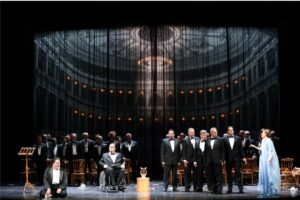
At the beginning of the performance, Venus is seen in bed wearing a red dress, while Tannhäuser, surrounded by spotlights, is about to sit in an armchair. Some sort of spiritual union of the title character and Elisabeth is shown when she wears his headphones and sits in his armchair in Act three, which features no other set design elements except for the spotlights (for a moment, Venus does the same in the first act). For most of the first two acts, a theatre auditorium can be seen in the background of the stage, allowing one to interpret the song contest in Act two as theatre-within-theatre. A music stand and numerous wooden chairs for the Wartburg nobility and the contestants are what is additionally seen in that act. A Shepherd Boy singing from the theatre balcony in Act one and Venus from one of the boxes in Act three proved to be a sonic attraction.
Despite the contemporary costumes and set designs, Van Laecke’s approach is for the most part faithful to the libretto. Although Act two is visually rather bland, and some directorial choices seem naïve (such as Tannhäuser “composing” while wearing headphones, with sheet music scattered across the floor) or clichéd (Hermann, Landgrave of Thuringia, appearing in a wheelchair), for a non-traditional production, it remains quite unobtrusive.
German Romanticism in Music
Srba Dinić conducted the so-called Dresden version of the work, which is not identical to the one heard at the world premiere in that city in October 1845, since Wagner introduced a few changes in 1846 and 1847 (in the original version, Venus did not sing in Act three). The standard cut in the duet of Elisabeth and Tannhäuser was observed, but there were some questionable additional cuts in the score. In Act one, fewer than the final 50 bars were heard of the entire first scene, the protagonist of which is the orchestra, while during the song contest in Act two the audience was deprived of Walther von der Vogelweide’s solo (as well as Tannhäuser’s preceding reaction to Wolfram’s singing). The full title of the opera is “Tannhäuser und der Sängerkrieg auf Wartburg” (“Tannhäuser and the Song Contest on the Wartburg”). Without Walther’s solo, which is both short and beautiful, the intensification of the contest controversy during the performances of Tannhäuser’s fellow minstrels and during his replies is undermined. In the 1861 Paris version of the score, Wagner omitted Walther’s solo only because the singer assigned the role was inadequate. In this production, however, the role of the famous Minnesänger is sung by Filip Filipović from the Zagreb Opera ensemble, a rising young tenor who has already successfully portrayed major roles in the operas of Mozart, Verdi, Bellini, Donizetti, and Puccini.
“Tannhäuser” is an opera that sounds unmistakably Wagnerian, but with a recognizable echo of the music of Carl Maria von Weber, Heinrich Marschner, and Felix Mendelssohn. Srba Dinić was successful in achieving the character and often transparent textures inherent to German Romanticism of the first half of the 19th century. The orchestra, which generally played very well throughout the evening, though often without sufficient nobility of sound in the violins, was perhaps at its best in the prelude to Act Three and during Tannhäuser’s Rome Narration. Among the orchestral solos, that of the bass clarinet during Elisabeth’s aria, “Allmächt’ge Jungfrau,” in the same act stood out. In the overture, however, the famous broken triplet figures in the violins were not properly balanced with the pilgrims’ chorus theme in the trombones, but the balance was improved during their appearance at the end of the opera. During ensembles and chorus scenes, as well as when some of the soloists were erratic in following the tempo, Dinić skilfully managed to coordinate the pit and the stage. The stage music was prerecorded.
The Highlight of the Cast: Elisabeth
Although Evelin Novak, an ensemble member at the Staatsoper Unter den Linden in Berlin, was born in Croatia, this was her first opening night at the Zagreb Opera, where she had previously performed as Mimì in “La Bohème.” Making her role debut as Elisabeth, she deeply immersed herself in the character – fully, in fact, considering how she sang in Act two during her second performance. When it comes to both singing and acting, she was undoubtedly the strongest link of the premiere cast.
Her warm and rich lyric soprano was capable of both tender piano singing and executing a secure and powerful high B natural on the words “Haltet ein!” while protecting Tannhäuser in the Act two finale. Another secure high B was heard earlier near the end of “Dich, teure Halle.” Novak was especially poignant during Elisabeth’s solo leading to the finale’s concertato; after she sang the line “daß auch für ihn einst der Erlöser litt” twice (saying that the Saviour once suffered for Tannhäuser, too), tears were visible on the singer’s cheeks during the third performance. It is indeed rare to encounter a rendition of a solo that is both beautifully sung and so deeply and sincerely felt, with the singer herself being profoundly and visibly touched by the music. During the prayer “Allmächt’ge Jungfrau” in Act three, in which Elisabeth asks for her death in order to save Tannhäuser’s soul, she succeeded in maintaining clear intonation and achieving an appropriate dynamic range. She was also distinguished by her excellent German diction.
In the role of Wolfram von Eschenbach, Ljubomir Puškarić’s baritone was at its best in passages written in the style of Lied, where his pleasant timbre, ease in the upper register, and ability to sing legato in the bel canto tradition were most noticeable. This was evident both during his solo “Als du in kühnem Sange… War’s Zauber, war es reine Macht,” which introduces the ensemble of the Act one finale, and, most notably, in Wolfram’s famous Act three aria, “O du mein holder Abendstern,” which stood out as the highlight of Puškarić’s interpretation. Although his acting was not always equally refined, in the last act in general and this aria in particular, he succeeded in combining considerable technical control with warmth of performance.
Canadian tenor Eric Laporte sang the grueling title role. At first, his pleasant, bright-timbred voice might have seemed too lyrical for the part. Indeed, some of the notes in the upper register, such as those in the concertato of the Act two finale, seemed mannered and sung without sufficient power. Although his breathing technique – challenged by the brisk tempo of “Dir töne Lob!” in the first act – initially gave rise to certain doubts, he sounded fresh and was both vocally and dramatically very convincing in Tannhäuser’s Roman Narration in Act three, in which his interpretation of the title role was at its peak. He was most memorable when citing the words of the Pope, who did not want to pardon Tannhäuser’s sin of tasting the pleasures of the Venusberg. Although lyric, his voice was generally well-projected. Laporte was quite attentive to the delivery of the text when saying the names of Elisabeth and, in Act one, the Virgin Mary.
Sofija Petrović looked every bit the attractive and seductive Venus. Her dramatic mezzo sounded appealingly dark and she offered some powerful high notes, including high B and B-flat. Her voice was well-projected, with the sole exception of middle C and the register just above it.
Despite an occasional shaky vibrato, Sorin Coliban was successful in portraying the authoritative figure of Landgrave Hermann. His voice is a rich and dark bass. The roles of Walther and the Shepherd Boy were beautifully sung by the already mentioned Croatian tenor Filip Filipović, who brought stability and a special brilliance to the ensembles, and by young Croatian soprano Petra Cik, a member of the theatre’s Operatic Studio. As Biterolf, bass-baritone Ozren Bilušić was dramatically convincing, if vocally a bit nasal during the song contest. The roles of the two remaining minstrels were adequately performed by Ivo Gamulin and Siniša Štork.
The Zagreb Opera Chorus was diligently prepared by chorus master Luka Vukšić. Despite the singers being positioned too deep onstage, the pilgrims’ chorus in the first scene of Act three did not fail to excite, highlighted by a powerful tenor sound during the two “Halleluja!” exclamations.
Despite certain flaws, the third performance of “Tannhäuser” in the beautiful 1895 building of the Croatian National Theatre in Zagreb – commemorating the 85th anniversary of the death of Milka Trnina – proved, for the most part, to be a gratifying experience, elevated by Evelin Novak’s moving portrait of Elisabeth.
It was touching to hear spontaneous comments from several Zagreb Opera artists about how the late, renowned Croatian conductor Nikša Bareza is missed. He conducted the last three Wagnerian premieres in the theatre – “Parsifal” (2011), “Lohengrin” (2013), and the “Urfassung” of “Der fliegende Holländer” (2018). Now, “Tannhäuser” is back, too.