Teatro Real de Madrid 2025-26 Review: Carmen (Cast A)
By Galina Altman(Credit: Javier del Real)
There are operas that survive by turning into monuments–and others by remaining dangerously alive. “Carmen” belongs to the second category. It refuses preservation. It resists comfort. And every so often, a production appears that reminds one why this work still unsettles rather than reassures.
Production Details
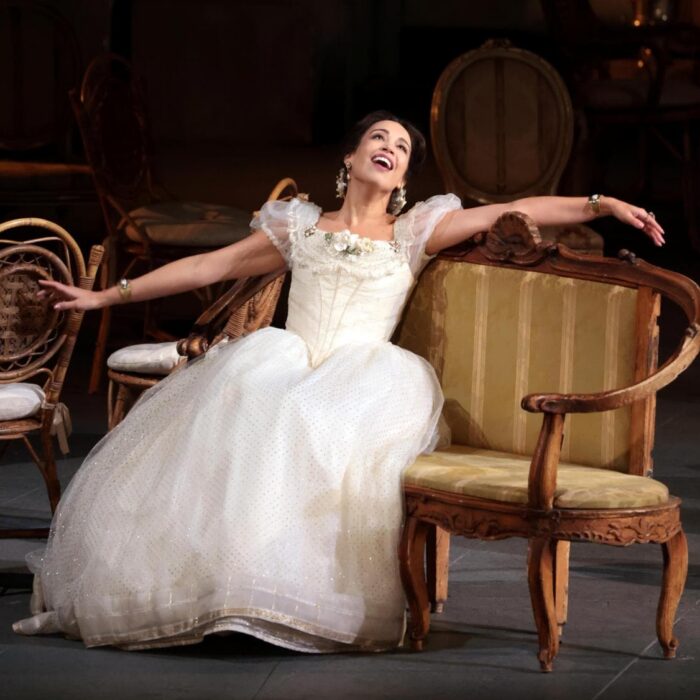
Damiano Michieletto’s “Carmen” at Teatro Real is one of those rare moments. It does not announce itself as a radical reinterpretation, nor does it rely on provocation. Instead, it performs a quiet but decisive act of removal. What disappears first is the aesthetic anesthesia that has long softened Bizet’s opera: the folkloric varnish, the ornamental “Spanishness,” the romance of danger viewed safely from a distance. What remains is a story stripped to its psychological core.
Michieletto, a Venetian by birth and a realist by artistic temperament, has long worked in a theatrical language that borrows from cinema rather than from museum opera. His productions do not decorate emotion; they expose it. Here, he deliberately dismantles the postcard version of Carmen–fans, scarlet skirts, ritualized seduction–and replaces it with something more troubling: a social environment shaped by pressure, surveillance, and control.
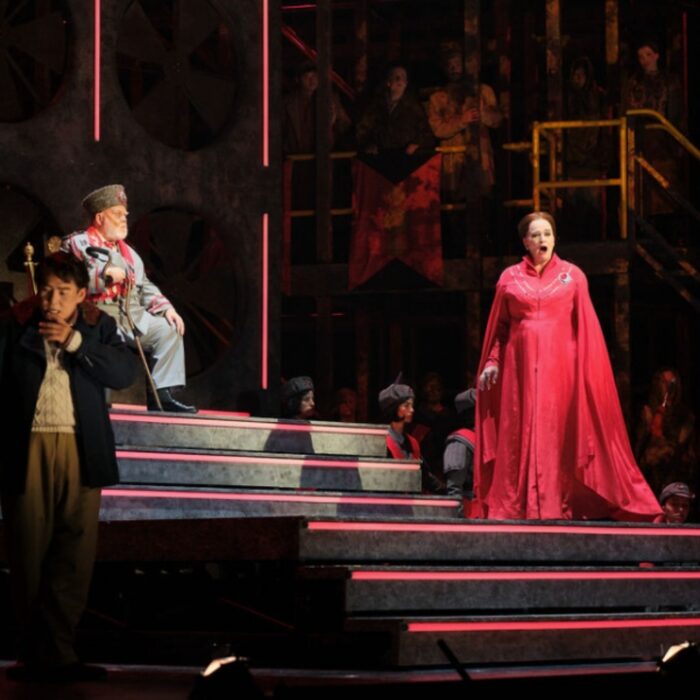
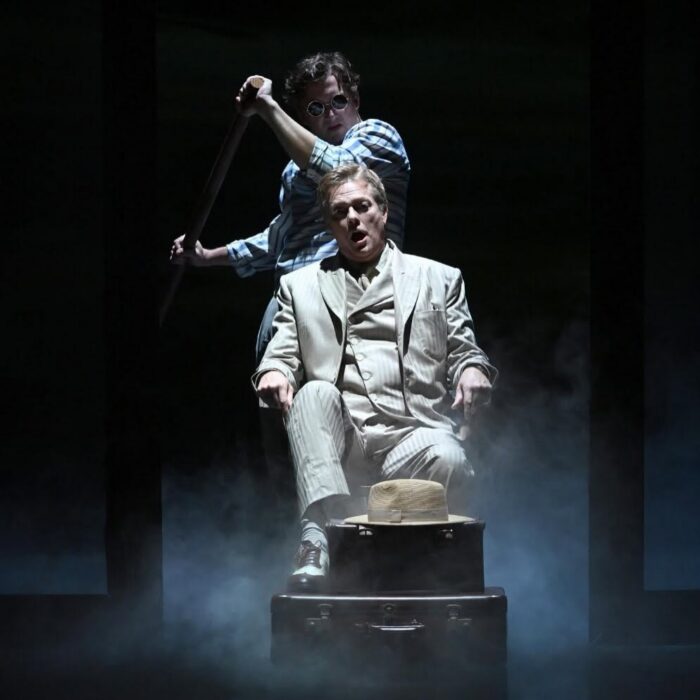
Paolo Fantin’s scenography and Carla Teti’s costumes construct a space that is resolutely non-specific. This is not Seville preserved in amber, but a contemporary landscape of tension–recognizable, transferable, and disturbingly close. The tragedy unfolds not as folklore but as anatomy: of power relations, of obsession mistaken for love, of violence normalized through repetition. Domestic violence is no longer framed as fate or passion; it is shown plainly, without romantic alibis.
This “Carmen” could exist almost anywhere: in the American Midwest of the 1960s, in modern Latin America, or in the moral bleakness of late-Soviet cinema. The staging moves with cinematic rhythm, demanding from its performers not only vocal authority but sustained psychological precision. Nothing is static; every gesture carries consequence.
Musical Highlights
Crucially, the production’s coherence rests not only on its visual clarity but on its musical intelligence. Eun Sun Kim’s leadership from the pit proves fundamental. Her presence at Teatro Real is historically significant–she is the first woman to conduct opera on this stage–but history alone would mean little without substance. Kim offers something rare: a reading of Bizet that is disciplined, lucid, and quietly subversive.
Rather than treating “Carmen” as a sequence of famous numbers stitched together by excess emotion, Kim builds a continuous dramatic architecture governed by inevitability. Her approach avoids both sentimentality and brute force. The overture, strikingly light and almost festive, aligns perfectly with the deceptive normality of the opening scenes. Violence does not announce itself here; it infiltrates.
Under her baton, the orchestra of Teatro Real sounds focused and psychologically alert. Kim’s handling of tempo and balance reflects a deep understanding of the Opéra-Comique tradition for which “Carmen” was written–clarity, elegance, and irony–while allowing a darker undercurrent of fatality to emerge organically. The music does not foreshadow the ending with blunt emphasis. It leads us there patiently.
Kim’s career has followed a path rarely celebrated but immediately audible: discipline, preparation, structural thinking. Born in Seoul, trained first as a pianist, she gravitated early toward composition and then toward the architecture of sound rather than her own individual display. Her decision to study conducting in Stuttgart was not a bid for prestige but for craft. Years spent in rehearsal rooms, archives, and score study inform her work today. There is no desire to overwrite the composer–only to clear away accumulated habits.
That intellectual clarity proves decisive in “Carmen.” Bizet’s score, often treated as relentlessly passionate, regains its complexity. Kim reveals its restraint, its irony, and its fatal logic. The orchestra becomes not an accomplice to excess but a narrative force, shaping the drama from within.
On stage, this musical discipline allows the cast to inhabit Michieletto’s vision fully.
Stellar Cast
Aigul Akhmetshina as Carmen stands at the center of the production not as a femme fatale but as a figure of moral consistency. Her dark, saturated mezzo-soprano conveys gravity rather than seduction. This Carmen does not manipulate; she refuses. Her final rejection of Don José is not theatrical bravado but philosophical clarity. Freedom, here, is not romantic–it is absolute.
Charles Castronovo as Don José charts a chilling transformation. His descent from lyrical vulnerability to psychological collapse reads less as a love story than as a study in obsession. What unfolds is not passion turning violence but entitlement exposed. The final act feels disturbingly inevitable.
Adriana González offers one of the evening’s most striking reinterpretations as Micaëla. Traditionally reduced to moral contrast, she emerges here as vivid, intelligent, and magnetically alive. González’s Micaëla represents not only innocence but an alternative future–one that José actively rejects. This choice deepens the tragedy. He does not lose everything by chance; he refuses it.
Lucas Meachem’s Escamillo moved decisively away from the traditional image of the swaggering, overtly virile bullfighter. What emerged instead was a portrait of contemporary masculinity: controlled, self-possessed, and grounded in musical intelligence rather than physical display. His baritone was firm and evenly projected, with a darkened center and a clear sense of line, allowing the famous Toreador Song to unfold without exaggerated bravura. Spanish critics have noted the restraint of his interpretation, emphasizing how Meachem resists caricature in favor of a psychologically credible presence. This Escamillo does not conquer the stage; he inhabits it. The authority comes from vocal balance and rhythmic precision, especially in ensemble passages, where his phrasing remains attentive to the dramatic context rather than isolated moments of effect. In this reading, masculinity is articulated through control and poise an approach that aligns seamlessly with a modern sensibility and gives the character a quietly compelling relevance.
Michieletto’s “Carmen” ultimately dismantles the opera’s most persistent myths. This is not a story about exotic Spain, nor about destiny, nor even primarily about passion. It is about freedom and about the systems that cannot tolerate it. Carmen’s independence is not alluring; it is threatening. Her death is not a climax but a conclusion.
By removing folklore and restoring psychological truth, this production returns “Carmen” to its radical origins. Bizet did not write a spectacle. He wrote about people who could not live otherwise than honestly.
That is why “Carmen” still hurts.
And why, in Madrid this season, it feels urgently alive.