Komische Oper Berlin 2025-26 Review: Orlando
By Zenaida des Aubris(Photo: Jan Windszus Photography)
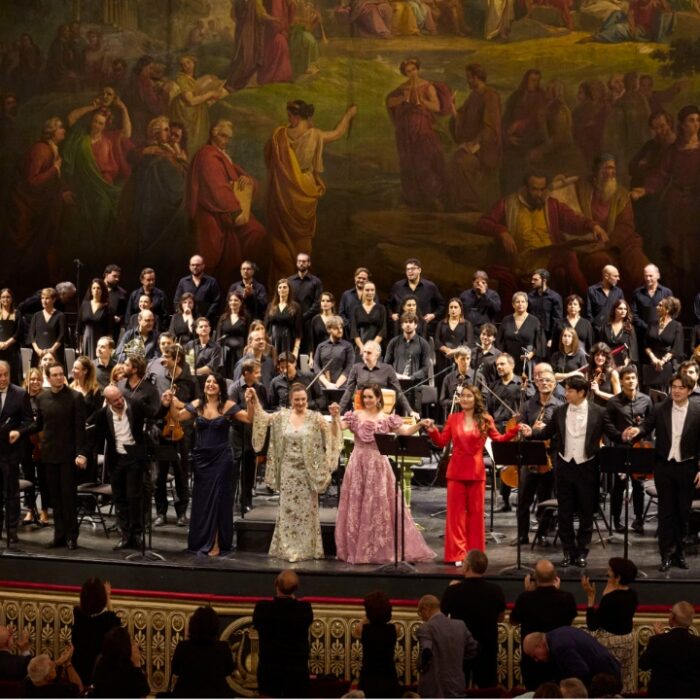
With “Orlando,” Olga Neuwirth has not simply written an opera based on a Virginia Woolf novel, but a sprawling epic that seeks to be everything at once: a parable on gender, a cultural-historical chronicle, a political warning, a queer manifesto, a critique of the media, and a musical panorama of Western modernity. From the very beginning, one senses the immense ambition of this undertaking – and at the same time its struggles to master this enormous mass of themes. Now the Komische Oper Berlin has staged its German premiere, directed by Ewelina Marciniak and conducted by Johannes Kalitzke.
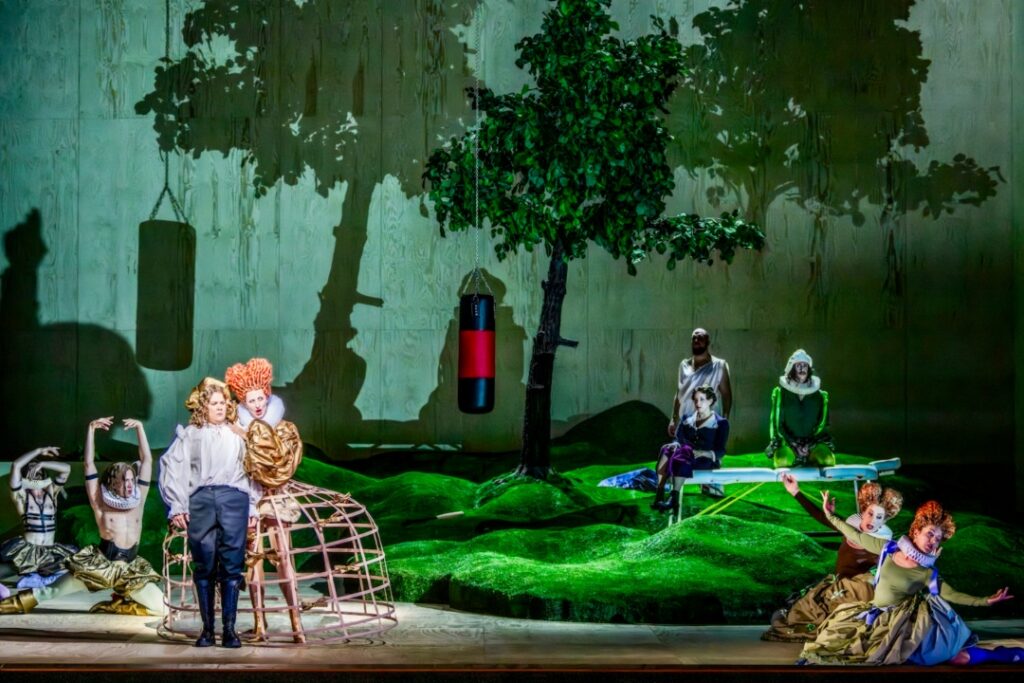
Together with the American playwright Catherine Filloux, Neuwirth has expanded Woolf’s 1928 novel far beyond its original scope. The central character remains: Orlando, initially a young English aristocrat at the court of Elizabeth I, traverses the centuries, experiences love, disappointment, and literary solitude, and ultimately transforms from man to woman. Woolf’s subtle play with gender, identity, and social roles remains the true core of the work and is guided by the narrator — aptly costumed in a Virginia Woolf-style look. Yet where Woolf narrates with lightness, irony, and melancholic elegance, Neuwirth tends toward demonstrative heavy-handed over-clarity.
(Photo: Jan Windszus Photography)
For her work by no means ends after 1928, as the original novel. “Orlando” is sent further through the 20th and 21st centuries: through world wars, the Holocaust, Hiroshima, counterculture, feminism, consumer society, queer debates, and the climate crisis. Hardly any contemporary issue is left out. The libretto relies less on dramatic development than on a check-off list. The dramaturgy becomes episodic; at some point, despite all the visual and musical energy, the evening begins to feel noticeably tiresome.
Neuwirth’s score certainly possesses evocative power. It operates with an enormous apparatus: a large orchestra, several choirs, dozens of soloists and instrumentalists. Stylistically, anything seems possible. Renaissance madrigals appear, Purcell shimmers through, along with hymns, jazz, cabaret, punk, rock, electronic soundscapes, out-of-tune harpsichords, and a storm of percussion effects. Time and music history are, as it were, interlocked.
Yet this constant sonic overstimulation wears thin. The music often knows only escalation, only densification, only commentary. Lyrical moments of calm remain rare. Especially in the first part, there is a lack of pause that allows musical memory to emerge in the first place. One does not miss traditional arias in the conventional sense — but one does miss musical focal points, moments of genuine concentration. Johannes Kalitzke holds this vast musical structure together with admirable clarity, though always too loudly. He not only conducts the masses of sound with precision but also structures them, creating transparency where the score could easily tip into chaos. The orchestra and chorus of the Komische Oper deliver an extraordinary performance.
(Photo: Jan Windszus Photography)
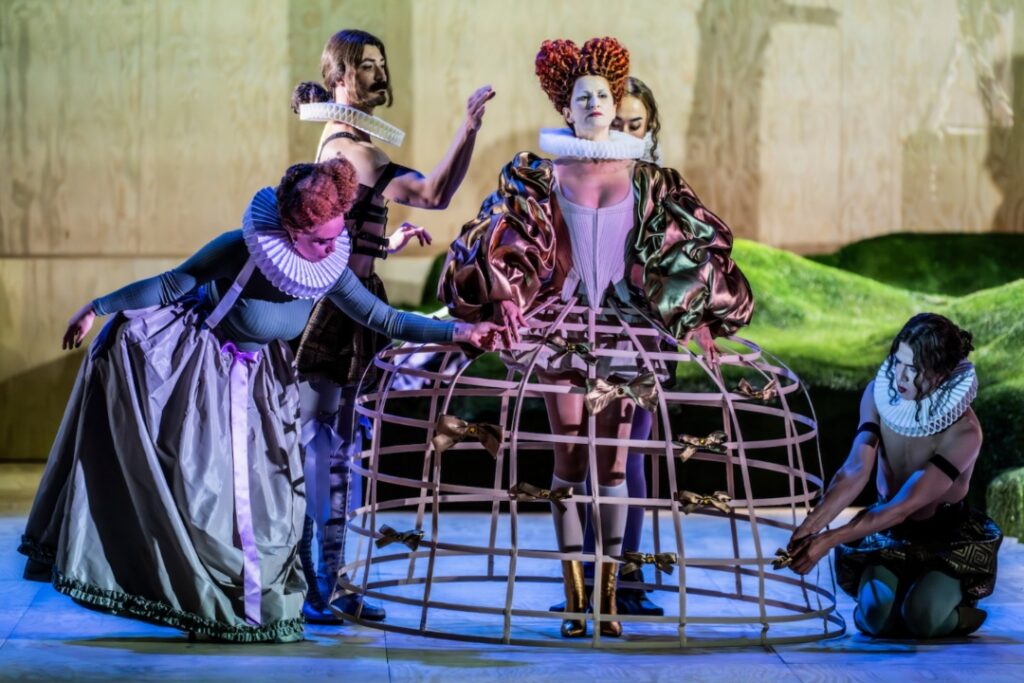
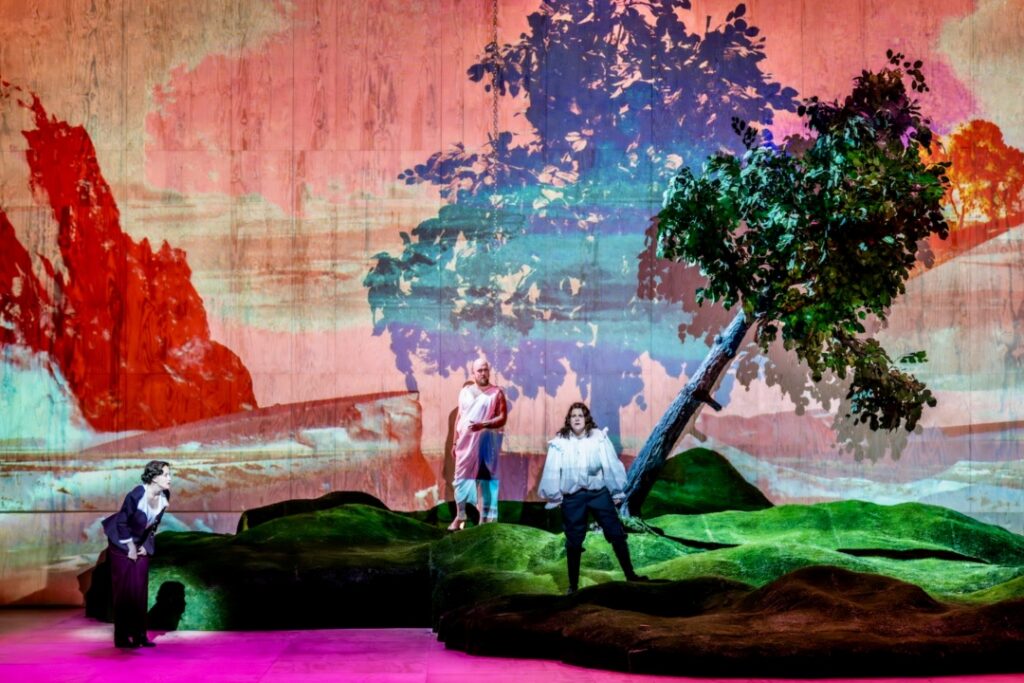
Ewelina Marciniak’s production responds to the wealth of material with an aesthetic of superimposition. Mirek Kaczmarek’s stage space, with its large projection screens, is almost constantly filled with Natan Berkowicz’s videos: images, historical documents, and surreal tableaux flow into one another. Julia Kornacka’s costumes combine historical allusions with postmodern stylistic sensibility. Time and again, powerful, sometimes unsettling images emerge — such as when gender identities are grotesquely exaggerated or war and the consumer world are mirrored within one another.
Yet even the direction occasionally succumbs to the very kind of oversimplification already inherent in the libretto. Much is illustrated, some things are displayed, little is left to the imagination. The constant symbolic overloading eventually exhausts itself. Is it part of the LGBTQ+ brand to only dress up in ornate, over the top costumes? Where is the inner conviction?
Nevertheless, it would be wrong to simply regard “Orlando” as a failure. This work possesses greatness — perhaps precisely in its excess. Neuwirth has not written a pleasing piece of musical theater, but rather an exuberant panorama of our times that strives with all its might for relevance. That this gives rise to overwhelm, repetition, and fatigue is almost an inevitable part of this undertaking.
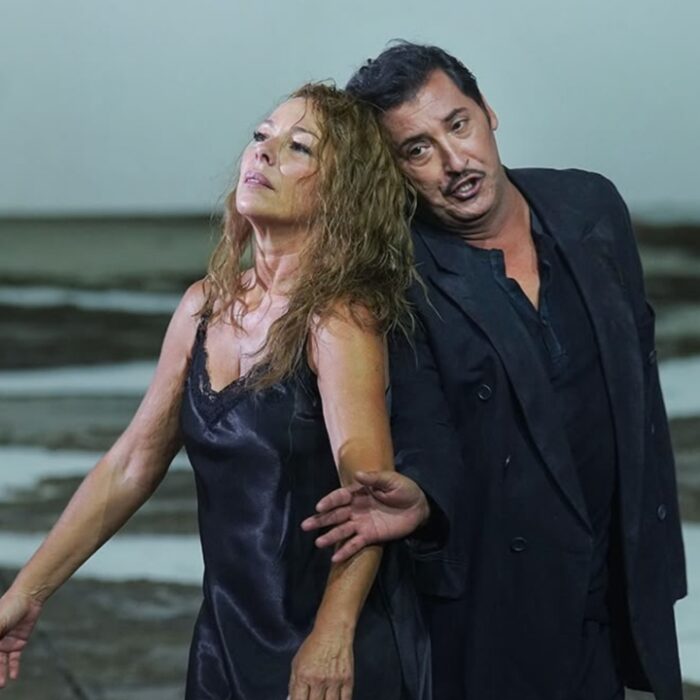
The title role, however, is a challenge that Ema Nikolovska carried with admirable intensity. Neuwirth writes the part as a vocal metamorphosis: the male Orlando initially moves in darker registers; only with the gender transformation do coloratura and bright high notes open up. Later follow spoken-song passages, amplified passages, and almost aggressive rock songs. Nikolovska mastered all of this with technical mastery and remarkable stage presence.
(Photo: Jan Windszus Photography)
The remaining roles were also superbly cast. Baritone Günter Papendell as Shelmerdine combined lyrical warmth with melancholic distance while simultaneously portraying the cynical critic Greene with sharp definition. Soprano Anna Nekhames lent Sasha sensual elegance; mezzo Karolina Gumos portrayed Elizabeth I with impressive dignity. Alma Sadé served as narrator and Virginia Woolf’s alter ego with quiet concentration. Kevin(a) Taylor, as a trans non-binary child in the second part, added striking accents.
In the end, admiration remains, but no real shock. One leaves the evening feeling more relieved that this loud opus is over than moved. Perhaps this is precisely the difference between Virginia Woolf and Olga Neuwirth: Woolf relied on the subtle shifts in perception; Neuwirth, on the other hand, seems to want to ensure that each of her messages is heard at maximum volume.