Teatro Real de Madrid 2025-26 Review: A Midsummer Night’s Dream
Deborah Warner’s Production Illuminates Britten’s Shifting Worlds
By Galina AltmanFour centuries after William Shakespeare imagined a night-time forest where desires dissolve into illusions, Benjamin Britten transformed that world into one of the most enigmatic operas of the 20th century. Now the work returns to the stage of Teatro Real in a new production by director Deborah Warner under the baton of conductor Ivor Bolton–a duo that has repeatedly shaped Britten’s sound at this theater.
The premiere of “A Midsummer Night’s Dream” took place in 1960, and in Britten’s oeuvre it holds a special place. The composer did not so much adapt Shakespeare as “condense” his dramaturgy. Together with tenor Peter Pears, he created a libretto that retains a significant portion of the original play’s text while radically altering the structure of the action. The opera begins not in an Athenian palace but directly in the forest, placing the audience inside a space where conventional logic has already been disrupted.
Musically, Britten constructs the drama through contrasts among three sonic worlds. The fairy world is an almost weightless orchestral texture: harps, celesta, harpsichord, and shimmering strings that evoke moonlight. The world of the lovers is much more traditional–lyrical strings convey an almost romantic passion. The world of the craftsmen, by contrast, is deliberately earthy, with winds and rough rhythms sometimes bordering on parody. The score thus becomes a kind of map of psychological spaces.
Bolton’s return to the podium at Teatro Real is particularly significant. A former music director of the theater, he knows the orchestra intimately and favors clarity over spectacle in Britten’s music. Under his direction, the orchestra revealed the extraordinary transparency of Britten’s score. The delicate interplay of harp, celesta, and harpsichord created an almost weightless sonic atmosphere for the fairy world, while darker orchestral colors underscored the emotional turbulence of the mortal lovers. Bolton avoided excessive romanticism, instead allowing Britten’s intricate orchestration to emerge with remarkable clarity and theatrical precision.
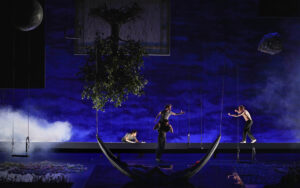
Warner, one of the most intellectually rigorous interpreters of Shakespeare in contemporary theater, approaches the opera not as a fairy tale. Her production abandons the decorative “enchanted forest” and transforms the stage into a rather abstract open space–more a theatrical laboratory than a pastoral landscape. This approach recalls the tradition inaugurated by Peter Brook’s legendary 1970 production, in which Shakespeare’s forest first became symbolic and nearly empty.
At the center of the vocal cast is countertenor Iestyn Davies as Oberon. Historically associated with the voice of baroque pioneer Alfred Deller, Davies performed the role without the usual ethereal detachment, giving the character a distinctly human psychological clarity. His partner, soprano Liv Redpath as Titania, combined virtuosic coloratura with playful, ironic lightness.
The quartet of mortal lovers–tenor Sam Furness (Lysander), baritone Jacques Imbrailo (Demetrius), mezzo-soprano Simone McIntosh (Hermia), and soprano Jacquelyn Wagner (Helena)–navigated their enchanted confusion with remarkable vocal clarity, turning the chaotic forest scenes into a masterclass of ensemble singing. Their musical interactions brought emotional coherence to the opera’s shifting labyrinth of mistaken identities and magical manipulations.
Particular interest surrounded the role of Bottom. The part had originally been announced for baritone Simon Keenlyside, one of the most celebrated interpreters of the character in recent decades. Due to illness, however, the role was taken over by bass Clive Bayley, who turned the last-minute replacement into one of the evening’s most memorable performances. Bayley balanced broad comedy with unexpected warmth, making Bottom not merely a comic figure but a strangely sympathetic one. His scenes with Titania became some of the most theatrically vivid moments of the production.
Around him unfolded the comic troupe of craftsmen, including bass Henry Waddington as Quince and tenor Rupert Charlesworth as Flute–whose deliberately coarse theatricality becomes the opera’s final mirror: a parody of the operatic genre itself.
The Athenian court was represented by baritone Thomas Oliemans as Theseus and mezzo-soprano Christine Rice as Hippolyta, adding vocal solidity and dramatic grounding to the opera’s closing scenes.
Ultimately, the Madrid production served as a reminder of how contemporary Britten’s theater remains. “A Midsummer Night’s Dream” is not merely a story about magic but about instability: the fragility of identity, the mutability of desire, and the strange theatrical machine that turns it all into spectacle. In Warner’s interpretation, the enchanted forest appears as an unsettlingly modern space where the boundaries between imagination, theater, and reality dissolve, immersing the audience completely in Britten’s shifting worlds.