Carnegie Hall 2025-26 Review: Il trittico
National Symphony Orchestra performs Puccini’s Triptych
By Jennifer E. Pyron(Credit: Stefan Cohen)
Music Director and Conductor Gianandrea Noseda of the National Symphony Orchestra (NSO) took to Carnegie Hall’s infamous podium on Sunday, May 3, 2026 for an enlightening and entertaining evening featuring Giacomo Puccini’s “Il trittico.” The all-star cast included soprano Erika Grimaldi, soprano Meryl Dominguez, mezzo-soprano Agnieszka Rehlis, tenor Hakeem Henderson, tenor Gregory Kunde, baritone Roman Burdenko and the Washington Chorus with director Eugene Rogers.
This triptych of one act operas is well-known for packing in some of Puccini’s best work. Director Noseda’s decision to kick it off with “Suor Angelica” (which is typically second in the lineup) really set the tone for an insightful and intelligently bold move.
Suor Angelica
The opening bells and voices of the Washington Chorus lifted into the hall and enriched the atmosphere at the start of “Suor Angelica.” Noseda’s attentiveness to the singers, both in the chorus and cast, made it possible for one to fully immerse themselves in listening awareness. The NSO played with excitement and dedication to Puccini’s beautiful music.
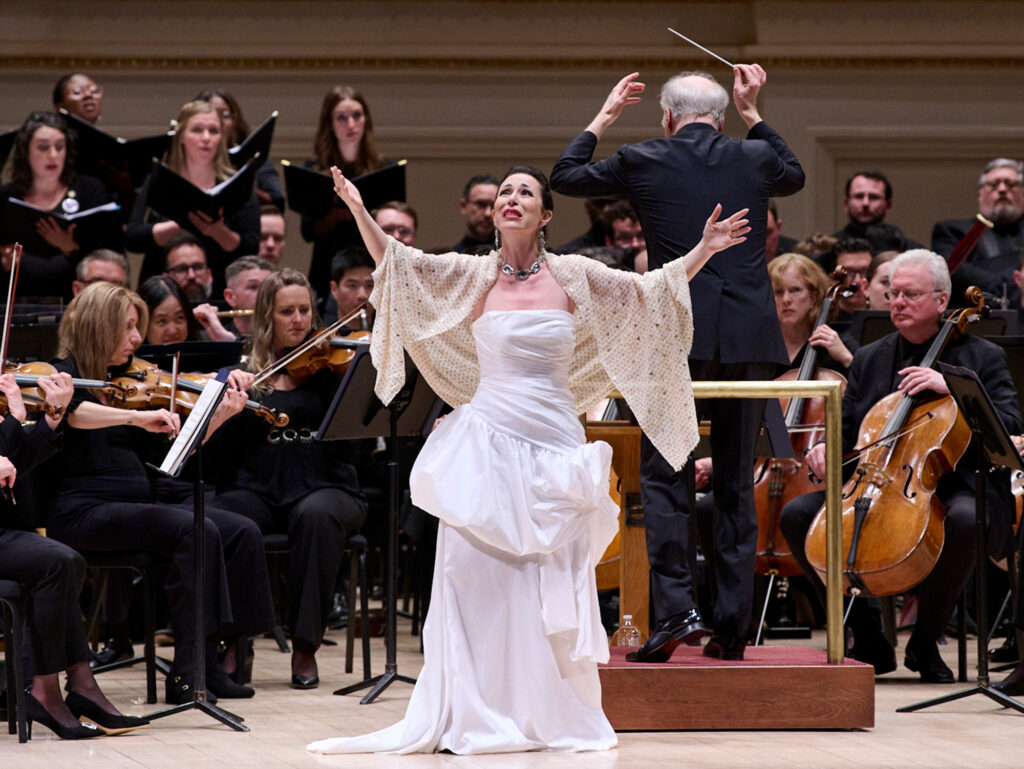
There was a gentle glow of hope that blossomed as soprano Erika Grimaldi (Suor Angelica) entered onto the stage. Her voice resonated with a golden timbre, illuminating her middle-range with ease. Her high notes ascended in ecstasy. Her interpretation of Suor Angelica was so pure that she might have reminded one of the Virgin Mary herself, floating in perpetuity as an illusive vision observing the terrors and delights of the world. Grimaldi’s voice was grounded in her solid vocal technique and this sustained her well, especially for the dramatic expectations of this role (and the fact that she had two more operas to sing to complete the triptych).
Highlights included Grimaldi’s aria “Senza mamma o bimbo tu sei morto,” in which her vocal power fully unfurled. Her open vowels spun brightly and her dramatic expressions came across as uniquely genuine. During the pauses between her singing, the audience remained silent and still, no one even shifted in their seat. Grimaldi kept her momentum focused and aligned with Noseda’s direction. They were synthesized in a mesmerizing way, creating space for one to forget everything outside of this single moment in time.
The sweeping violins layered in intensity as Grimaldi’s voice revealed her imminent doom upon mixing her poison, “Suor Angelica ha sempre una ricetta buona fatta coi fiori.” The voices of the Washington National chorus performed their obedient hymns as Grimaldi met her fate with open arms, embracing the spirit of her son.
The all female cast also included soprano Meryl Dominguez as Suor Genovieffa. Her aria, “Soave Signor mio,” was outstanding. Mezzo-soprano Agnieszka Rehlis as La Zia Principessa, Hannah Ludwig as La badessa, Michelle Mariposa as La suora zelatrice, Anne Marie Stanley as La maestra delle novizie, Megan Moore as La suora infermiera, Lauren Carroll as Suor Osmina, Anneliese Klenetsky as Suor Dolcina, Vivana Goodwin as La prima suora cercatrice, Veronica Siebert as La seconda suora cercatrice, Lauren Carroll as Una novizia, Viviana Goodwin as La prima conversa, and Veronica Siebert as La seconda conversa filled the stage with ingenuity and beautiful singing.
This “Suor Angelica” was a revelation that set the bar high for the next two operas to come.
Il tabarro
Puccini’s gift for inventing sound worlds is one of the main reasons “Il trittico” still resonates with audiences today. From the angelic voices in the convent during “Suor Angelica,” to the layered street and barge sounds along the Seine for “Il tabarro.” His operas bring different worlds to life and tell complex stories of humanity through sound and the human voice that pull at the heart strings of listeners abound.
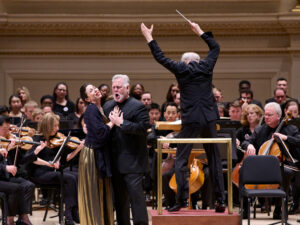
“Il tabarro” (“The Cloak”) is a tragic melodrama about love, lust, jealousy and murder. Director Noseda’s choice to follow up with this after “Suor Angelica” allowed the shock and intensity of Puccini’s music and drama to continue to build. The moment that stood out above all in this second opera was during Grimaldi’s arias as Giorgetta, along with Kunde as Luigi, “E ben altro il mio sogno” and “Hai ben ragione! meglio non pensare.” Their chemistry was pure magic similar to a Fellini film, with its dreamy lovers exposed in vulnerability to their own harsh reality. Grimaldi and Kunde cultivated an honest connection that made for an intimate and developing timeline between the two. Audience members sat at the edge of their seats, waiting for Michele to discover their secret love for one another.
Baritone Roman Burdenko as Michele also paired well with Erika Grimaldi as Giorgetta. His voice during “Perchè, perchè non m’ami più?” was lyrical and tainted in angst towards Giorgetta’s lack of love towards him. His aria “Nulla! Silenzio!” was terrifying as his voice grew into a wild wrath of rage. The deadly interaction between Burdenko and Kunde was bone chilling. Kunde’s dead body sat lifeless in a chair on stage as Burdenko pretended to cover him with an invisible cloak. For me, the fact we were able to look upon Kunde’s ghostly face while Burdenko justified his rage and then forced Grimaldi to face her lover’s dead body was most impactful. Normally the cloak hides the body for a big reveal. Here, it made it difficult to look away from the wrongdoing of murder and to sit with all the feelings that come with this knowing. This “Il tabarro” was very impactful and still lingers in the back of my mind.
It also must be mentioned that Scott Wilde as Talpa and Nicholas Huff as Tinca sounded bright and energetic in their roles. Agnieszka Rehlis as La Frugola sang with fondness and ease during her aria, “Se tu sappessi.”
Gianni Schicchi
The final opera of the night was a welcomed dark-comedy relief, “Gianni Schicchi.” This opera tells the story of a real-life grifter who manages to weasel his way into the middle of a Florentine family’s estate battle over a recent and very public death of the wealthy Buoso Donati.
Roman Burdenko as Gianni Schicchi performed the titular role with confidence and playfulness, masking his character’s true intentions until the bitter end when he gets what he came for–Donati’s home. Hakeem Henderson as Rinuccio performed his aria “Firenze e come un albero fiorito” with gusto and earnst. Erika Grimaldi as Lauretta’s aria “O mio babbino caro” was also a major highlight for this final opera’s comedic effect.
The cast as a whole also included Meryl Dominguez as Nella, Scott Wilde as Simone, Randy Ho as Gherardo, Veronica Siebert as Gherardino, Thandolwethu Mamba as Betto di Signa, Jonathan Patton as Marco, Michelle Mariposa as La Ciesca, Chandler Benn as Maestro Spinelloccio/Ser Amantio di Nicolao, Robert Frazier as Pinellino and Atticus Rego as Guccio.
Everyone in this cast had their own unique way of standing out, whether it was a perfectly timed sound effect, facial expression, gasp, or as Chandler Benn highlighted, the swiftness of a speedy walk on Carnegie Hall’s stage. The comedic cadences were spot on.