Teatro Municipale di Piacenza 2025-26 Review: La Bohème
By Bernardo Gaitan(Credits: Ph. ©Gianni Cravedi)
When a theater’s season announces one of the standard repertory operas, such as “La Traviata,” “Le nozze di Figaro,” or “Rigoletto,” opera lovers are immediately apprehensive about what invention the director will come up with in an attempt to innovate, rather than create yet another production that goes unnoticed, with almost invariably catastrophic results.
When the Teatro Municipale di Piacenza announced that it would present “La Bohème” in October, that anxiety set in. It was reassuring to know that this was not just any “Bohème,” but the one created in 2019 and signed by none other than Leo Nucci, who certainly understands opera and classical productions. Opera lovers can rest assured that Puccini will be honored rather than ridiculed or forcibly staged. Much of the credit goes to the baritone-turned-stage director, who after decades of experience as a singer, now brings to his stage work a particularly profound understanding of the relationship between singing, gesture, and theatre.
Production Details
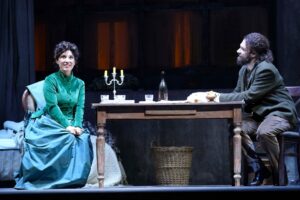
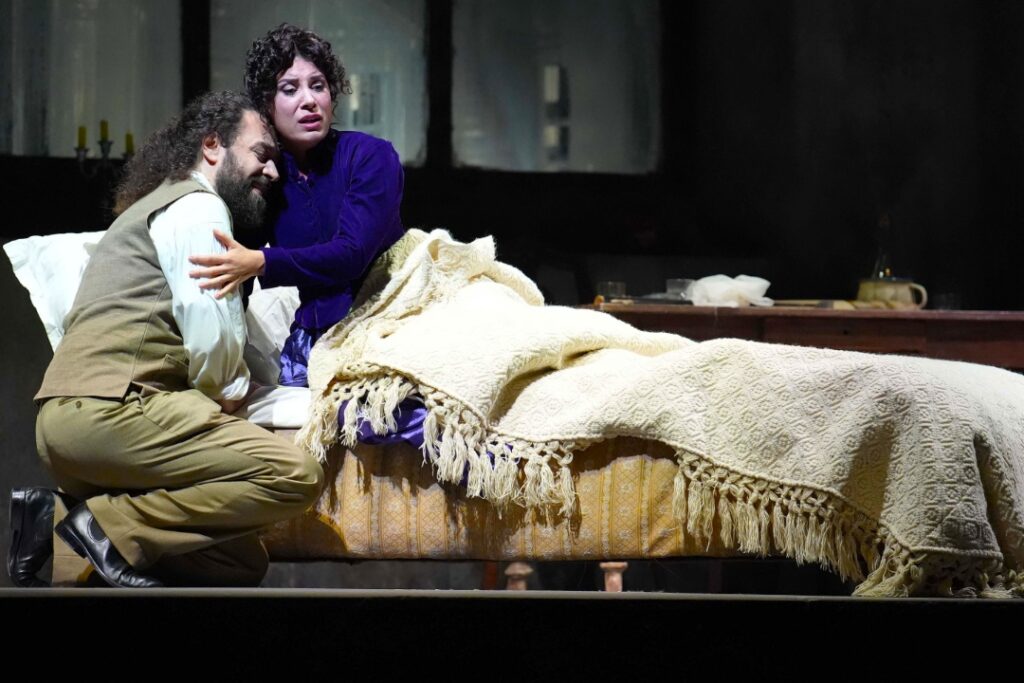
This revival at the Teatro Municipale di Piacenza, in co-production with the Teatro di Modena, presents a traditional production of considerable taste, with an evident visual reference to Zeffirelli’s historic version; consequently, it can hardly be anything other than tasteful. Nucci worked extensively on the histrionic aspects with the performers, although, for the production to be fully convincing, a little more was needed to make it truly emotional and referential. Nevertheless, his stage direction is distinguished by its attention to detail. His profound knowledge of the work translates into precise movements and specific glances that reveal the relationships and intentions of the characters.
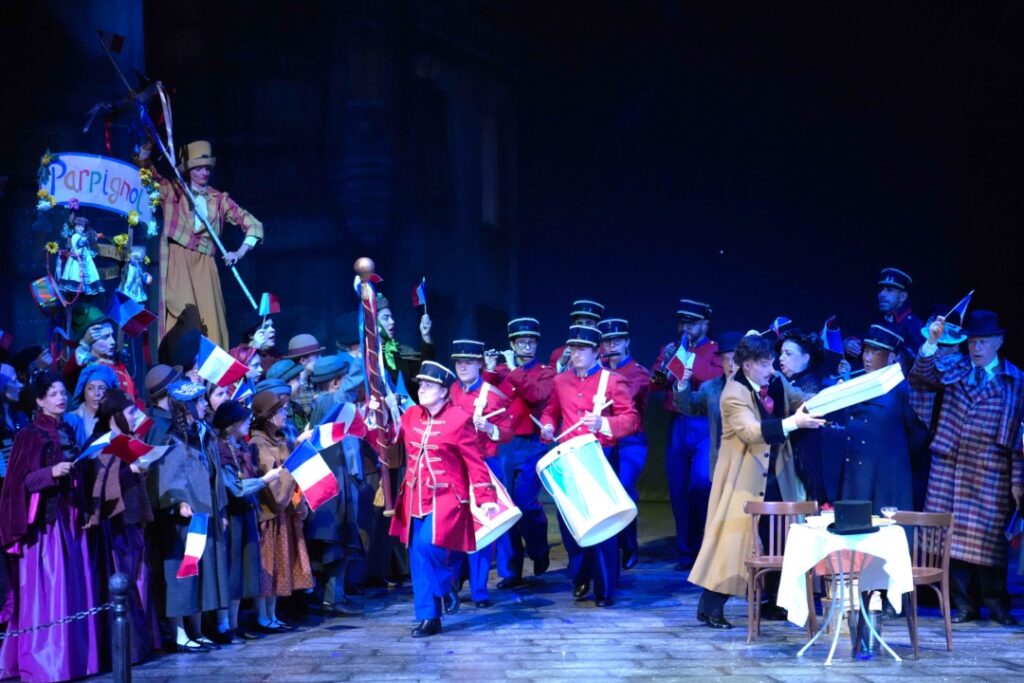
Carlo Centolavigna’s highly effective sets unmistakably evoke the French capital of centuries past. The garret in Act one, together with Michele Cremona’s carefully conceived lighting, places the action in a gloomy, impoverished space, yet one filled with youthful enthusiasm. Act two magnificently conveys the effervescence of the Quartiere Latino, while Artemio Cabassi’s elegant costumes carefully recreate Puccini’s Parisian world. Together with Nucci, the creative team respects the indications of the libretto without any need to innovate at all costs or impose a personal idea, instead asserting itself through a well-crafted proposal, just as Puccini would have liked.
(Credits: Ph. ©Gianni Cravedi)
Musical Highlights
From the pit, Vincenzo Milletarì conducted with attention and academic rigor, maintaining an effective relationship between the orchestra and the stage and carefully accompanying the singers, although without making any major contributions or introducing particular ideas. The Italian conductor’s baton was effective at the head of the Orchestra Filarmonica Italiana; however, it did not always find the necessary plasticity, nor the undeniable Puccinian melancholy and dramatic intensity that the work requires. At certain moments, Milletarì’s reading was more focused on the technical than the expressive side, whereas verismo demands not only academic rigor but also tension, impetus, and drama. All the same, Milletarì demonstrated a good understanding of the relationship between orchestra and voices.
The Coro del Teatro Municipale di Piacenza, prepared by Corrado Casati, displayed some problems of cohesion and almost imperceptible, though present, inaccuracies, while the children’s chorus of the Conservatorio di Piacenza, directed by Marcello Valentini, gave a much more effective performance, although there were some moments in which greater precision could have been achieved.
Illuminating Cast
Among the vocal cast, although all were competent, there was a pronounced difference in favor of the female protagonists, who stood out above the rest of the male ensemble. Claudia Pavone as Mimì, was an in crescendo. She began the performance well, but without contributing anything extraordinary; her “Sì, mi chiamano Mimì” was satisfactory and anticipated an important upper register. However, by Act three she was already something else: “Donde lieta uscì” was deeply moving in its intentions, while Act four was spectacular both vocally and dramatically. Her voice was luminous and rich in harmonics, particularly in the upper register; she possessed a solid instrument, and the soprano convincingly conveyed the protagonist’s fragility.
Mariam Battistelli was equally commendable as Musetta, always fresh and natural, both vocally and on stage. Her character was genuine, sensual, and emotional as the moment requires. The Ethiopian-born soprano’s voice was beautiful, with enviable lightness and power. Convincing fiato and a correct vocal line. Her “Quando m’en vo” was one of the highlights of the performance, as was her acting in Act four in the face of Mimì’s death.
Davide Giusti as Rodolfo took on one of the most demanding tenor roles almost as an emergency replacement, as Milletarì made clear when he thanked him at the end of the performance for his availability, saying that “he was not supposed to be here.” Nevertheless, Giusti possessed a powerful instrument, with ease in the upper register, although with evident technical difficulties in the management of fiato, with occasionally swallowed high notes and a discontinuous vocal line, resulting in a somewhat uneven interpretation. His “Che gelida manina,” however, was convincing, while in the duet and quartet of Act three and the final scene of Act four he was deeply moving.
Fabrizio Brancaccio as Marcello had a luminous and even voice, although at times perhaps somewhat too light for this role. Nevertheless, his contribution was successful: particularly good in Act three and in the duet “O Mimì, tu più non torni.” He had excellent stage chemistry with Giusti and Battistelli, which earned him well-deserved applause.
(Credits: Ph. ©Gianni Cravedi)
More Cast Details
Mexican baritone Fernando Cisneros offered a solid Schaunard, with a well-projected voice and an appropriate stage presence, probably the most accomplished of the male cast, with a powerful voice, consistently in tune and well projected, as well as more than correct pronunciation. His interventions were always successful, and his vocal line demonstrated a strong command of the role.
Bass Diego Maffezzoni as Colline, endowed with good vocality, offered Puccini’s greatest gift to basses: “Vecchia zimarra, senti” with great depth both vocally and histrionically; his contribution was very good. The remaining comprimario roles completed the ensemble effectively: Dario Giorgelé portrayed Benoît and Alcindoro with a sound and very youthful voice that did not reflect the mature age of the characters, but was nonetheless well placed and effective, while Carlo Bellingeri took on Parpignol, contributing, like the others, appropriately to the development of the performance.
At the end of the performance, there was warm applause for the protagonists and an enthusiastic ovation for Leo Nucci, who, after receiving the affection of the Piacenza audience, embraced and thanked each of the protagonists, demonstrating what a great human being he is. Afterwards, Milletarì said a few words to thank Davide Giusti for being there and prompted the orchestra to play and the soloists to sing “Happy Birthday” to him, as the tenor was celebrating his 40th birthday that very day.