Opera på Konstakademien 2026 Review: Blomstrande Barock
By John VandevertOn a blustery, grey, rather tired, Saturday afternoon, an exciting new initiative broke melodious ground under the ambiguous yet all-consuming gaze of a knitted Christ on the cross in the makeshift Parisian salon of Sweden’s Royal Art Academy’s auditorium. An unadorned harpsichord on a carpeted platform and a chair and stand for the recorder player were surrounded by a semi-circular arrangement, with a chair as the performance’s only set piece. Yet, what Opera på Konstakademien (Opera at the Art Academy) achieved in their inaugural concert was a sensational display of technical brilliance, artistic comradery, and slew of refined gestures, tasteful antics, and playful nuances that left the packed hall bewitched. I was left positively transformed.
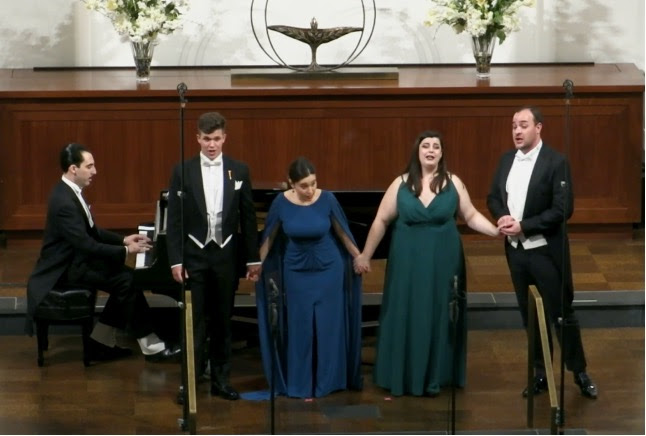
The concert featured the husband and wife duo Dan Laurin (recorder) and Anna Paradiso Laurin (harpsichord), and the sensational pair, Alexandra Linde (soprano), and Mårten Wåhlström (baritone), each dressed in period-inspired clothing with a variety of floral flourishes. These four masters provided a “greatest hits” tour of the early-middle Baroque and Rococo periods in sumptuous detail. Bach died in 1750, Handel died in 1759, Rameau died in 1764, and Mozart died in 1791. Filling the atmosphere with jovial buoyancy and decorous passions, Dan, Anna, Alexandra, and Mårten gave us the taste of an experience absent from our world today: the 19th-century salon!
The concert featured six composers including Handel, Rameau, and Monteverdi, as well as less recognized names like Fiocco and Sartorio, and spanned 14 artfully-organized duets and arias. The concert began with two jewels from Fiocco’s “Premiere suite” from “Pièces de clavecin, (Op. 1),” followed by three offerings from Handel’s “Giulio Cesare” (1724). The first duet, “Caro, bella,” was ecstatic, where Alexandra’s spinning resonance, fluid lyricism, and dramaturgical penchant complimented Mårten’s velvety tone quality, unmanufactured flow, and grounded expressive approach. The next two arias, “L’empio, sleale” (Mårten) and “Tu lemia stella sei” (Alexandra), showcased vocal strengths, although “L’empio, steale” did not really emphasize Mårten’s evidently robust competence in traversing registration shifts, passaggio/head voice mixing, and melismatic dexterity. I would have to wait until the concert’s second half to hear his technical abilities at work.
The final vocal work of Part 1 was “Pur ti miro,” performed effectively as a S/B arrangement, although alternatives like the offerings in de La Guerre’s “Céphale et Procris” (1694) could have been used for a more unexpected flavour. Following a majestic traversal through Handel’s “Recorder Sonata in F major, HWV 369,” Alexandra and Mårten continued with a softly choreographed presentation of Rameau’s “Forets paisibles” from “Les Indes Galantes” (1735). Both sang with a sophisticated and unified pathos, and presented an elegant, though nonetheless restrained, dynamism as befit the repertoire. However, the dancing would have been more convincing with better choreography.
The rest of the concert were alternating solos between Alexandra and Mårten. First, Alexandra sang, “Quando volgio,” from Sartorio’s “Giulio Cesare” (1676) — a version occluded by Handel’s indomitable shadow. Although neither the most decorated nor the fastest aria, its pensive leans and dotted rhythmic pulses up and down a mostly octave ambitus were handled with steadfast cleanliness and unaffected malleability by Alexandra. In response, Mårten sang, “Pensa a chi geme” from Handel’s “Alcina” (1735), which tastefully continued with the dotted rhythm character and registrative meanderings. Mårten’s voice blossomed and his artistry came alive. As he crested through his upper tessitura, I kept hearing the bel canto penchant at the heart of his approach, and I was left hungry for his Count Almaviva.
Alexandra took us back to “Les Indes galantes” with the aria “Regnez plaisirs.” This was a masterful presentation of her vocal abilities and artistic merits, of which there are many. From her invigorating trills and flourishes that seemed to caress the air without a hint of pressure, to her uncomplicated wanderings through her range without losing her opaline timbral proclivity, Alexandra truly flourished. What makes the aria demanding is its da capo form, but even here, her subtle, but tastefully inserted, ornaments were a coup de grâce to a marvelous display of art. Not to be outdone, Mårten then sang “Sibilar gli angui d’Aletto,” from Handel’s, “Rinaldo” (1711). I wondered where this Mårten was at the concert’s beginning. The aria not only demonstrated his obviously well-practiced ability for upper-tessitura onsets and weightless movement, but also melismatic simplicity, breath control, and navigation between expressive dramaturgy and technical stability. Extremely well done!
The concert concluded with the duet, “Trionfi amore e il mondo serva intiero,” from Gluck’s “Orfeo ed Eurydice” (1762). This is the opera’s finale and an inspired choice. A sonorous celebration of love’s triumph, all four musicians rejoiced in the accomplishments of the evening. There is no question why the auditorium was nearly full, nor why the audience demanded another round of the finale. What Opera på Konstakademien has introduced to Stockholm is a radically new approach towards musical art. This is one where the bounds of the medium are broken and one can step back into the Baroque sensibility of the unknown, the transcendent, the divine, and a humanist desire for metaphysical articulation of that which lies beyond perception. One must also remember the great theory, the doctrine of the affections, whose impact could be detected throughout the concert’s undulating sentiments.
I wish to end with a quote from Adorno on the relationship between fine art and music, as his musings summarize what Opera på Konstakademien attempted to do. They sought to rekindle the pre-modern impulse and rebuke post-modernist fanaticism by unifying the arts through emotion and expressive means outside words.
“Music and painting become writing through their renunciation of the communicative, which is precisely the element, in both media, that is in truth unlinguistic, because it suggests what is merely subjectively desired… If art is the recollection of nature in the midst of domination over nature, then it cannot be adequate to both in a pure, unbroken way; hence its imperfection.”
— Adorno, “On Some Relationships between Music and Painting” (1995)
Categories
Reviews