Royal Ballet & Opera 2026-27 Review: Parsifal
By Mike Hardy(Photo: The Royal Opera ©2026 Marc Brenner)
The titular character arrives on stage chased by an unruly mob, carrying a convincingly designed and crafted dying swan—the spoils of his hunt. His pursuers are clearly bent on seeking retribution, yet under questioning, he appears to know very little of anything: neither his origins, the world around him, his past, nor even his actual name. “Ich weiß nicht” (I don’t know) is pretty much all he can say to the elder knight, Gurnemanz. It would be perfectly reasonable for a casual observer to harbor reservations as to this man’s sanity, in which case the said observer might conclude the swan killer had arrived at the right place.
Production Details
For in set designer Etienne Pluss’s vision, the environment for the Knights of the Grail is not the sunlit, sacred forest by a lake that Wagner intended, but a hellish mental health institution where monumental blocks of granite slide and move, and the Knights spy on each other, courtesy of a bank of CCTV screens in the corner. Walls rise and fall to reveal a shower area reminiscent of something from “Resident Evil,” where the perpetually ailing King Amfortas, rather than bathing in the aforementioned lake to ease his pain, has his never-healing wounds scrubbed by Knights in pseudo-Hazmat suits and rebreather masks. In the corner cowers a young woman, Kundry, some kind of shapeshifter orchestrated by supernatural forces, who has apparently procured a healing balm for the King’s wounds and who ostensibly appears to be a victim of the Knights’ physical, emotional, and sexual abuse.
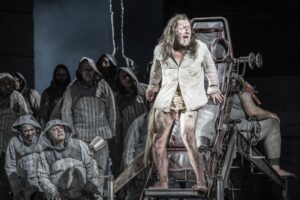
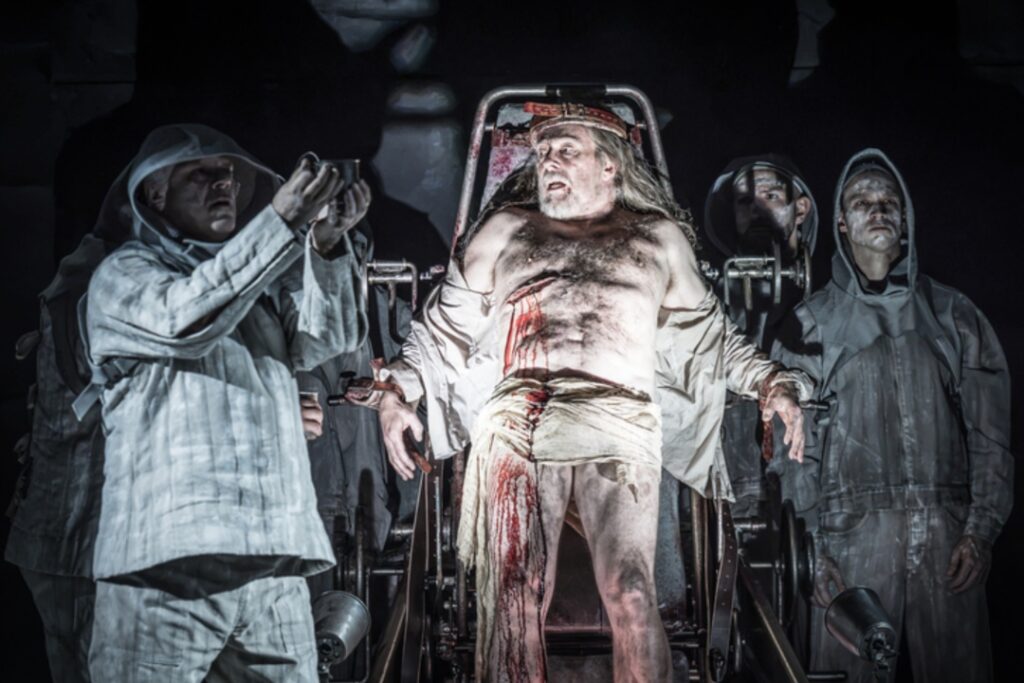
Later, the King staggers to the front of the stage draped in rags, dragging behind him his metal hospital bed, conveying the impression he had been restrained in it. There, the Knights attend to him, dressed in what appear to be strapless straitjackets: padded, striped pajamas with hoods. They strip the King of his rags and proceed to feast on his blood, collecting it in small metal cups as it oozes from his open wound.
(Photo: The Royal Opera ©2026 Marc Brenner)
Welcome to the Lunatic Asylum
Of course, if one is even partially conversant with Wagner’s “Parsifal,” his final work, one will understand, at least, the obvious Christian allegories. But under director Evgeny Titov, the peaceful tale of holy knights, holiness, and romanticised, divine grace has clearly been stripped away and replaced with a dystopian, dark examination of what he perceives to be the story beneath. Here, there are no noble knights searching for the Holy Grail, as in the Arthurian legend. Instead, they are a brooding, dysfunctional group of inmates in an asylum-cum-bunker—a paranoid cult, seemingly holding their King Amfortas captive in order for him to satiate their weird, literally bloodthirsty desires via the Holy Grail rituals of feasting on his blood.
The sacred spear that caused Amfortas’s endless wound is also the only thing that can heal it. It was stolen by the villainous Klingsor, who used his unwilling slave Kundry (the same deliverer of the balm) to seduce the King. Catching the King off guard, Klingsor struck him with the spear and retreated to his realm, where the weapon is now displayed as a trophy, enclosed in a glass stand.
The story, thus presented, is impossible to grasp, even as it unfolds. Titov doesn’t go in for explanations, and one must rely on his previous interviews to fully grasp that this work is his deconstruction of religious fundamentalism, sexism/misogyny, and authoritarianism. Unless one is relatively familiar with the tale, it’s best to just embrace the music and singing, and be as astounded as everyone else at the bizarre, often disturbing scenes as they unfold.
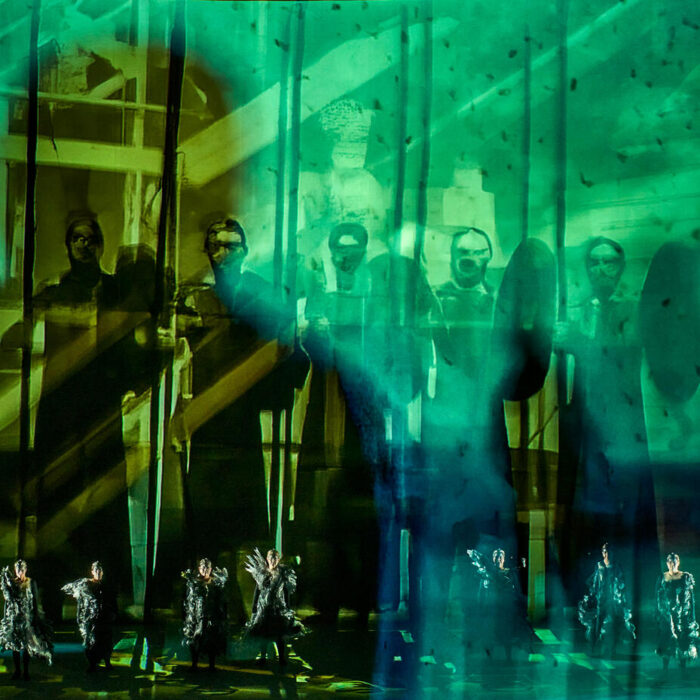
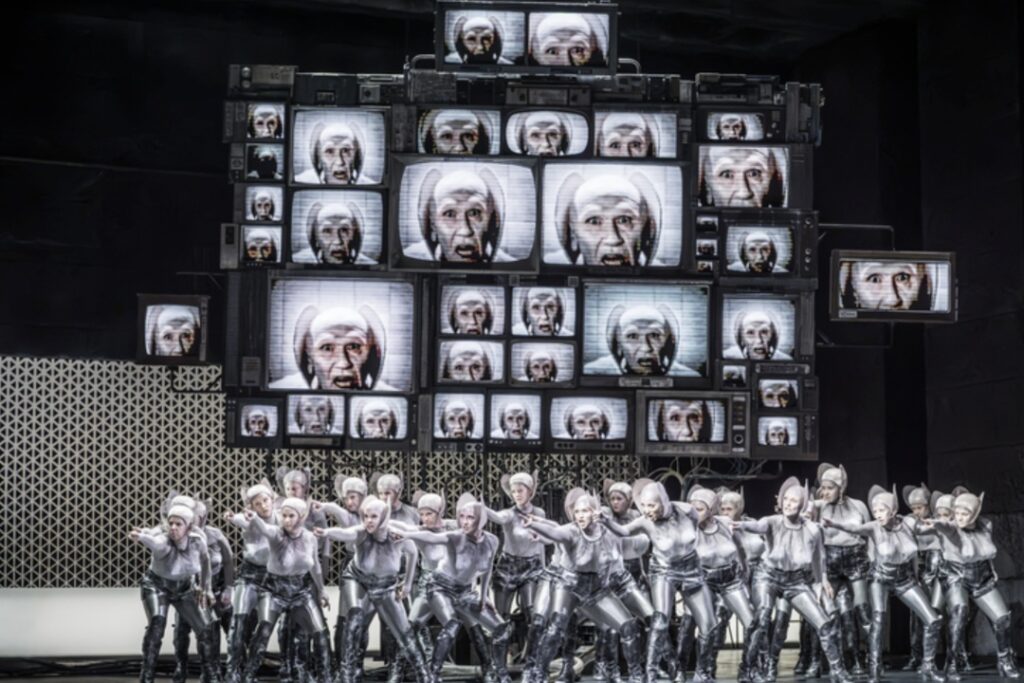
We get to meet the evil Klingsor in the second Act in his realm which, rather than the magical gardens of Southern Italy that Wagner envisioned, is a bizarre, sterile surveillance centre and museum with a huge bank of video displays of various dimensions that conjoin to produce multiple images.
Klingsor is no wizard or sorcerer here, but a smarmy, shiny-suited, oily predator who sings to his small, sweet ballerina girls as they watch the images on the screens. These are the Flowermaidens who will grow up to be his slaves and seductresses. Personally, I found this grooming inference somewhat unpalatable and entirely unnecessary.
We get to see the adult version of these sirens as our would-be hero Parsifal enters the domain. Sent to seduce him, they all have ridiculously pointed breasts and are dressed in silver mesh tops with silver boots, shorts, and tights, with winged hats atop their bald heads, looking like extras from some X-rated “Star Wars” spin-off.
They manage to divest Parsifal of much of his clothing before he manages to extricate himself from their lair. Alas, Klingsor now employs his key weapon; the hapless Kundry is coerced once again to be the chief seductress.
This time, emotional manipulation is brought into play, and this is where Parsifal learns his true name for the first time, along with details about his past. The encounter also produces another jaw-dropping moment when, in a freakish employment of a Freudian twist, Kundry (as part of her seduction technique) bares her breast so that Parsifal can suckle it in some regressive adoration of his mother. It is during this process that Parsifal experiences a brutal awakening, where he ‘feels’ Amfortas’s wounds in his own chest, transforming him from a rather docile, innocent simpleton to an enlightened savior-warrior who is able to take possession of the Holy Spear and destroy the fabric of Klingsor’s realm by smashing the multiplexed displays with a thrust of the weapon.
The final Act sees Parsifal returning to the realm of the Knights, many years having passed. In a rare moment of tenderness, he baptizes Kundry, freeing her from the repetitive cycle of shapeshifting rebirths. Titurel, father of King Amfortas, has died. Amfortas, having refused to take part in the gruesome blood-letting rituals for some time, consents to submit to the Grail one last time. In Wagner’s original version, Parsifal heals the aging King’s wounds by gently touching them with the spear.
(Photo: The Royal Opera ©2026 Marc Brenner)
Spoiler Alert!
The ending is not so much tender nor tending—more Tarantino. Less healing, more Hitchcock.
As already stated, it’s best not to try and unravel the multitudinous complexities of Titov’s motives and ideas, nor to try and articulate what his interpretations represent. For as complex and confusing as this work is, it is held together by some astounding singing and acting.
Christian Gerhaher as Amfortas was simply beguiling. His broken, shuffling figure was the very epitome of a man entrenched in agony. He sang with a majestic, sonorous baritone instrument that pervaded all areas of the theater with crisp clarity. His first Act monologue, “Wehvolles Erbe, dem ich verfallen,” where he laments his immense physical suffering and guilt just prior to performing the Grail ritual, was an astonishing display of singing and utterly convincing theater. Likewise, his second milestone piece just before the opera’s cessation, where he sang “Mein Vater! Hochgesegneter der Helden!,” was heart-rending. I cannot recall such an amazing operatic acting performance.
Tenor Stanislas de Barbeyrac as Parsifal was equally clarion in voice. He sings with real power, his voice gleaming steel. His “Mit diesem Zeichen bann’ ich deinen Zauber” in the second Act is majestic and most rousing, where he sings of his victory over Klingsor and his triumphant intents. His final Act “Wie dünkt mich doch die Aue heut so schön” is majestic, where he sings of the tranquillity of his surroundings—one of the few melodic passages from the opera. Further, his athletic physical presence and demeanour hugely enhance his portrayal in this role as a cogent fool turned redeemer.
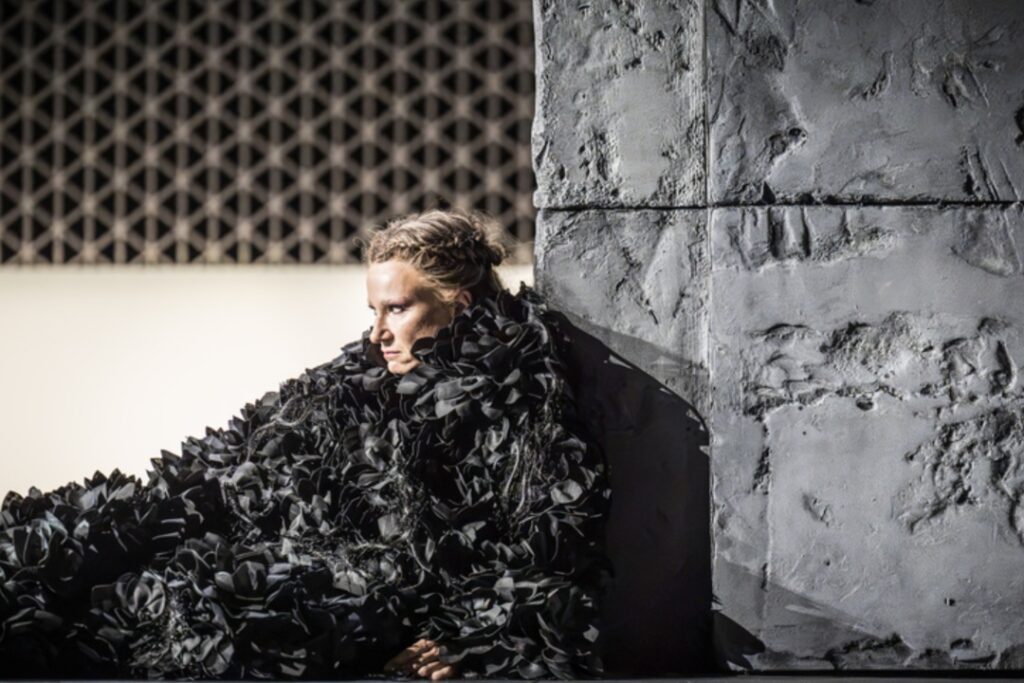
Mezzo-soprano Ekaterina Gubanova played Kundry—in my estimation, a difficult role to both sing and perform. Both a seducer and an abused victim, a friend (albeit without loyalty), and a frequent foe, Gubanova managed to portray all aspects with certitude. A deeply, psychologically flawed prey in one moment, a confident, seductive enchantress the next, she sang with beautiful expression and enunciation. Her second Act “Ich sah das Kind,” where she employed emotional leverage in her attempts to woo and procure Parsifal, was totally enchanting.
Baritone Mark Stone as Klingsor cut a wonderfully devilish figure. More Lex Luthor than the traditional cloaked sorcerer of Parsifal’s past, he strutted around with almost pantomime malevolence. He sang with dark, rich colors and controlled power. He totally dominated much of the second Act with his series of monologues, starting with “Die Zeit ist da.” His “Furchtbare Not!” where he sang of his bitter rejections and his desire to exact vengeance, was particularly impressive. I was left wishing his role had been larger, so that I could have heard more of his fine voice.
(Photo: The Royal Opera ©2026 Marc Brenner)
More Stellar Cast Highlights
Special kudos must be awarded to Brindley Sherratt in the role of Gurnemanz. Unofficial leader of the Knights of the Grail and effective narrator of the opera, his role is immense and demanding. He not only offered modicums of much-needed explanation and sanity throughout the first and final Acts, but he also managed to portray an almost tangible human face to a sub-human dystopia. His final Act sermon, “Das ist Karfreitagszauber,” was sweet and emotional, at abject odds with much of the rest of the opera. He sang with a radiant, treacle-rich bass that enhances the intensity of his stage presence and was unquestionably the pivotal pin of this whole work. It had just been announced that Sherratt was appointed Artistic Director of the Grange Festival, and it will be interesting to see in which direction he guides the renowned opera company.
Esther Bialas certainly deserves points for her costumes; those Flowermaiden sci-fi bots, for one, will remain with me for some time!
Conductor Jakub Hrůša’s Entrancing Style
This is Jakub Hrůša’s first “Parsifal,” and more gifted musicologists and appraisers than I will undoubtedly attest to his credentials; but I have to say that I found his conducting utterly entrancing. He seemed to have a completely symbiotic connection with the always sublime Royal Opera Orchestra and at times, I found certain key passages quite overwhelming in their profundity, a testament to not only his mastery of the score, but also a direct reflection of Wagner’s compositional prowess.
Particularly magnificent was the Chorus of the Royal Opera, whose breathtaking contributions and vocal ornamentation achieved a transcendental beauty that was almost weep-inducing. Under chorus master William Spaulding, if a finer chorus exists, I’d pay dearly to hear it. They were, for me at least, the standout feature of the evening.
“Parsifal” is notoriously difficult to present, carrying a unique power to deeply polarize its audience. Richard Wagner himself was acutely aware of Parsifal’s intense propensity to offend, and he took measures to control how the work was performed and perceived. He anticipated backlash from multiple cultural, religious, and political angles.
I do not doubt director Titov’s sincerity when he professed to want his “Parsifal” to question many of the unpalatable traits of society, both present and historic, challenging the obvious, deeply embedded Christian themes, but I found too many of the shock-value moments to be exploitative and sensationalist rather than a valid intellectual commentary. It was telling that, at his curtain call where he stood with the other creatives, there were audible boos among the audience.
It’s definitely not the opera for a first time goer, but if one insists, it might be better to just close one’s eyes and let the more divine passages of Wagner’s score embrace you.