Teatro Colón 2026 Review: Juan Diego Flórez & Vicenzo Scalera in Concert
By David Salazar(Photo Credit: Juanjo Bruzza)
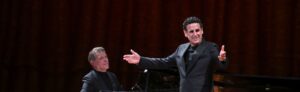
From the moment that he took the stage of the Teatro Colón alongside pianist Vicenzo Scalera (who was incidentally celebrating his birthday), Juan Diego Flórez had the audience under a spell.
Flórez, who has never performed a role at the famed opera house, has always exuded star power and even as he moves through his middle age, he remains at the peak of his vocal powers. His lyric tenor has clarity and focus, with an added punch. His way with a phrase is second to none. His presence is immense.
For this occasion, Flórez chose a program that, on paper, ticked a great deal of boxes. The first half focused mainly on his bel canto speciality with a Mozart aria to kick off the proceedings. In the second half, he brought in a mixture of Spanish and French repertoire, ending it all with an aria from Verdi’s “I Due Foscari.” And while Flórez delivered throughout, the program, again on paper, itself proved questionable in its setup. Then things took a different turn.
Bel Canto
Flórez opened the concert with “Misero! O sogno… Aura che intorno spiri,” a surprising choice. He sang the opening recitatives with tremendous forcefulness, allowing his voice to warm up in the space before delivering some glorious legato singing throughout the aria itself. Here he introduced the full gamut of vocal versatility that would become a staple of the remainder of the concert. In a way, this piece came off as a statement of intent for the remainder of the performance. The climax of the piece, which demands greater strength and drive, was rendered with corresponding intensity.
From there, he shifted into several Rossini songs from “Péchés de vieillesse,” including “La Lontanaza” and “L’esule.” In both, the tenor was allowed to scale back the sound from the forte singing at the close of the Mozart, his breath control spotless throughout, his phrasing elegant. To cap off the Rossini section, the tenor brought on “La speranza più soave” from “Semiramide.” The first half of the aria was delivered with fluidity of line and brightness of tone. Then came “Sì, sperar voglio contento.” While Flórez’s coloratura is still fluid, it was clear the tenor had to negotiate tempo for clarity of execution. Instead of propulsive tempi, there was a rallentando throughout, which also gave the piece a more lethargic feel. The fact that he repeated it, only made this feeling more evident. Obviously Flórez has mostly moved on to heavier repertory (though he continues to sing Rossini) so it is to be expected that his coloratura would slow down. Nonetheless, the execution was still notable. One thing that has not lost its luster in least and has, in fact gained a tremendous amount, are his high notes, which were pristine throughout the night. He was always in complete control, every high note thrilling and precise.
While Flórez rested from the intensity of the aria, Scalera took on a gentle “Une caresse à ma femme,” a glorious piece built on a gentle rising three-note motif with two contrasting sections to shift the pacing. Scalera’s ability to build a phrase by subtly stressing the final note of the three-note figure was sublime and his articulation of the music was among the most arresting moments of the entire evening.
From there, Flórez embarked on two of his most successful ventures of the evening. First was the iconic “Una furtiva lagrima,” wherein the tenor delivered his most glorious singing of the night, bar none. Every phrase was elegantly constructed. He differentiated beautifully between the crescendo on the dotted half note E (“cercando io vo”) that connects into “M’ama!” and the latter, climactic one that brings the music into A major; the first one was a subtle crescendo with the second allowed to soar and provide the key change its catharsis. Throughout, Flórez caressed each phrase, allowing the moment to linger, the tempo always steadily moving forward. The cadenza runs were delivered with finesse and clarity and the two final “Sì puó morir” were given due contrast, with the latter a honeyed fil di voce. And the final E natural was given a tender but impassioned mezza di voce. The audience exploded with enthusiasm after that final note.
Then came “Ed ancor la tremenda porta… Come uno spirto angelico… Bagnato il sen di lacrime” from “Roberto Devereux,” where the tenor managed the shifting tones with elegance and potency. Where his interpretation of Nemorino’s famous aria was delicate, this portrayal was far more resolute, the sound flowing and resonating beautifully in the space. It capped a solid first half.
Spanish, French… Verdi?
With Italian repertory dominating the first half, the second half shifted focus to Zarzuela and French opera before taking a detour back to Italy. The sequencing here felt a bit more thrown together and lacked the thematic fluidity of the first half.
He kicked things off with “Bella enamorada” from “El último romántico.” While he was impassioned throughout the bel canto and Mozart portion of the program, there remained some restraint. Here, the tenor allowed himself a bit more freedom with the flow of the line, the colors far more varied. This was particularly notable in the ensuing “Suena, guitarrico mío,” an impassioned plea to a lover. At two junctures in the piece, the text shifts into anaphora with the lover repeatedly stating “Dile que…” Flórez played up these sections with a notable diminuendo before crescendoing back for the final lines of the sequence. The first time around, the effect was surprising and even if you expected the same the second time around, the execution was spotless and equally thrilling. Same went for “Aqui está quien lo tiene tó,” which the tenor delivered with a gracefulness and bouncy energy.
After that, Scalera got a moment to showcase his glissando in Ernesto Lecuona’s “Mazurka Glissando.” In this short piece, Scalera played up the humor of the repeated effect, without ever dragging the tempo.
Then came “Vainement, ma bien-aimée” from Lalo’s “Le roi d’Ys,” wherein Flórez’s voice was far softer, the singing sweeter. It provided a fine contrast with “Ah, lève-toi, soleil” from Gounod’s “Roméo et Juliette,” which like “Una furtiva lagrima,” was Flórez’s other climactic moment. The tenor delivered fluidity of line throughout, the sculpting of phrases up to the high B flats on “Parais!” beautifully paced and constructed. Where most tenors tend to extend the two “Ah! lève-toi!” that precede the B flat, Flórez accented them and was more precise with the rhythm, adding a drive and sense of urgency to the moment. As the piece entered its coda, the tenor scaled back the intensity, allowing for a more honeyed sound to take over before the final ascent to the final B flat. On this final note, the tenor delivered his most potent high note of the entire event, extending it rather generously. As with “Una furtiva lagrima,” the audience was effusive in its adoration.
Scalera delivered yet another interlude thereafter, this time with Godard’s “Berceuse de Jocelyn.” Again, he played elegantly and delicately, capping off his solo moments with finesse.
Then came “Ah, sì, ch’io senta ancor, chio respire,” which proved a strange choice to cap the evening. It mirrored the choice to open the program with Mozart, who was not Italian; in this case, Verdi was neither French nor Spanish, so his inclusion stuck out. However, given that the entire first half was in Italian, returning to Italian (even if it “brings things full circle”) after a stream of Spanish and French felt like odd to the overall flow. Then there’s the piece itself. Verdi is always a treat to hear in any context, but this was the final piece of the formal program. This is far from Verdi’s most powerful tenor aria and the part that has the potentially to be a bar burner, the cabaletta, was not even performed fully here. Without the repeat, the cabaletta ended up being rather brief as to almost not even register fully. Had this piece been placed at different point in the program, it might have been compelling and interesting. The tenor delivered the aria beautifully. His singing was flawless throughout the central aria and he had the vigor and potency for the cabaletta, but the piece itself proved unsuitable to close out what was otherwise an intelligently devised program.
The Second Recital
But of course, the Verdi wasn’t really the ending of the recital because Flórez always delivers encores. But he doesn’t just give you one or two, but a series and this is what he did.
With the audience going wild at the close of the formal part of the recital, the tenor came out with his guitar. The audience started throwing out requests, which he listened for before announcing that since he was in Argentina, he would begin with a tango. And he chose Carlos Gardel’s “El día que me quieras.” As his fingers nimbly stroked the guitar, Flórez transformed into a different artist altogether. The singing here was as beautiful as everything he’d performed up to that moment, but it had a more relaxed feel. Every phrase was caressed meticulously and preciously. If the formal part of the recital often felt like the tenor was singing to the audience, here he was inviting the audience in. Neither is better than the other, but the experience was far different. In the former, the experience was thrilling and full of dramatic energy. Here, there was a sense of unpredictability that created its own unique tension. The tenor was looser with the phrasing, extending notes and moments, while he vamped on his guitar. The audience went wild for his softer piannisimi.
He told the audience after Gardel that he never knew what he wanted to sing and chose to follow up, despite varying requests from a very vocal audience, to sing “La flor de la canela.” Then he transitioned to “Zamba de mi esperanza,” which he noted was a song his mother used to sing to him. And from “Zamba,” he transitioned directly into one of the constant requests, “Cucurrucucú paloma” where the tenor really stretched the phrases. At one point, he delivered the flawless high note in a piannissississmo falsetto that he held and held, the guitar vamping endlessly. The audience couldn’t even hold back its gratitude, exploding into adulation before he had even finished the song.
Once that was done, you might expect the concert to have come to a natural conclusion.
But the tenor wasn’t done. He brought back Scalera and announced to the audience that his long-time collaborator was celebrating his birthday. From there, the audience took over for a moment, exploding into a rendition of “Que lo cumpla feliz” (“Happy Birthday”). As a gift, the tenor stated that he would sing Scalera’s favorite “Mattinata” by Leoncavallo, which was performed gloriously. At the close, the tenor moved upstage, allowing the pianist to take centerstage for the brief interlude and closed out the aria in the same position, ensuring that Scalera was at the center of attention.
At that point, the lights went on and people made for the exits. But those of us who stayed applauding were treated to one final song, “Amapola.” Again, his vocal finesse and elegance were on display. At that point, the performance, which had commenced at 8 p.m., was nearing 10:30 p.m. local time (it was supposed to be finished by 9:50 p.m. local time, per the program). And Flórez sounded like he could keep going. In fact, when he came out for “Amapola,” you could sense that he was trying to bring the people who were exiting the theater back into their seats.
If Flórez had decided to continue, I would have stayed. The performance on the whole was nothing short of magisterial, the tenor’s star power coming from his presence, vocal elegance, and artistic versatility. Given the fact that he performs mainly in Europe these days, I hadn’t seen Flórez in quite some time. Seeing him again after all those years was a reminder of how incredible an artist he has always been and continues to be. He undoubtedly remains one of the best singers in the world.