Teatro Real 2026-27 Review: Manon Lescaut (Cast B)
When a Cast Change Reframes the Production
By Galina AltmanA complicated chain of emergency substitutions unfolded at Madrid’s Teatro Real during the run of Puccini’s “Manon Lescaut.” The celebrated Spanish soprano Saioa Hernández fell ill and was forced to cancel several performances. As a result, Sondra Radvanovsky – originally scheduled in her own cast alongside tenor Michael Fabiano – was moved into Hernández’s cast, performing alongside Jorge de León. The dates that Radvanovsky had vacated were then covered by the young soprano Carolina López Moreno.
Looking ahead to my conclusions, I want to name this chain of events as one of those cases where force majeure made a production more interesting and unpredictable than any standard audience expectation could have anticipated.
Production Details
What do we usually associate with Puccini’s “Manon Lescaut?” An unfortunate young woman who, through inexperience, is drawn into a carousel of temptation and pays for it with her life – not of her own free will – and a young man passionately in love with her from first sight, who follows her to the end through her misfortunes but cannot save her.
Puccini is a remarkably feminist composer, and he reveals his heroines musically through the pain and suffering that every last man in their lives – knowingly or not – inflicts upon them. His women suffer and become hostages to choices that the male patriarchal world does not actually offer them. His Manon is equally a victim of male influence: she is first sold by her own brother, to whom the family has entrusted the right to “place” their daughter profitably in the capital rather than give her to a convent for nothing. As we know, in many countries women continue to be a means of transaction for their fathers, families, and brothers – and Puccini’s opera reminds us of this again and again.
The composer wrote staggeringly intense, beautiful, and emotionally charged parts for his two leads. Singers call the tenor role, Des Grieux, “a vocal killer” – it is considered one of the most demanding and punishing tenor parts in the entire operatic repertoire. And every production faces the same challenge: to build a stage space and dramatic action capable of matching such music and allowing the audience to follow the story and the development of the characters simultaneously.
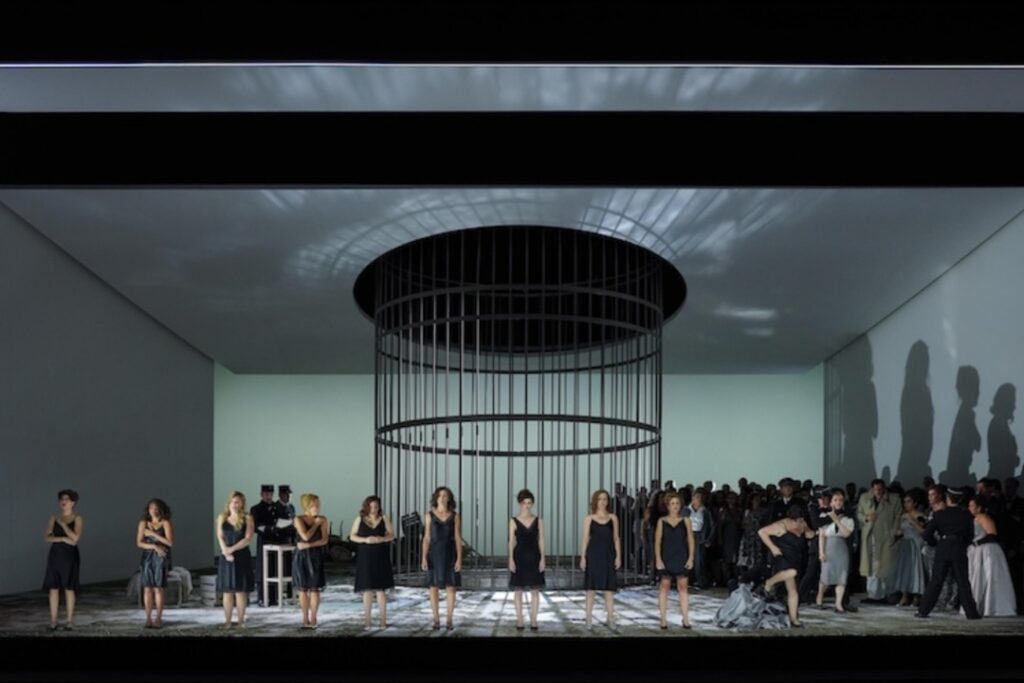
Director Carlos Wagner, in this co-production between Teatro Real and Oper Köln, has genuinely succeeded in creating a world of sharp contrasts – one where love and commerce, naivety and sacrifice, a young woman’s desire to control her own fate, and the monstrous price of “disobedience” all coexist. Wagner spoke directly about wanting to show a contemporary and feminist perspective on the story, and explained his concept this way:
“The production was quite difficult to stage, because the plot is full of ruptures, missing narrative connections, ellipses… It is far from an organic dramatic form. To be honest, in places it is simply unclear: the structure consists of four vignettes from Prévost’s novel, between which the logical bridges have been lost.
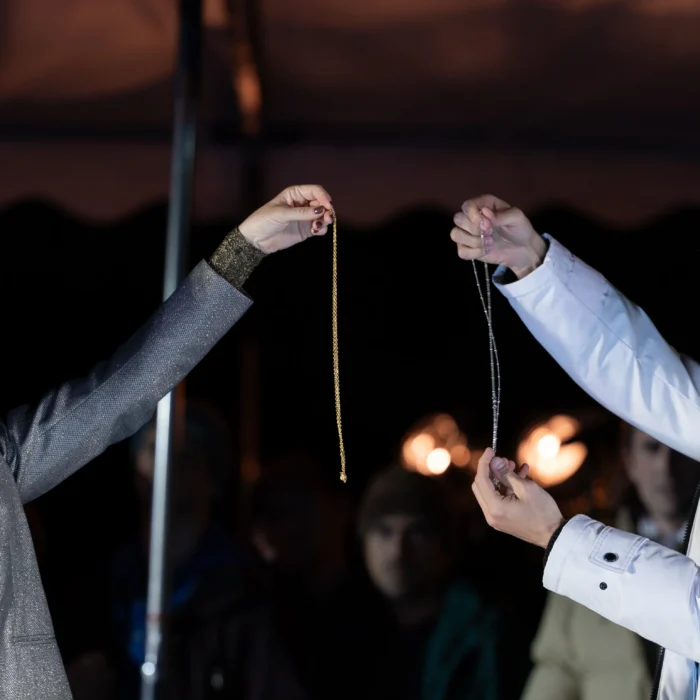
So we also used the device of smoothing the jarring leap between Acts one and two, when the audience usually cannot grasp what has happened. In Act one she has only just fallen in love with Des Grieux, and in Act two she is already living with Geronte. How? We created a short pantomime at the end of Act one to show the audience the moment of temptation from a different angle – in our case, a magnificent gown with diamonds from Geronte. And there we see her hesitation: ‘Stay with love and passion, or choose safety and luxury?’ One could say that every member of the audience is meant to make that choice alongside Puccini’s heroine and our soloists on stage.”
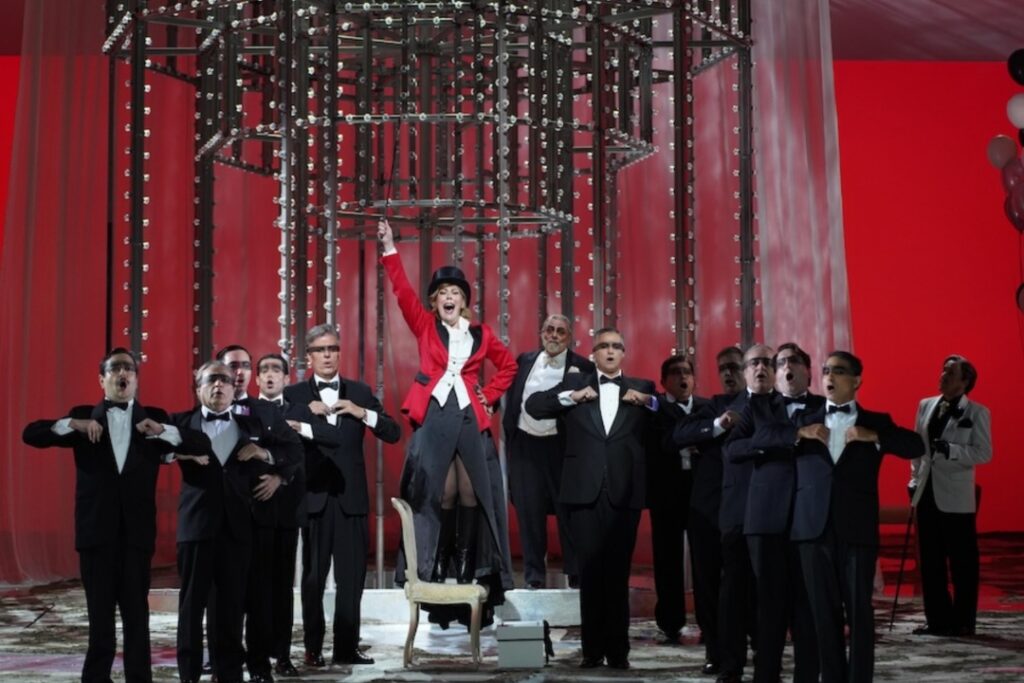
So, what do we see on stage? The first two Acts are full of festivity – a carousel, a joy, some illusory cinematic world, half Soviet, half Hollywood, where everyone is dressed in dark gray tones from which only Manon stands out in her brightness. A celebration of life that captivates from the start. And then, together with Manon and her vivid costumes, we sink into the dark backstage of this “cabaret,” operating by the laws of the male patriarchal world, where a woman is a commodity as long as she is convenient, and a victim of the system the moment she ceases to be.
The third and fourth Acts, at an extraordinary emotional remove from what came before, shock us with a sense of hopelessness and the cruelty of a system that punishes “fallen” or “discarded” women. The set design is remarkable: it gradually plunges the characters’ world from the heights of pleasure and comfort into a prison basement sealed by a grille – beautifully designed, incidentally – that is at once a cage, a carousel, and the wheel of justice hurling the condemned across the ocean to the swamps of Louisiana and to death. The allegory accumulates references to “Moulin Rouge,” to Dante’s Inferno, and sardonically to contemporary fashion shows, until it becomes a completely barren space of souls, reflections, shadows, and glints of light in the company of remarkable singing and acting.
If at first the stage seems to lack scale, by Acts three and four the boundless American desert, with its sense of an abyss, makes the audience understand that our celebrations do not last forever, that there are many around us who were simply unlucky, and that every thoughtless celebration ends precisely this way. Total disorientation. Total hopelessness. The women falling from the “catwalk” are a beautifully conceived image.
Musical Highlights
The musical palette of Puccini’s “Manon Lescaut” was perfectly described by conductor and musical director Nicola Luisotti himself:
“Of course the orchestral language of ‘Manon Lescaut’ differs greatly from his previous operas – one could say this opera is almost Wagnerian. It requires Wagnerian singers with very powerful voices, because the orchestral fabric… Yes, I try to make it more tender and soft, but Puccini writes for practically every instrument at once. And to achieve a pianissimo with an orchestra of this density, I will tell you, is extraordinarily difficult.”
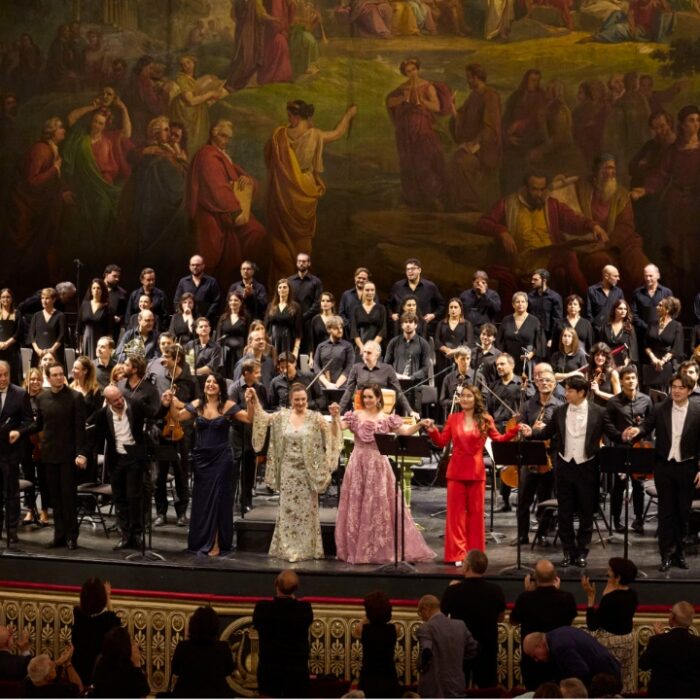
The second cast of “Manon Lescaut” at Teatro Real had been announced with Saioa Hernández, but went on with Sondra Radvanovsky and Jorge de León – the change announced one hour before curtain.
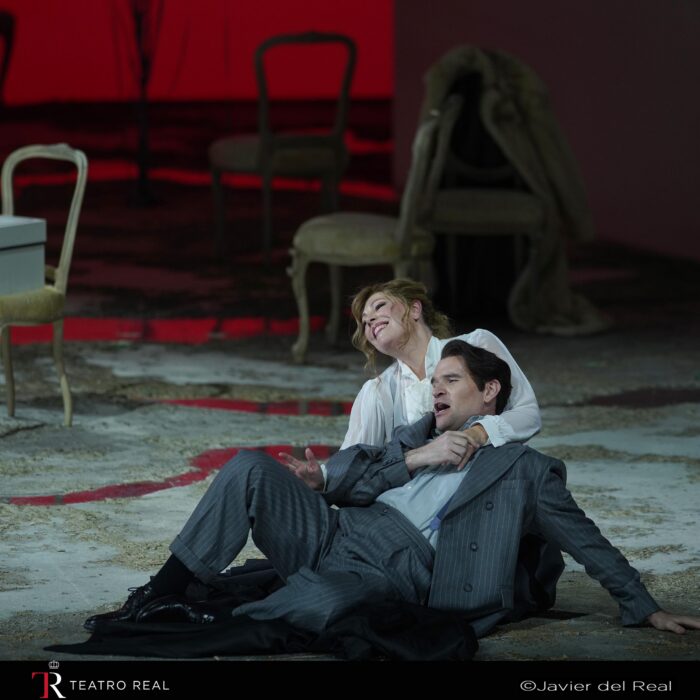
What followed was a triumph for De León in this role – not only vocally but dramatically. He plays Des Grieux in a way that makes you forget everything and truly believe him: his boyish love and passion, the complete obsession with a woman for whom and for whose salvation he is prepared to do anything.
De León’s voice possesses exceptional power and resonance, capable of cutting through the dense orchestral fabric without effort at the production’s climactic moments. He has a bright, metallic quality of tone and an overall expressiveness of delivery. But the singer showed us another side of his artistry as well. Alongside the dark, saturated motifs in his voice there were luminous tones, beautiful in their unexpected lightness and with upper notes of exceptional beauty.
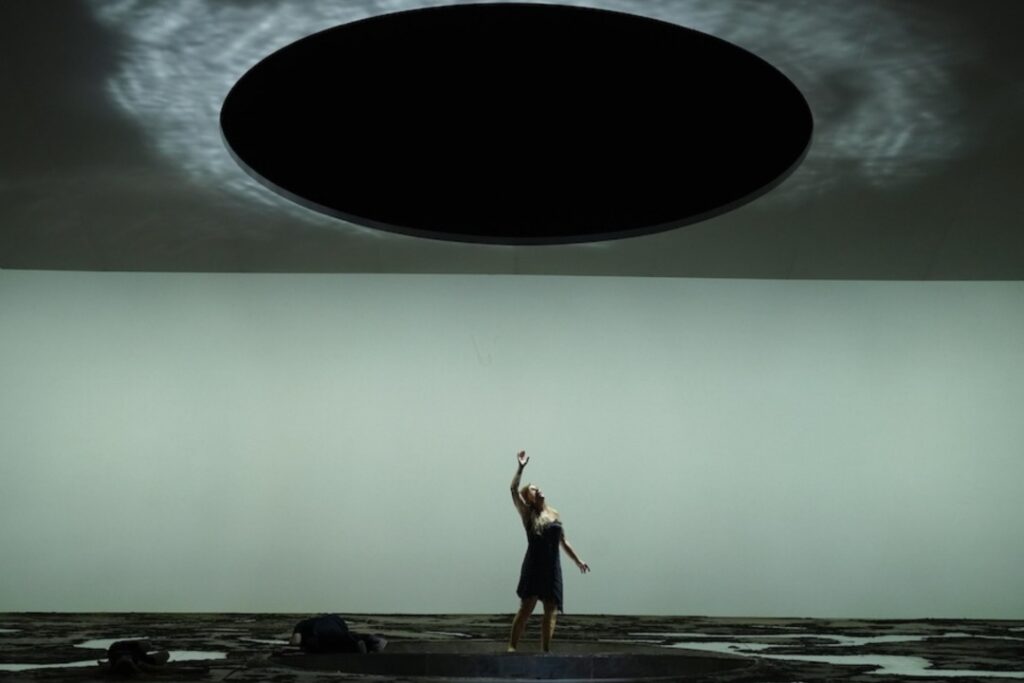
Radvanovsky, long an established star both vocally and scenically, with an outstanding voice and vast experience, inhabited the role that evening as though she herself were seventeen. Her physicality and expressiveness were at the height of her mastery. The voice was initially not entirely settled – perhaps because she stepped into this replacement after singing several of her own consecutive performances and may simply have been tired. But from that point on she delivered a vocal power and contrast that filled the entire hall of Teatro Real completely. The command of every shade of piano, the ability to hold the audience’s attention absolutely – in that kind of atmosphere you breathe and live alongside the artist, forgetting everything and never once taking your eyes from the stage.
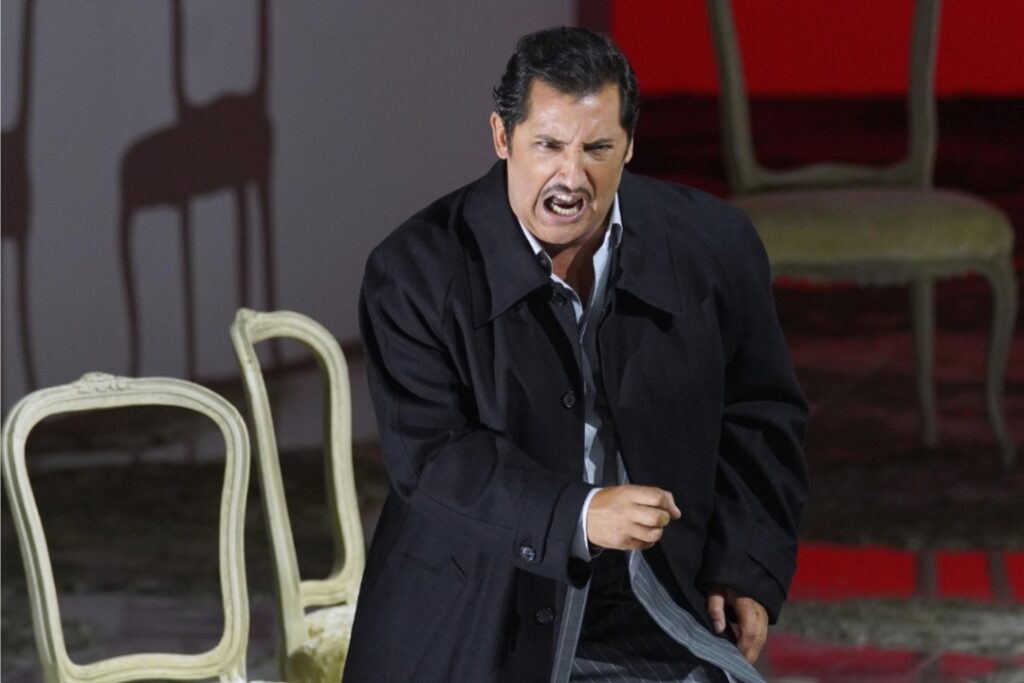
Szymon Mechliński as Lescaut – Manon’s brother – was resonant and authoritative, with a fragility running through the warmth, even throughout his range, a dark and warm timbre, musical assurance, and solid technique. Pietro Spagnoli as Geronte brought the instincts of an Italian buffo baritone whose dramatic gift matches the voice: vivid characterization, natural comic timing, and expressive stage presence.
It was impossible not to remark on the work of Nicola Luisotti. Before the fourth Act he did something remarkable with the orchestra: a thin, filigree sound literally pulsed in the air and passed through every listener in the hall, leaving a sense of extraordinary radiance and light, underlining the beauty of the vocal lines. The Teatro Real Chorus under José Luis Basso fell into this sublime current with complete precision.