Oper Frankfurt 2026-27 Review: Zaide
By Mengguang Huang(Photo: Barbara Aumüller)
Mozart left his “Zaide” (1779-1780) unfinished. Written during a frustrating period as a court musician in Salzburg, this work set in a German libretto lacks overture, recitatives or spoken dialogue, and a final plot resolution. Centered on captives attempting to escape a Turkish ruler’s grasp, the surviving musical fragments display remarkable dramatic potential directly foreshadows his later “Die Entführung aus dem Serail.”
Production Details
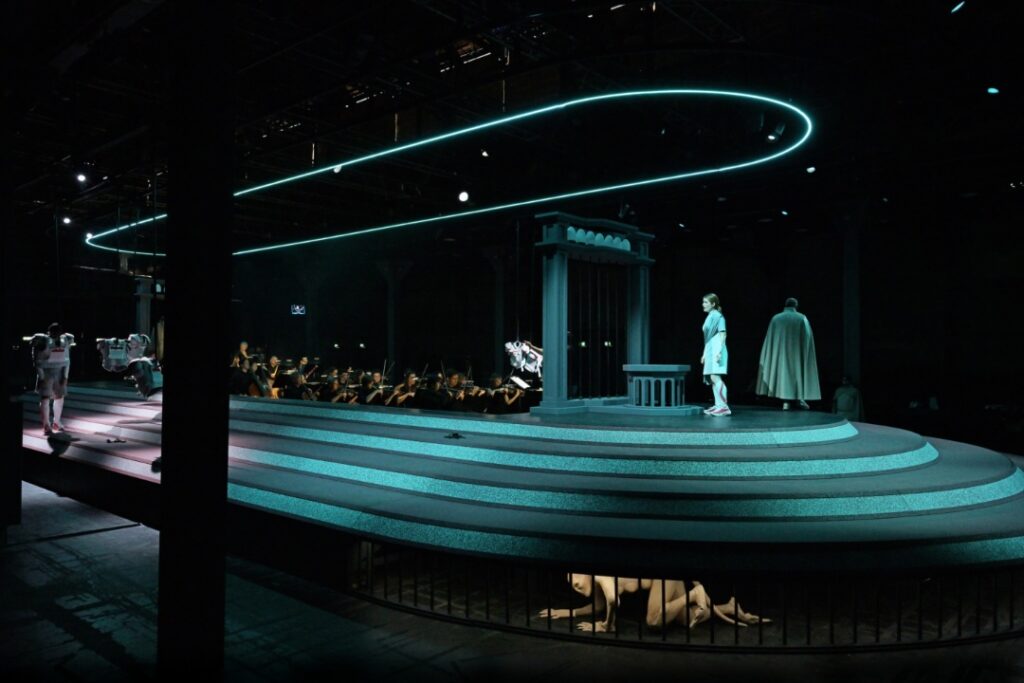
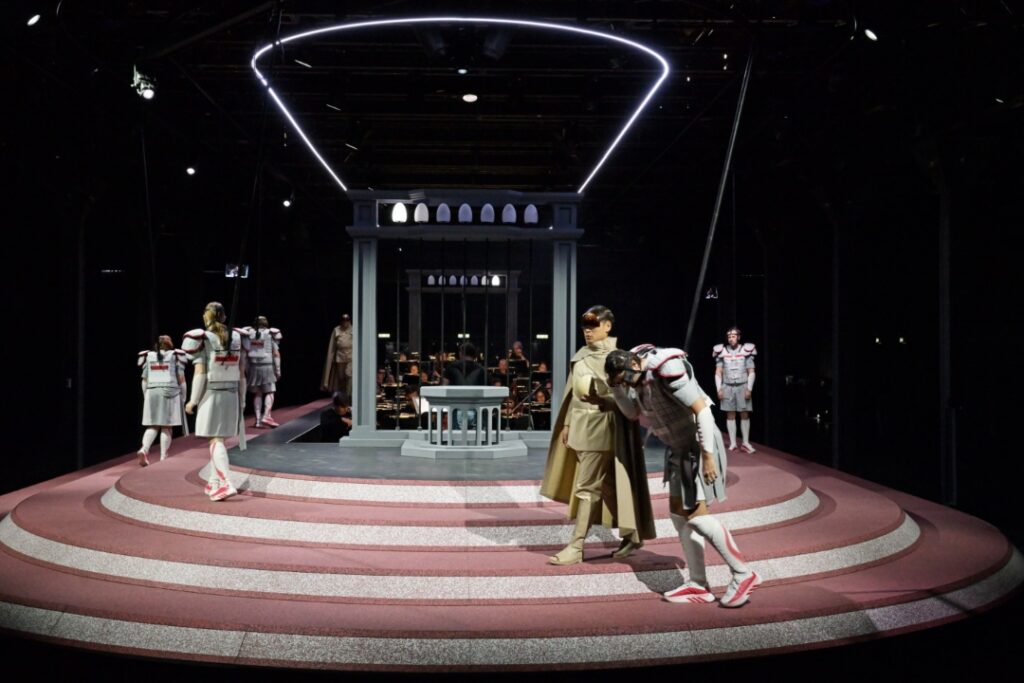
Inside the industrial Bockenheimer Depot, this early Mozart piece premiered in Frankfurt in 1866, is presented as a unsettling fusion between an immersive fashion runway and an ancient Roman arena. Set designer Jo Schramm places an elongated oval track right in the center, with two portal-like structures standing at its focal points. They resemble altars or gateways, each installed with a row of lights. They gradually extinguish as hope slips away scene by scene. Between these two portals sits the orchestra pit. Above the stage we find suspended overhead as a network of parallel tracks and lighting rigs. Suspended armor-like garments are in red-white color. They carry a subtle hint of both ancient Roman armor and the aesthetic of contemporary Japanese anime. Sultan Soliman’s enslaved captives are forced to clothe themselves in these rigs, marching pointlessly along the parallel tracks in a state of mechanical exhaustion.
(Photo: Barbara Aumüller)
Admittedly it is an impressive visual concept, but it is though not without its drawbacks together with music. As instrumental interludes borrowed extensively from Mozart’s “Thamos, King of Egypt” (1773) develop, this endless circular marching starts to feel somewhat repetitive. It was easy to notice a slight friction between the slow, heavy steps of the chained captives and the highly dramatic music.
Yet the atmosphere remains consistently depressing, it occasionally plunges the space into a terrifying blood-red glow. Because Mozart left the work unfinished without resolution, director David Hermann opts for a tragic end: Zaide, her lover Gomatz, and their helper Allazim all step straight into helpless death. The internal logic here is clear, with nothing on stage pointing hints of redemption. Even beneath the stage, an actor dressed as an alien monster constantly crawls as a constant reminder of the hostile force controlling their fate.
The production also takes an editorial approach to the two melodrama passages. They are basically pure spoken dialogues over music which Mozart originally modeled after Georg Benda’s “Medea.” The libretto is modified by new fragments of text. Words break apart, making you wonder if the characters, especially Gomatz, have lost their minds under torture.
Illuminating Cast
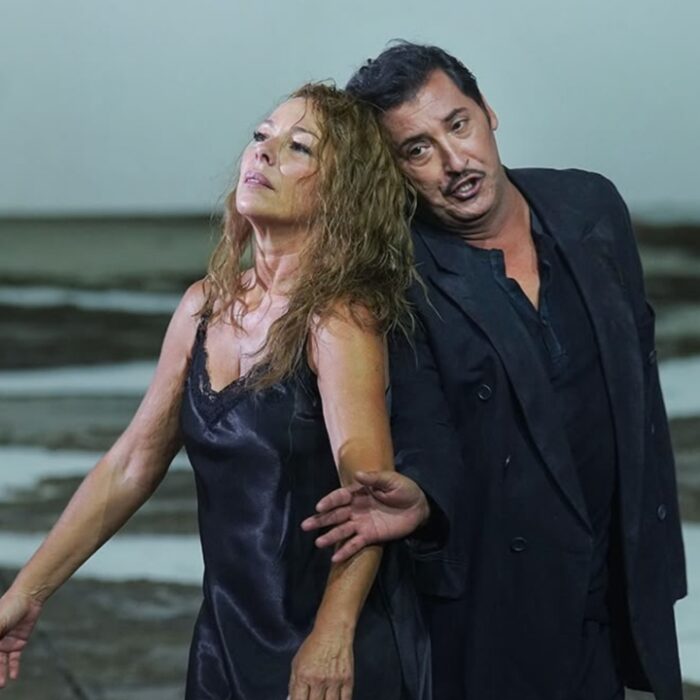
As the title role, Karolina Bengtsson’s Zaide shone as probably the sole beacon of hope in this dark world. She refused to bow to the oppressive machinery around her, fighting bravely for her own destiny. Bengtsson gave voice to real human emotion: her soprano was firm and radiant. In her famous aria “Ruhe sanft, mein holdes Leben,” she brought a genuine warmth and radiance. Later, when captured again by Soliman, her fiery outburst against the tyrant was delivered without fear. She stood firm in her anger and devotion to love. If her very first few minutes hadn’t relied quite so heavily on a tearful tone, her overall character arc would have felt even more complete.
(Photo: Barbara Aumüller)
As Gomatz, Michael Porter delivered a convincing performance. He captured the character’s awakening to love alongside his unvarnished vulnerability. His vocal line was grounded and sincere, matching the genuine exhaustion of his stumbling body on stage. Still, this Gomatz carried an inescapable sense of anonymity. One cannot help feeling that he was less like a specific individual and more like an abstract symbol of a collective suffering group. Beside him, Aleksander Myrling made the most of the smaller role of Allazim, infusing the figure with genuine empathy and ellusive moral awakening.
Peter Marsh’s Soliman does not have a lion’s share of the plot. But dressed in the same uniform as his gangsters, his presence was omnipresent. His tone was cold and unyielding against Zaide’s defiance. His commanding performance culminated in his second Act fury aria, flanked by trumpets and timpani, he conveyed a terrifying authority. Curiously enough, his desire for Zaide was almost impossible to sense.
This ruthless efficiency extends to Osmin, played by Pete Thanapat, who handled his bullying the captured lover couples with chilling precision. Meanwhile those repeated notes from his aria “Wer hungrig bei der Tafel sitz” showed clearly Osmin’s vulgar nature. Of course, the minor satirical moments of the original libretto are not highlighted on stage to keep the focus entirely on the production’s oppressive tone.
In the pit, the Frankfurter Opern und Museumsorchester under George Petrou delivered an energetic, and highly theatrical performance. The extensively integrated “Thamos” passages bridge the gaps in Mozart’s fragment effectively, bringing out a dramatic gravity that even hints at later “Idomeneo” and “Don Giovanni.” Petrou kept the tempos tight, extracting remarkably vivid playing from the orchestra, particularly the brass and strings.
This is a well-crafted production backed by robust logic. It knows exactly what it wants to say about power and human spirit, delivering a haunting 90-minute experience without falling into over-interpretation. Naturally, this staging could only be imaginable after witnessing the cruel twentieth century.