Teatro San Carlo 2025-26 Review: Alcina
By Laura Servidei(Photo: Luciano Romano)
Handel Arrives at Teatro San Carlo
It is hard to believe that Teatro San Carlo, one of Europe’s largest and most prestigious opera houses, had never staged an opera by Handel. And yet, until now, not a single note by the 18th century’s most famous and prolific opera composer had ever resounded in this historic house—a streak finally broken by a performance of “Alcina.” While it is unfortunate that perhaps the most theatrical of Handel’s operas was presented merely in concert form, this event remains an immensely appreciated and noteworthy milestone.
The Spell of the Libretto
The libretto draws its source from Lodovico Ariosto’s 16th-century chivalric epic “Orlando Furioso.” The heroic knight Ruggero finds himself on an island ruled by the sorceress Alcina, who enchants every handsome man shipwrecked on her shores, turning them into feral beasts, trees, or rocks once she tires of them. Ruggero falls literally under Alcina’s spell, indulging in worldly pleasures while forgetting his glory, his heroic duty, his Christian faith, and his fiancée Bradamante. Determined to save him, Bradamante arrives on the island disguised as the knight “Ricciardo,” accompanied by Melisso. Alcina’s sister, Morgana, takes a liking to “Ricciardo,” but once Melisso uses a magic ring to awaken Ruggero from his enchantment, the knight recommits to Bradamante’s love. Together, they break Alcina’s power, restoring her former lovers to human form while defeating both sorceresses, who reveal their true nature as hideous old hags. At its heart, this is a coming-of-age story: Alcina and her island represent a dream and an illusion—beauty born of magic and fantasy. When Ruggero matures (“wakes from the spell”), both revert to reality: a desolate rock in the middle of the sea and an aging witch stripped of her charm.
In Uncharted Baroque Waters
The performance practice of Baroque opera has matured significantly over the past half-century, characterized by period instruments and precise (if, according to some, fairly arbitrary) stylistic conventions. The San Carlo Orchestra found itself in somewhat uncharted territory given their modern instruments and limited background in 18th-century repertoire. It was difficult to shake an impression of the “old-fashioned;” while the sound lacked the crispness of a historically informed execution, the orchestra nevertheless played with great precision. They offered beautiful details, such as the inspired violin solo during Morgana’s aria “Ama, sospira,” or the cello solo in “Credete al mio dolore.” (However, the horns in the introduction to “Sta nell’ircana” were less than focused.) What felt noticeably absent was a sharper differentiation of the affetti across the various arias: conductor Iván López Reynoso did not quite manage to vary the interpretive tone between scenes, leaving the overall result slightly monotonous.
A Triumph for Alcina
The title role was originally intended for Lisette Oropesa, who fell ill three days before the opening (on October 7). She was replaced by Mariangela Sicilia, fresh off her success at the same theater as Sifare in “Mitridate.” Despite her last-minute stepping-in, Sicilia was superb. Her high soprano displayed both the precise, pearly coloratura required for the part and a sweet, mellow core in her middle register. This range served her exceptionally well in Alcina’s pièce de résistance, “Ah, mio cor,” which was deeply moving and charged with emotion. She was equally convincing in her furore arias, such as “Ma quando tornerai,” successfully balancing Alcina’s regal authority with the vulnerability stemming from a sincere love for Ruggero—a passion that ultimately proves to be her undoing.
Pure Magic from Morgana
As Morgana, Erin Morley deployed a silvery, sparkling soprano ideally tailored to Alcina’s sweet, lighthearted sister. Her upper register was spectacular, featuring luminous, pinpoint-focused high notes that felt truly born of sorcery, like bright sparks from a magic wand. Morgana boasts arguably the finest joyful aria Handel ever penned: “Tornami a vagheggiar” at the end of Act one. Morley sang the absolute lights out of it, sweeping the audience along in a radiant burst of delight.
(Photo: Luciano Romano)
Fagioli’s Dynamic Ruggero
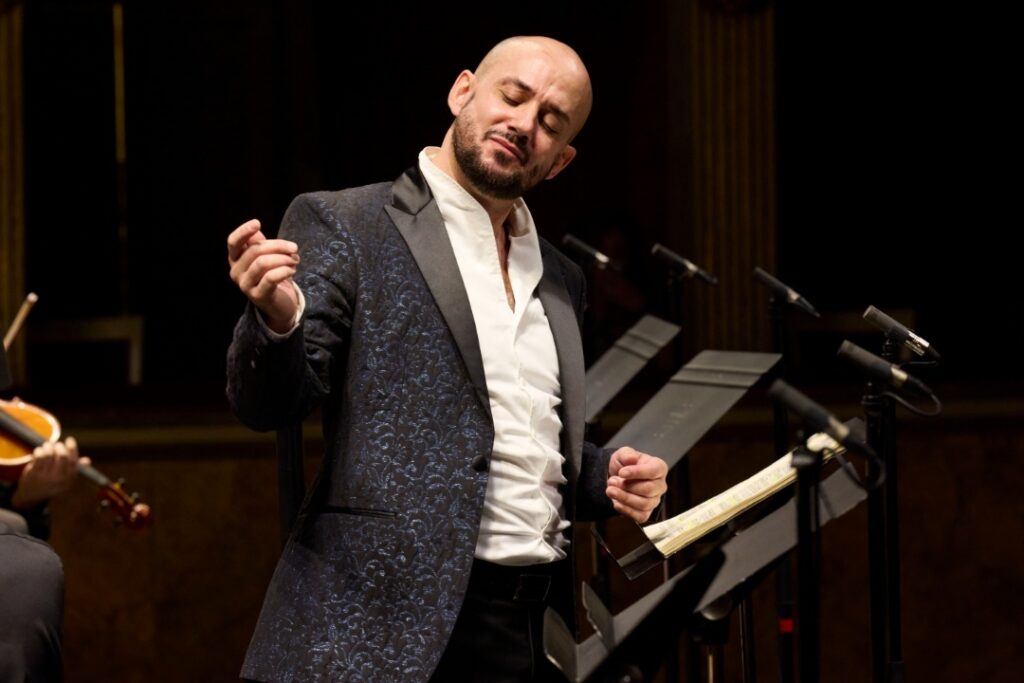
Franco Fagioli, likewise coming off his success in “Mitridate,” returned to his signature role as Ruggero. Informed perhaps by a deeper study and grasp of the character, his countertenor sounded in finer shape than in the Mozart opera (or perhaps it was simply a particularly good evening for him). The orchestra tuned to 440 Hz, forcing the cast to sing at a slightly higher pitch; one got the impression that in several of Ruggero’s arias, the key was transposed down to offer greater comfort. Even if that were the case, his performance was undeniably pyrotechnic, defined by spectacular coloratura and brilliant high notes. Nowadays, concert performances frequently benefit from a semi-staged approach where singers act out their roles without full sets or costumes. That was not the case in Naples, where the execution remained strictly concertante; singers even left the stage while another delivered an aria addressed directly to them. Fagioli (alongside Varduhi Abrahamyan as Bradamante) was among the few who genuinely attempted to enliven the presentation through acting and physical gesture, turning Ruggero into a truly three-dimensional character. He delivered his finest work in the slow, melancholic arias like “Mi lusinga il dolce affetto” and “Verdi prati”—the ultimate coming-of-age aria in which he bids farewell to the island’s beauty. His mezza voce was sublime, making for a deeply moving interpretation.
Flawless Virtuosity
Bradamante features perhaps the most florid coloratura in the entire opera, including tempestuous arias requiring a warlike demeanor, which Abrahamyan executed with flawless precision and phenomenal breath control. Having recently ventured into different repertoire (including a foray into throwing babies into fires), her style felt less strictly Baroque than in the past. Yet this proved no drawback, adding intensity and depth to an interpretation free of any mechanical delivery. Her mezzo was deep and bronzed, boasting seamless transitions between registers and a stunning timbre. Regrettably, extensive cuts deprived the audience of the reconciliation scene between Bradamante and Ruggero.
Closing Highlights
Tianxuefei Sun sang Oronte, Morgana’s suitor; his tenor, while impressive, felt a bit overly heroic for the role. Yunho Eric Kim portrayed Melisso with a deep, stentorian bass—perhaps a bit too stentorian, occasionally verging on the unrefined. He also missed an entry in his aria “Pensa a chi geme,” but López Reynoso quickly guided him back, and Kim demonstrated admirable composure in concluding the aria confidently. The role of Oberto is often omitted entirely from productions of “Alcina;” here, only an aria and a half survived, which Sayumi Kaneko delivered with a warm, velvety mezzo.
One hopes this successful foray into Baroque opera at Teatro San Carlo marks the beginning of a promising new chapter.