Teatro Carlo Felice Genova 2025-26 Review: Tristan und Isolde
By Ossama el Naggar(Photo: Marcello-Orselli)
“Tristan und Isolde” is a colossal work, not only for its length (five hours, including two 30-minute intermissions), or for the influence of the famous Tristan chord on Western music, but also for the symbolism it represents. Wagner was hugely influenced by Schopenhauer’s philosophy when he wrote this masterpiece, while conducting an affair with Mathilde, the wife of his benefactor, Swiss businessman Otto von Wesendonck.
Arguably the apex of opera, “Tristan und Isolde” is notoriously challenging to stage, as there is little action and its story is well known. The optimum staging of this opera is one that accompanies the action without adding inane stories onto the simple narrative. Sadly, many productions overthink it, which is always the source of my apprehension when faced with seeing a production of this, my favourite opera. A case in point is Bárbara Lluch‘s mediocre production for Barcelona’s Teatro Liceu seen a month ago. With all this in mind, I nonetheless had high expectations for this production (seen February 20), as the director was Britain’s Lawrence Dale. In fact, I extended my trip to Europe especially to see this Genova production.
Production Details
For years, I’ve known Dale through his recordings as an excellent lyric tenor who mostly sang Mozart and Rossini roles with style and elegance. In 1981, he created the role of Don José in Peter Brook’s “La Tragédie de Carmen” at Les Bouffes du Nord in Paris. Years later, he started a career as conductor and later as stage director. This past August, I saw his brilliant staging of Rossini’s “La cambiale di matrimonio” at Pesaro’s ROF (Rossini Opera Festival) which, despite being an early farce by Rossini, was by far the best-staged opera at that prestigious festival. It was then and there that I vowed to Dale’s work. If he was able to render a modest early work by an eighteen-year-old Rossini into a stimulating production, I marveled at the ideas Dale would impart to “Tristan und Isolde,” the greatest of all operas.
Thankfully, I was not disappointed. Together with his set and costume designer Gary McCann, Dale intervened all but minimally in recounting the story, without distraction or wishing to “improve” it. Dale and McCann conjured a fascinating visual storyboard. The ship bearing Isolde to Cornwall was rendered as a raked, mobile circular platform, surmounted by a matching inclined disc suspended above it like a looming lid. The upper lid was used as a mirror and screen for videographic images. The effect of the platform and its upper lid was akin to an open shell, an appropriate image in the first act, which takes place at sea. The shell imagery also provided a nurturing space for the amorous couple in the second act, and for the dying Tristan in the third act.
The images projected in the background were those of the sea in the first act, the forest in the second act and ice in the third. Through John Bishop’s effective use of light and Leandro Summo’s creative video projections, the moods were expertly set for each act. The blue of the sea predominated in the first act, a red forest reflecting ardent passion in the second, and black and white images of ice alluding to death prevailed in the last act. These beautiful backdrops accompanied the action but never intruded. Bishop’s lighting indicated a perfect understanding of the opera’s chiaroscuro elements. “Tristan und Isolde” is about love and death, but it also concerns dark and light, as elucidated by Tristan in the second act’s love duet.
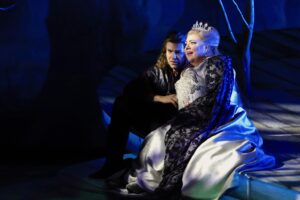
The first act opens to Irish princess Isolde wearing a regal dress and a diamond-encrusted diadem, seated on a treasure chest, insinuating that she, like the strongbox, is a tribute to the Cornish conquerors of Ireland. Isolde’s royal station and obvious pride are also thus conveyed. When she erupts into rage upon hearing the young sailor sing “Frisch weht der Wind der Heimat zu: mein irisch Kind, wo weilest du?,” the change of mood is both predictable and natural. Isolde’s rage is more against herself than against Tristan, for her love of Tantris/Tristan betrays everything she stands for: love for her future spouse and love of country. For the man who caused all this to then claim her as a spouse for his elderly uncle was too much to bear. Consumed by the consequences of her fate, Isolde turns her fury toward those she believes responsible for her undoing: Tristan and herself.
During Isolde’s narrative and curse “Von einem Kahn, der klein und arm an Irlands Küste schwamm,” there’s an enactment of the battle between Isolde’s betrothed Morold and Tristan in which the wounded Tristan mortally stabs Morold in the back, thus conveying Tristan’s unworthiness and added reason for Isolde’s rage. For once, Brangäne’s decision to substitute the poison Isolde requested for a love potion is presented as a spur-of-the moment decision.
The second act opens with Isolde being chaperoned to the meeting place with Tristan in the forest by the latter’s best friend, Melot. The latter’s ostensibly winsome manner confirms his duplicity. Brangäne’s displeasure at seeing Melot is also evident. The long duet between Tristan and Isolde is accompanied by the forest changing colour, its redder hues signifying a burgeoning passion. Upon the arrival of King Marke, Melot and the hunting party, the red forest turns gray and yellow. The besotted Tristan and Isolde are palpably unaware of the gravity of the situation. Like children, they both avoid Marke’s gaze.
The third act is the hardest to stage, due to extended lamentations by the dying Tristan and the ensuing exchange with his loyal servant Kurwenal. Only the intensity of the two singers can keep the audience interested, and that they did. However, Dale’s subtle background images, which looked markedly Nordic – though Tristan’s native Kareol is in relatively temperate Brittany – augmented the intensity. Icebergs and icy wind reflected Tristan’s emotions as he sensed impending death. These images were neither invasive nor distracting. Immersed as we were in the singers’ performances, we could just as easily not have noticed them. This was the beauty of Dale’s staging, a loving “accompagnamento” rather than an obtrusive imposition.
The majestic “coup de théâtre” was Isolde’s “Liebestod;” while she sang the most shattering of soprano arias, King Marke holds and consoles a devastated Brangäne, a testament to this loyal companion’s love for Isolde and to Marke’s forgiveness and humanity. Instead of Isolde collapsing on the dead Tristan at the end of her aria, Tristan is resurrected, insinuating an ascent to Eternity. What a beautiful message of love and humanity! Subtly and lovingly, he prioritizes love over Schopenhauer’s nihilism.
Illuminating Cast
This was unquestionably one of the finest “Tristan und Isolde” productions I’ve ever seen (and I’ve seen quite a few). The cast was strong, but not on the same level as the staging. Vocally, the two lead roles are murderously challenging, with both singing throughout. Tristan earns some respite during Act one’s narration (known as Isolde’s act), as does Isolde, at the start and middle of Act three (known as Tristan’s act). Both can recharge during King Marke’s long narration in Act two.
American soprano Marjorie Owens is best known for her German repertoire. Heard in Florence in 2019 as Senta in “Der fliegende Holländer,” and more recently as Santuzza in “Cavalleria rusticana” in Toronto last season, Owens is an incandescent singer endowed with a richly powerful voice and winning stage presence. Ideal as Senta, Sieglinde, Elsa and Elisabeth, Wagner’s more lyrical roles for soprano, Isolde tests the limits of this magnificent singer. Fortunately, she rose to the occasion with brio. At moments, especially in the second act, there was a slight metallic edge, which was forgivable, given how murderous the role is. Her Isolde was poised, intense yet also fragile. Thanks to Dale’s brilliant staging, her fury in the first act was almost terrifying. She conveyed the Irish princess’s rage against herself for succumbing to Tristan’s charm and bringing him back to health, though she had clearly figured out that the knight who called himself Tantris was none other than Tristan, killer of her betrothed Morold. Her “Liebestod” was supreme, especially in Dale’s staging, sung with beautiful legato and interpreted with subtlety; it felt like a solemn prayer.
German Dramatic tenor Tilmann Unger is a much-in-demand singer who performs Wagnerian heldentenor roles such as Siegfried, Tristan and Florstan all over Europe. His timbre is appealing and youthful sounding and his stage presence is magnificent. His phrasing too is beautifully clear, and he impressed in the first two acts. In the third, there were signs of fatigue, understandable given the role’s demands. Astutely, Unger used this fatigue to convey Tristan’s moribund condition. He was a convincing actor, but not vocally equal to his Isolde.
Italian mezzo Daniela Barcellona, heard as Isabella in “L’Italiana in Algeri” at last year’s Pesaro’s ROF, was a surprise as Brangäne – her first Wagnerian role. Already at the summit of her career, established as a leading Rossini and bel canto singer, Barcellona is a curious singer who’s eager to learn new things. Brangäne is certainly a very different role for this bel canto singer, yet Barcellona – unlike some mezzos who are basically sopranos with difficulty in their upper range – has an authentic mezzo timbre and the requisite lower notes. Hers was a warm Brangäne, maternal and caring. Her creamy mezzo contrasted well with Owen’s dramatic soprano. Her diction was astonishingly clear, rendering her lines even more memorable.
Italian baritone Nicolò Ceriani was a commanding and credible Kurwenal, more Tristan’s loving brother than loyal servant. His mocking of Isolde and Brangäne was as biting as his affection for Tristan was moving. He conveyed the desired qualities of a faithful servant: virile, humble, gruff with Isolde and Brangäne in the first act and compassionate towards his master in the last act. In the first act, he tended to sing too loudly, which disturbed the balance.
Russian bass Evgeny Stavinsky was a regal and avuncular King Marke. His important station stood out, thanks to his posture and charisma. His deep, warm voice conveyed authority as well as sagacity. In the second act, his lamentation following his discovery of Isolde’s infidelity was heartbreaking. This long monologue can easily be tedious, but thanks to Stavinsky’s interpretation and clear diction, it was deeply moving.
More Musical Details
Conductor Donato Renzetti had expressed in an interview years ago that conducting “Tristan und Isolde” was his dream. Heard last season at the helm of Nino Rota’s “Il cappello di paglia di Firenze” at La Scala, Renzetti produced a sparkling elegance more akin to Mozart than light operetta in Rota’s comic opera.
Finally Renzetti achieved his dream conducting this colossal work, and it showed from the first few bars of the work. His direction was admirably nuanced and poised, eschewing overpowering sound so as not to obscure the singers. The result was a sweet sounding, dare I say Italianate sound: “con dolcezza,” soft, loving but never saccharine or excessive. The chorus’s diction was adequate but insufficiently idiomatic. In the first act, they tended to sing too loud.
This was my third “Tristan” in six months, the previous two being that of Bayreuth in August and Lise Davidsen’s debut in the role last month at Barcelona’s Teatro Liceu. Though these were vocally and orchestrally superior, the present production was the most moving, largely thanks to Lawrence Dale’s loving staging, one I’ll not soon forget.