Maggio Musicale Fiorentino 2026 Review: Simon Boccanegra
George Petean and Luciano Ganci Shine in Florence’s Production
By Ossama el Naggar(Credit:© Michele Monasta – Teatro del Maggio Musicale Fiorentino)
Giuseppe Verdi’s “Simon Boccanegra” returned to Florence’s Teatro del Maggio Musicale Fiorentino on Nov. 24, 2026, in a new production by Àlex Ollé, co-produced with Valencia’s Palau de les Arts Reina Sofía. The evening offered several outstanding vocal performances, above all from George Petean in the title role and Luciano Ganci as Gabriele Adorno. However, the staging proved considerably less successful, failing to capture the distinctive historical and maritime character of the Genoese republic.
First performed in 1857, “Simon Boccanegra” initially encountered an unfavourable reception, largely because of the weaknesses of Francesco Maria Piave’s libretto. Verdi subsequently returned to the opera in 1881, enlisting Arrigo Boito to undertake a substantial revision. The resulting version transformed the work into one of the composer’s most sophisticated creations, combining political intrigue with a deeply moving exploration of paternal love, personal sacrifice and reconciliation.
The historical setting was particularly significant. Medieval Genova, one of the great maritime republics alongside Venice, Pisa and Amalfi, was a wealthy commercial power whose political life was dominated by the rivalry between its patrician and plebeian factions. Boccanegra, a former pirate elected Doge by the people, sought to reconcile these antagonistic interests. His aspirations were ultimately personal as well as political: the rediscovery of Amelia, his daughter by Maria, brought a profoundly human dimension to the conflict. Verdi’s attachment to this father-daughter relationship was especially poignant, given the early deaths of his own children.
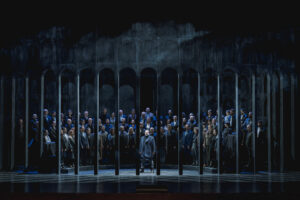
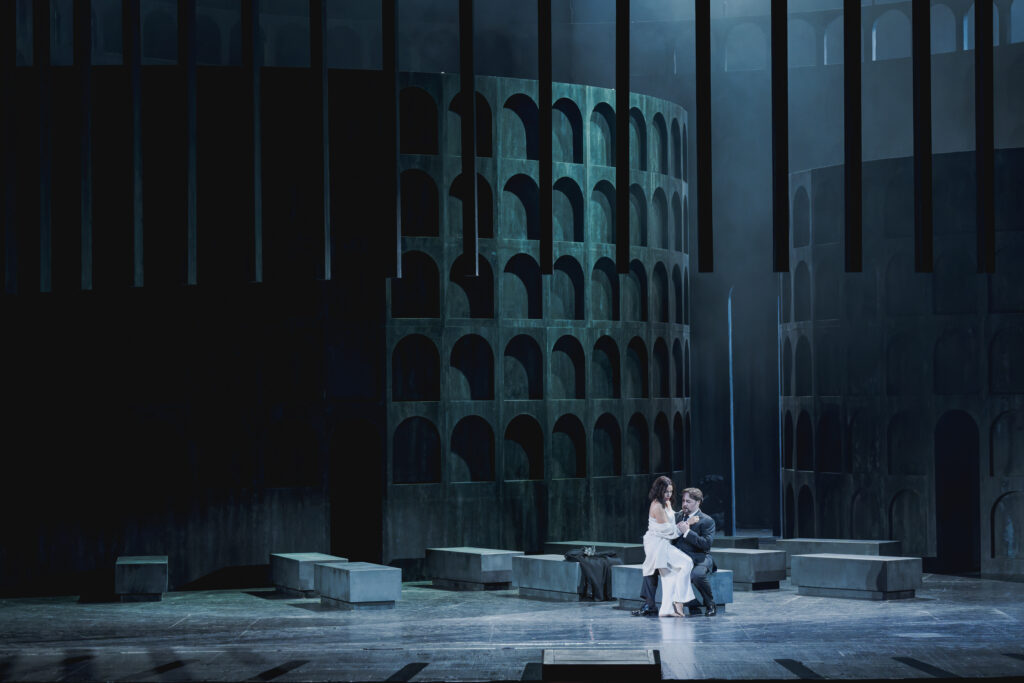
Àlex Ollé, one of the founding members of La Fura dels Baus, chose to abandon the opera’s medieval setting in favour of an indistinct contemporary environment. The central scenic element, designed by Alfons Flores, was an enormous rotating architectural structure, suggesting at different moments the Colosseum, the Tower of Babel or a monumental seat of political authority. It served as Fiesco’s residence, Amelia’s palace, the Senate and Boccanegra’s ducal headquarters.
The production’s visual vocabulary was dominated by black and grey, creating an atmosphere of unrelieved gloom. More seriously, the sea, so essential to the identity of Genova and to Boccanegra himself, was entirely absent. The conflict between patricians and plebeians also lacked convincing dramatic definition. Ollé’s contemporary setting might have offered an opportunity to reinterpret the political tensions as a struggle between harbour workers and commercial elites, but no such coherent parallel emerged.
The production was also short on dramatic invention. The crowd scenes lacked menace, and the romantic garden scene between Amelia and Gabriele was transferred to an austere courtyard. The final act was particularly distracting: a gathering of elegantly dressed socialites occupied the stage during Boccanegra’s death scene, drawing attention away from one of the opera’s most moving moments. A more historically specific or imaginatively conceived production would have served Verdi’s masterpiece considerably better.
The musical performances, fortunately, provided ample compensation.
George Petean was the evening’s undisputed star as Simon Boccanegra. The Romanian baritone brought a dark, attractive timbre, homogeneous vocal production and considerable expressive authority to the role. His voice possessed the necessary substance, while his command of Verdi’s phrasing gave the character an underlying nobility. Rather than exaggerating the Doge’s anger and political authority, Petean portrayed him as a fundamentally dignified man whose personal suffering remained close to the surface.
His most affecting moment came in the Act one recognition scene with Amelia, “M’abbraccia, o figlia mia.” The tenderness with which he greeted his long-lost daughter was deeply moving, and he conveyed the emotional transformation with admirable restraint. His final scene, particularly “Oh refrigerio!… la marina brezza,” was equally impressive. The Doge’s thoughts returned to the sea as he approached death, and Petean shaped the passage with exquisite sensitivity. Having admired his Germont in Berlin the previous year, I was particularly pleased to encounter him in one of Verdi’s greatest baritone roles.
Luciano Ganci gave an outstanding performance as Gabriele Adorno, arguably the evening’s finest vocal achievement. His ringing, virile tenor possessed generous projection, a distinctive Italianate timbre and the spinto resources required by the role. His vocal production remained remarkably assured, even in the more dramatic passages, while his phrasing retained a youthful lyricism.
Like in previous Verdi roles I had seen him in, he demonstrated once again why he deserves greater recognition on major international stages. His “Io la vidi” was beautifully and elegantly sung, while his passionate exchanges with Amelia revealed his ability to combine lyrical warmth with dramatic intensity. In “Sento avvampar nell’anima,” he conveyed Gabriele’s jealousy with considerable vehemence without lapsing into caricature. Although the character was less dramatically substantial than Boccanegra or Fiesco, Ganci made an exceptionally strong impression and received an enthusiastic response from the audience.
Jongmin Park was an imposing Jacopo Fiesco. His substantial bass conveyed the authority and aristocratic bearing of the patrician, while his interpretation avoided turning the embittered father into a one-dimensional villain. His “Il lacerato spirito” was particularly moving, communicating the old man’s grief and desire for revenge with considerable gravity. There were occasional limitations in expressive nuance, and he sometimes overemphasized his lower register, but the overall performance was authoritative and vocally impressive.
Carolina López Moreno’s Amelia was more variable, although she brought a luminous upper register and a commendable stage presence to the role. Some passages appeared to place considerable demands on her vocal resources, and her “Come in quest’ora bruna” lacked the sustained ease and legato that the aria required. Nevertheless, she was more successful in the recognition scene with Boccanegra, where she conveyed Amelia’s vulnerability and joy with greater naturalness. Her Act one “Nell’ora soave” was also more assured. While the role was not an entirely comfortable fit, she contributed some effective moments to the performance.
A particularly welcome surprise was Lodovico Filippo Ravizza as Paolo Albiani. Often a relatively thankless secondary role, Paolo emerged as a compelling theatrical presence in Ravizza’s hands. His insinuating vocal color, intelligent phrasing and understated characterization conveyed the character’s ruthless ambition without resorting to exaggerated villainy. His portrayal was sufficiently nuanced to make the audience almost pity this deeply unpleasant individual.
Huigang Liu as Pietro and Luca Tamani as the Captain provided solid support. The chorus, under Lorenzo Fratini’s preparation, made a valuable contribution to the performance.
James Conlon conducted the Maggio Musicale Fiorentino Orchestra with considerable sensitivity to the score’s orchestral colors. The balance between orchestra and voices was excellent, and the instrumental sonorities were often particularly beautiful. His reading, however, occasionally favored measured tempi and a uniform melancholy that somewhat diminished the dramatic momentum. Greater contrasts would have benefited the political confrontations and the more turbulent passages. Nonetheless, his command of the orchestra and attention to detail were commendable.
Ultimately, this “Simon Boccanegra” was a musically rewarding evening, distinguished by Petean’s noble interpretation, Ganci’s exceptional tenor and Park’s authoritative bass. Ravizza also made a particularly strong impression. Ollé’s production, by contrast, failed to exploit the extraordinary historical and dramatic possibilities of Verdi’s subject. The Genoese republic deserved more than an anonymous monumental city, and Boccanegra deserved a world in which the sea, the source of his identity and the lifeblood of his city, had not disappeared altogether.