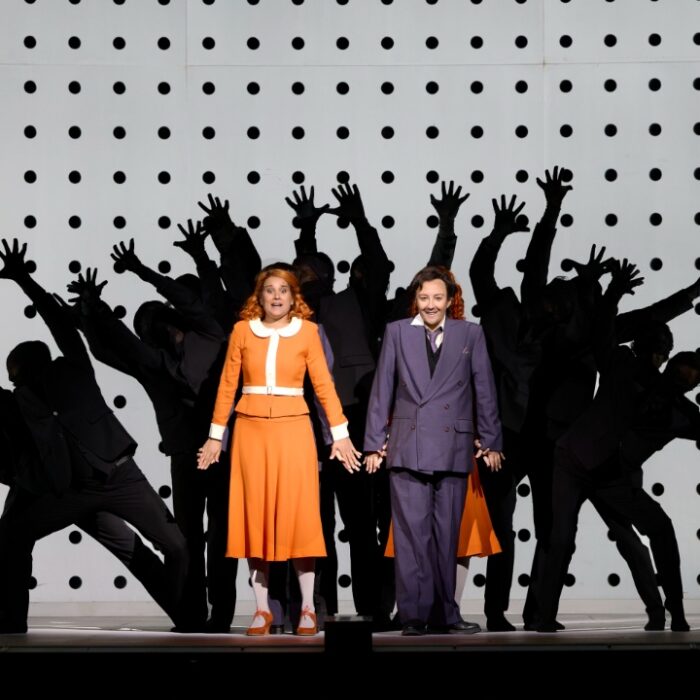
Teatro alla Scala 2025-2026 Review: La Traviata (Cast B)
By Bernardo Gaitan(Ph. Brescia e Amisano © Teatro alla Scala)
Incredibly, the curtain at Teatro alla Scala has already risen more than 300 times for the sole title of “La Traviata” since its first performance on December 29, 1859. In the lavishly produced programme, there is a list entitled “All the Violettas of La Scala,” which names the 39 sopranos who have performed the role across those three hundred performances. Interestingly, the list is headed by Tiziana Fabbricini with 30 performances between 1990 and 1995, followed by Gilda Dalla Rizza with 27 performances between 1923 and 1928, and Enrichetta Weiser with 26 performances between 1859 and 1860. Closing out the top five is Maria Callas with 21 performances between 1955 and 1956. The list also includes more recent names such as Marina Rebeka in sixth place with 14 performances, Irina Lungu in tenth place with 10 performances, Diana Damrau with 7 performances, Angela Gheorghiu and Ailyn Pérez with 4 performances each, and Anna Netrebko and Angel Blue with 3 each. Incredibly, we also find names such as Renata Tebaldi and Mirella Freni with just 1 performance.
This remarkable list of names is now joined, in this revival of Liliana Cavani’s historic production, by Nadine Sierra and Francesca Pia Vitale, who are alternating performances. For details of the production, readers can read the review dedicated to the other cast.
Michele Gamba’s conducting, leading the Teatro alla Scala Orchestra and Chorus with great sensitivity and close attention to the relationship between the music and what was happening on stage, placed particular emphasis on the interpretation of dynamics. He made certain passages considerably slower, giving a distinctive touch to what would otherwise be a traditional interpretation, while also adding numerous dramatic silences that the young singers took advantage of to further explore the dramatic side of their characters. The Milanese conductor found great allies in two young singers, by no means inexperienced, in the leading roles of Dumas’s immortal story. They responded to his vocal demands exceptionally well, demonstrating that the new generation of young talents comes with an impressive wealth of talent.
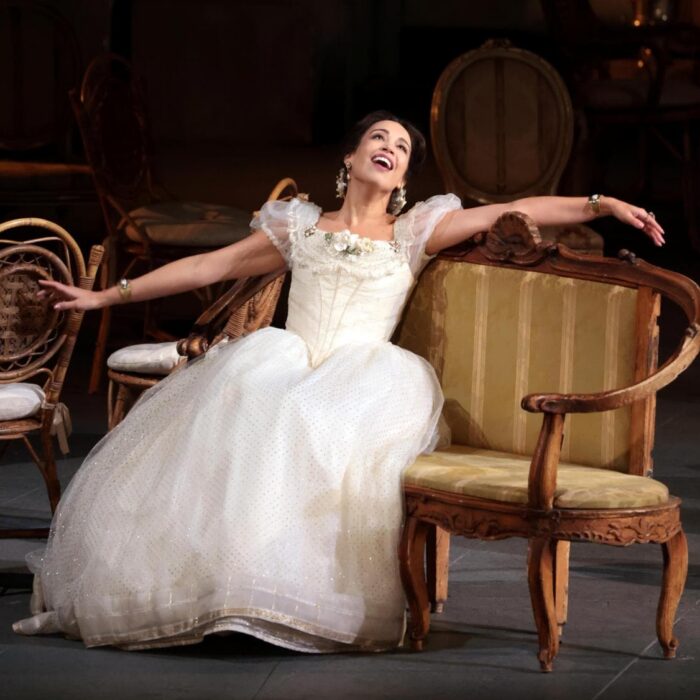
In the role of Violetta, Italian soprano Francesca Pia Vitale delivered a Violetta who remains consistent throughout all four acts. Her work on phrasing, verbal expressivity and the dramatic construction of the character stood out. Somewhat more restrained as an actress, but at the same time more elegant, she offered a rich vocality, assured top notes and a strong stage presence. Her interpretation of the exhausting and demanding Act one scene “E strano, è strano… Sempre libera” was of great quality, carefully executed and academic in its approach. She likewise closed the performance with an intense interpretation of “Addio del passato,” displaying the same qualities. She definitely brings youth and freshness to the role, especially when we remember that the real Traviata died at the age of 23.
In the role of Alfredo, Iván Ayón-Rivas proved a most welcome surprise. The Peruvian tenor possesses brilliance and distinctive character, and is a generous, capable performer who, in the Act two aria, the great letter scene “Questa donna conoscete” and the final duet, was able to give his phrasing an infinite variety of nuances. Ayón-Rivas has a luminous voice, incredibly well projected and supported, with enviable diction and a squilloreminiscent of the tenors of old. He is unquestionably a bold and reliable Alfredo.
Saori Sugiyama offered a young, fresh and engaged Annina. As Germont, Boris Pinkhasovich remained consistent in this interpretation showcasing a noble and warm Germont with vulnerability and humanity. Likewise, Carlotta Vichi as Flora, Francesco Pittari as Gastone and Fabrizio Beggi as Baron Douphol were the same throughout the performance.