Teatro San Carlo 2025-26 Review: Mitridate, Re di Ponto
A Long-Awaited Premiere in Naples
By Laura Servidei(Photo: Luciano Romano)
In 1770, Naples’ Teatro San Carlo attempted to commission a new opera from the fourteen-year-old Wolfgang Amadeus Mozart while he was touring Italy with his father. Mozart declined, having already accepted a commission from Milan’s Teatro Ducale. The resulting opera, “Mitridate, Re di Ponto,” was never performed at the San Carlo until its 2026–27 season, when the house finally presented a new staging by Claus Guth featuring an international star cast.
Intrigue, Betrayal, and Duty
“Mitridate” follows a strict Metastasian framework: recitativi secchi advance the plot, while an abundance of da capo arias gives voice to the protagonists’ emotional outbursts. Amedeo Cigna-Santi’s libretto dramatizes a fictionalized chapter in the life of Mithridates VI of Pontus (in modern-day Turkey) during his wars against Rome. The narrative is rife with political intrigue and forbidden love: Mitridate plans to wed the Greek princess Aspasia and arranges a marriage between his son Farnace and the Parthian princess Ismene to consolidate alliances. However, Sifare–Mitridate’s youngest and favorite son–falls for Aspasia, who reciprocates his love. When Mitridate is reported dead in battle, Farnace attempts to seize the throne and force Aspasia to marry him. Mitridate then returns, enraged by his sons’ betrayal and bent on revenge.
(Photo: Luciano Romano)
A 1970s Domestic Drama
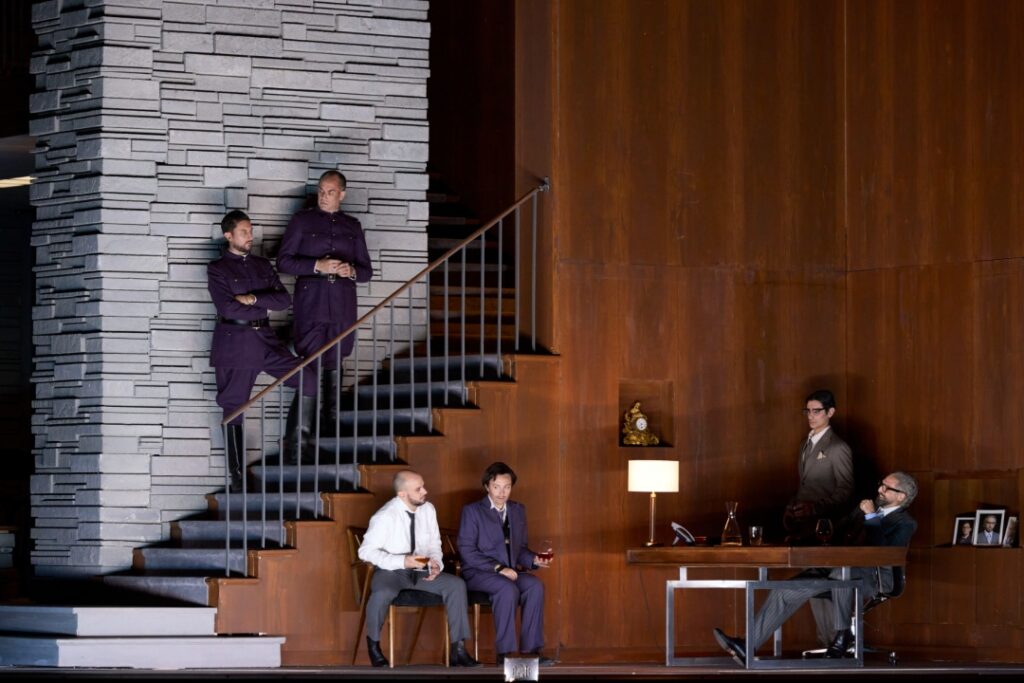
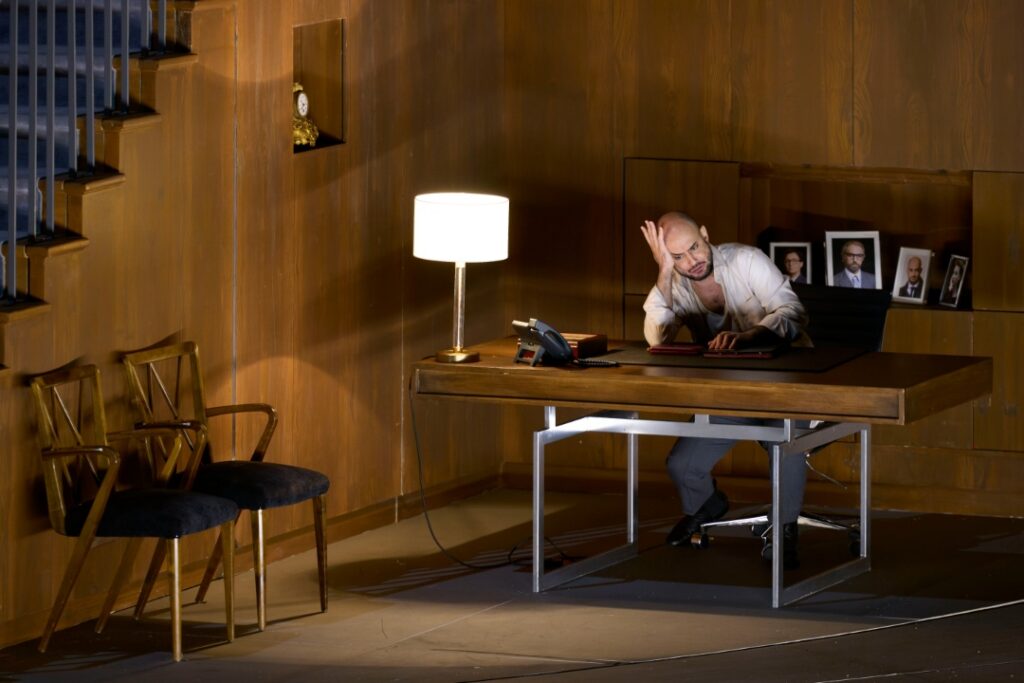
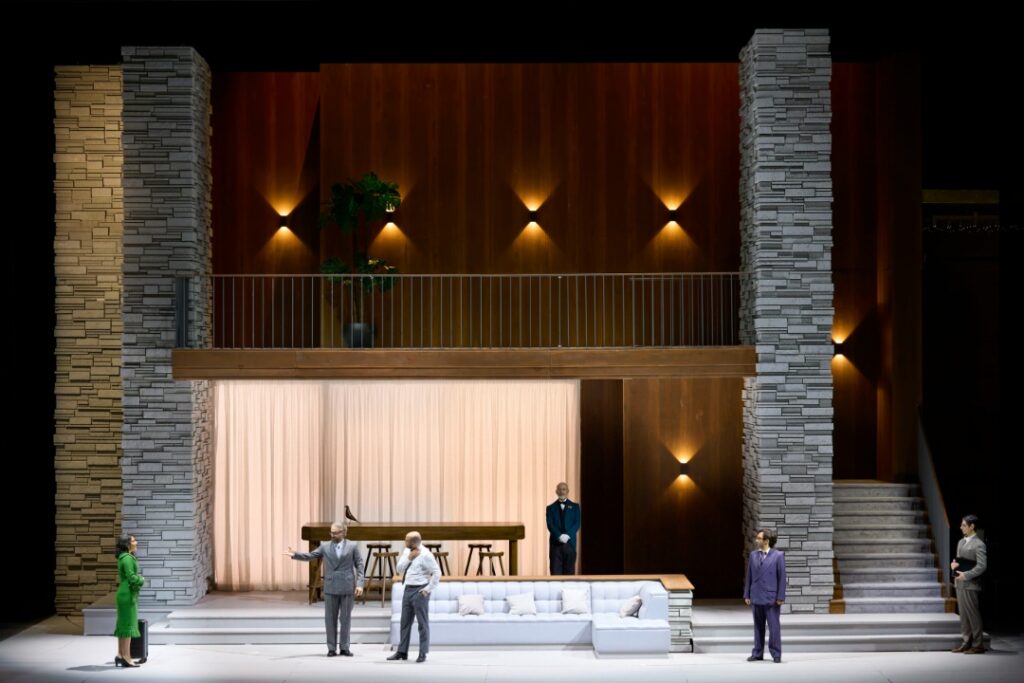
In this production, Guth updates the setting to the 20th century (likely the 1970s, judging by Ursula Kudrna’s colorful costumes), recasting Mitridate as the wealthy patriarch and business mogul of a large, elegant mansion. As is often the case, the rationale for this temporal shift remains vague–it adds little to the drama and removes the theme of war without substituting a corporate equivalent. Nevertheless, the dysfunctional family dynamics adapt easily to any era and were sharply drawn.
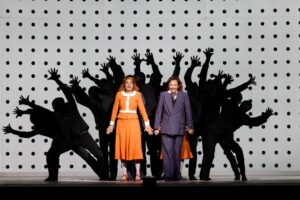
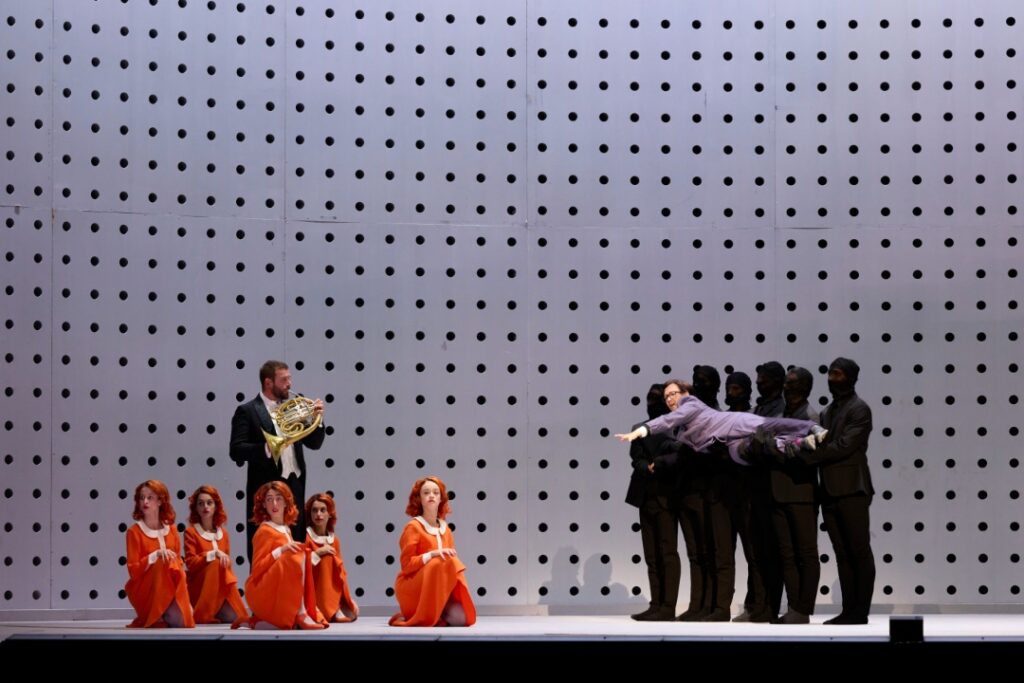
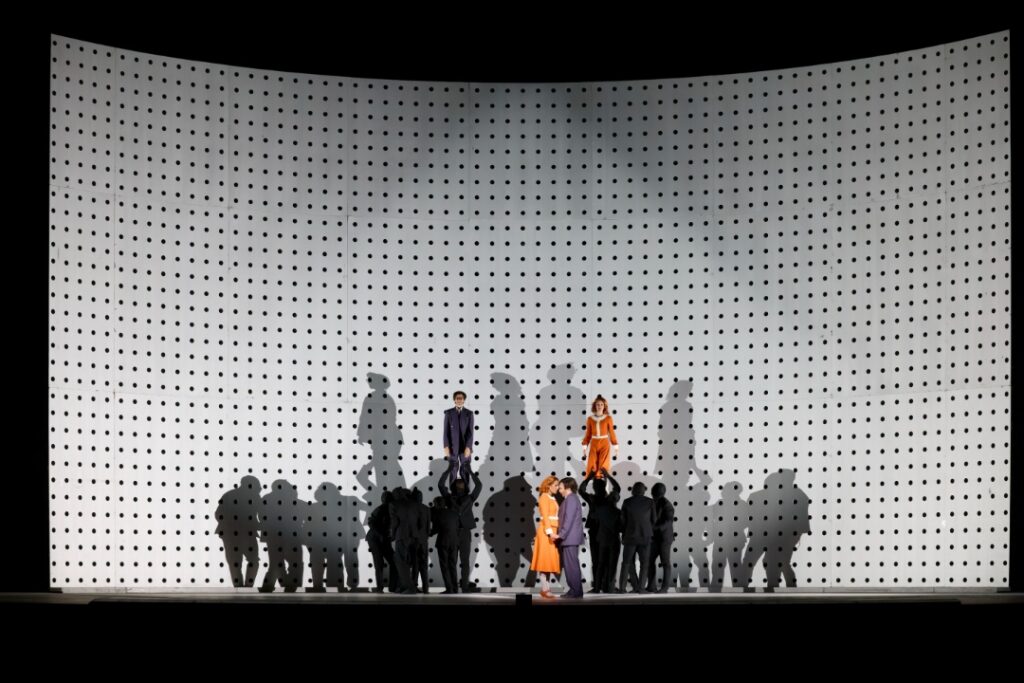
Christian Schmidt’s sets featured a revolving stage. On one side stood the mansion – complete with a sprawling living room, a view of the upper floor, and a small study where the main action unfolded. On the other, a large abstract space with a curved backdrop allowed the characters to explore their fears, desires, and nightmares alongside their “doubles” (dancers dressed in the same way) and ominous figures completely covered in black. This psychoanalytic environment lent the evening a striking, dreamlike intensity.
(Photo: Luciano Romano)
Elegance Under Frizza’s Baton
Riccardo Frizza offered a measured, classically poised reading of the score without hyperbole. He drew lush colors from the Teatro San Carlo orchestra, supporting the vocalists with careful attention to lyrical legato. His approach proved most compelling in fast tempi, where the orchestra’s precision and elegance shone; the slower numbers occasionally lacked dramatic tension, but the performance maintained a calm, steady intensity throughout. Unfortunately, most of the recitatives were cut–a regrettable trend in modern opera houses. Here, the choice proved particularly damaging: the plot is confusing enough even with the recitatives intact, and the cuts left Sifare and Aspasia’s nascent love completely unmapped, leaving the audience to take their feelings for granted.
(Photo: Luciano Romano)
Exciting Vocal Performances
Giovanni Sala sang the title role with a luminous tenor that balanced lightness with heroic weight, confirming his standing as a formidable Mozartian. While he suffered a few minor mishaps in the high register–notably during the treacherous final aria “Vado incontro al fato estremo,” where a few of its seven top Cs lacked focus–his Mitridate was an effectively brutal bully whose irrational fury toward his sons and fiancée landed with convincing force.
As Aspasia, Sara Blanch’s brilliant soprano dazzled with florid coloratura and sparkling top notes. Her technical resourcefulness easily compensated for a slightly weaker middle register. Her confidence in executing complex ornamentation was ironclad, and her picchiettati were exquisite. Clad in glamorous period attire, she commanded the stage with effortless charismatic flair.
(Photo: Luciano Romano)
Mariangela Sicilia took on the role of Sifare, performed en travesti. Guth’s treatment of her appearance was a major misstep: dressing her in an oversized gray suit, a knitted vest, thick-rimmed glasses, and a somewhat off-putting five o’clock shadow, he transformed what should have been a heroic prince who seduces his powerful father’s betrothed into a dorky, drab bureaucrat. Musically, however, Sicilia excelled. Her bright, very high soprano possessed a softer, warmer core than Blanch’s; alongside crisp coloratura, she conveyed a deep, agonizing sorrow as Sifare tore himself between duty to his father and love for Aspasia. Sifare’s aria “Lungi da te, mio bene”–in which he distances himself from Aspasia to preserve his honor–was a high point of the evening, beautifully complemented by principal horn Alessandro Fraticelli performing the solo obbligato on stage. The horn acted as a mirror to Sifare’s soul, amplifying the emotional weight of Sicilia’s singing.
(Photo: Luciano Romano)
Farnace, the eldest son who conspires with Rome to establish a puppet kingdom in Pontus, is arguably the opera’s most compelling character due to his dramatic arc. Franco Fagioli brought immense sprezzatura to the role, relishing Farnace’s entitlement as he pursued Aspasia, bullied Sifare, and openly mocked his father once exposed. Fagioli tackled some of the score’s most pyrotechnic arias with razor-sharp coloratura and fiery commitment. His countertenor showed some slight signs of wear, in particular, his middle and low register at times seem to drop into his male voice, losing the countertenor technique. This may have been a choice, of course; if that’s the case, then maybe he did this a bit too often. His high notes were somewhat drier than in past years, but he wisely refrained from interpolating extreme top excursions. In his final aria of repentance, “Già dagli occhi il velo è tolto,” Fagioli delivered a heart-rending interpretation grounded in superb breath control and seamless legato.
Giuliana Gianfaldoni brought a creamy, supple tone to Ismene. Her even timbre across all registers lent appropriate gravitas to the spurned Parthian princess, pairing powerful top notes with precise coloratura. Tenor Alasdair Kent (Marzio) and countertenor Agustín Pennino (Arbate) rounded out the cast with solid vocal contributions, completing a successful evening at the San Carlo.