Teatro alla Scala 2024-25 Review: Anna A.
Silvia Colasanti’s Opera World Premiere Marks a Historic Milestone for La Scala
By Bernardo Gaitan(Photo: Brescia e Amisano / Teatro alla Scala)
A major project with deeply feminine roots took place at Teatro alla Scala with the world premiere of “Anna A.,” a commission that, for the first time in the theater’s history, was entrusted to a female composer. The honor went to none other than Silvia Colasanti, currently the most frequently performed living Italian composer, who wrote an opera about the dramatic and tragic life of a woman: the poet Anna Akhmatova.
Adding to the symbolism, the first performances were also conducted by a woman. With a libretto by writer and Slavic studies expert Paolo Nori, this one-act opera tells the story of the great Russian poet whose voice of truth and resilience endured through Stalin’s reign of terror.
(Photo: Brescia e Amisano / Teatro alla Scala)
Musical Highlights
Colasanti’s score, lasting about seventy minutes, is agile, transparent, and surprisingly accessible. It is crafted with an economy of means that never turns minimalist. Fortunately, the Roman composer’s musical language distances itself from the clichés of certain contemporary music filled with atonality, distorted rhythms, and exaggerated cadences. Colasanti employs a traditional orchestra, to which she gives clear melodic and harmonic phrases–immediately recognizable to the European ear–while never abandoning modernity. The result is music that is alive, elegant, and communicative.
The score includes cabaret-like dances, dramatic arias, powerful choral passages, and lyrical ensembles. There are moments of deep intimacy, irony, and tragedy, with melodic echoes of Shostakovich, Rachmaninov, and Britten, all filtered through a distinctly Italian sensibility. The music alternates between spoken text, lyrical singing, and a kind of “sung conversation” creating a continuous flow of sound and meaning.
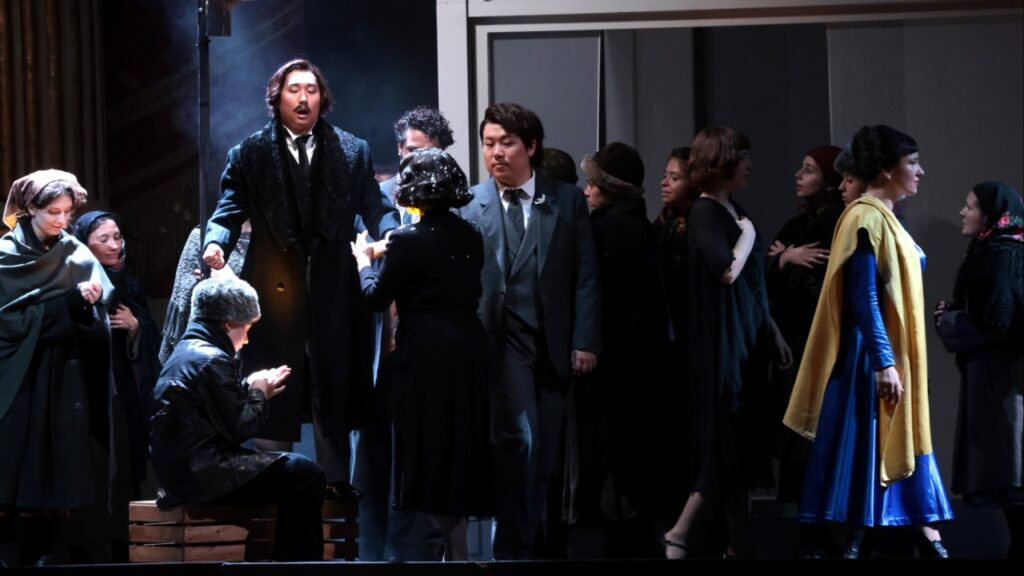
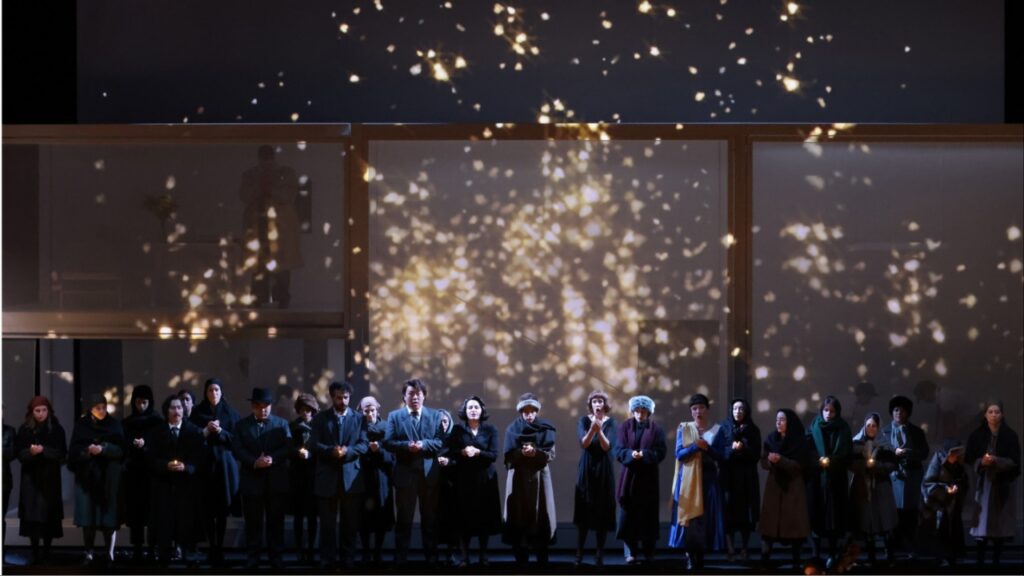
“I have always been fascinated by Russian literature,” Colasanti states in the program notes. “Akhmatova’s life, her courage, her art represent the moment when poetry meets history–when private pain becomes political truth,” she noted. The most moving scene, the “Chorus of Mothers” portrays women waiting outside the prisons of Leningrad: their voices merge into a collective requiem. Here, Akhmatova becomes the voice of all those who endured unspeakable suffering and transformed it into dignity.
(Photo: Brescia e Amisano / Teatro alla Scala)
Anna Akhmatova
Born in Odessa in 1889, Anna Akhmatova was one of the most powerful and courageous poetic voices of the 20th century. A leading figure of Russian Acmeism, a literary movement that sought clarity and precision in contrast to Symbolism, she personally experienced the ideological violence of the Soviet regime: her first husband, the poet Nikolai Gumilyov, was executed; her son Lev was imprisoned; and her partner Nikolai Punin died in a gulag. “Anna A.” does not recount these events chronologically, but through a torrent of memories surfacing in the mind of a dying woman. The action unfolds in a sanatorium in Domodedovo, near Moscow, where the elderly poet, attended by her friend and fellow writer Lidija Chukovskaya, revisits fragments of her life. Present-day dialogue alternates with visions populated by ghosts from her past poets, lovers, friends, and victims. Among them, the silent shadow of her son Lev becomes the gravitational center of her memories.
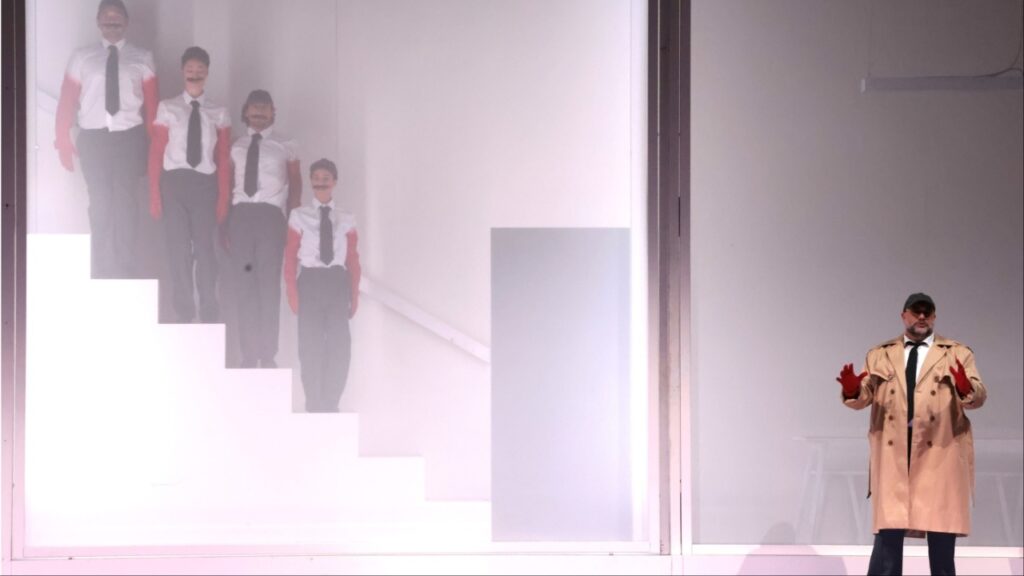
Alongside historical literary figures such as Boris Pasternak, Osip Mandelstam, Marina Tsvetaeva, and Mikhail Bulgakov, Nori and Colasanti introduce an especially intriguing allegorical figure: The Power / The Authority (Il Potere), a chilling embodiment of ruthless and unyielding authority. While clearly evoking the Russian government of that era, the character’s presence resonates universally and remains hauntingly relevant today. This figure maintains constant dramatic tension, a symbol of an invisible regime that never relents.
(Photo: Brescia e Amisano / Teatro alla Scala)
Production Details
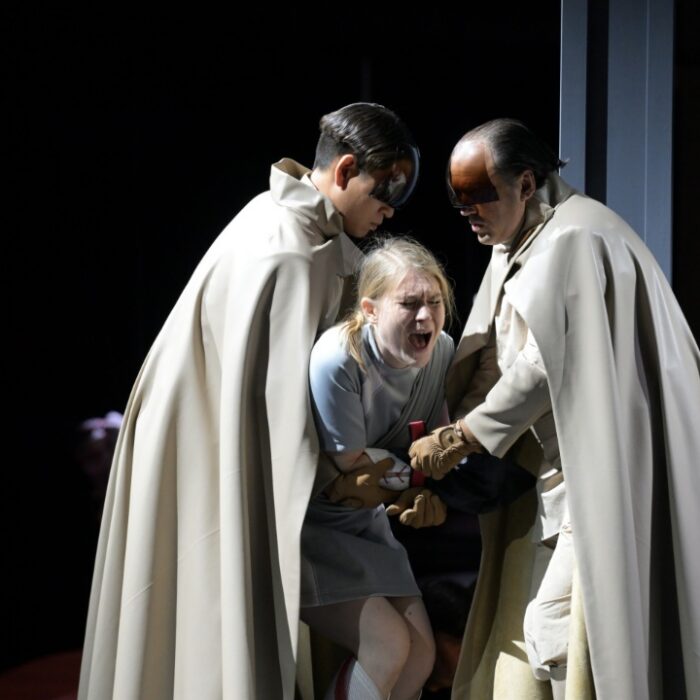
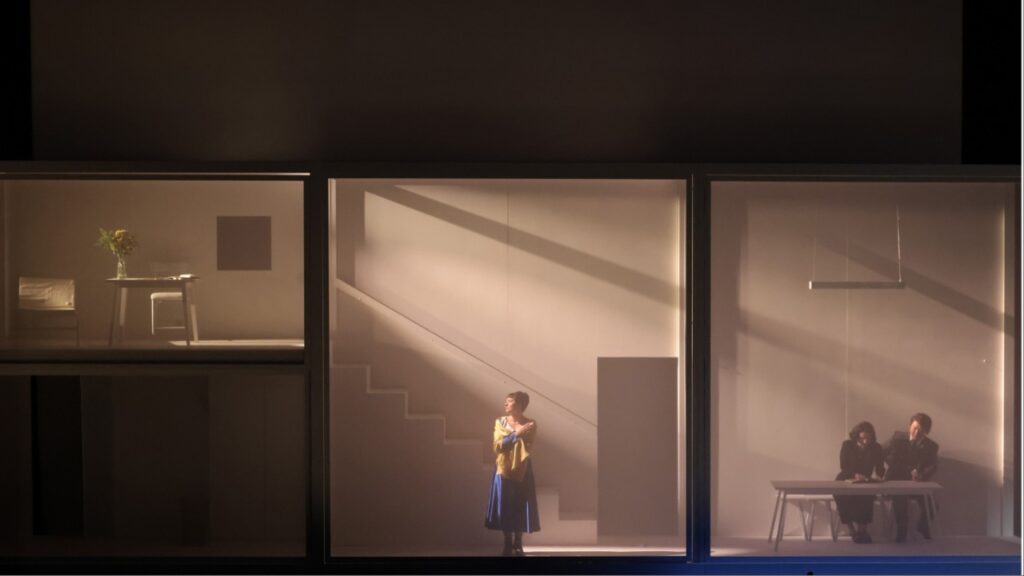
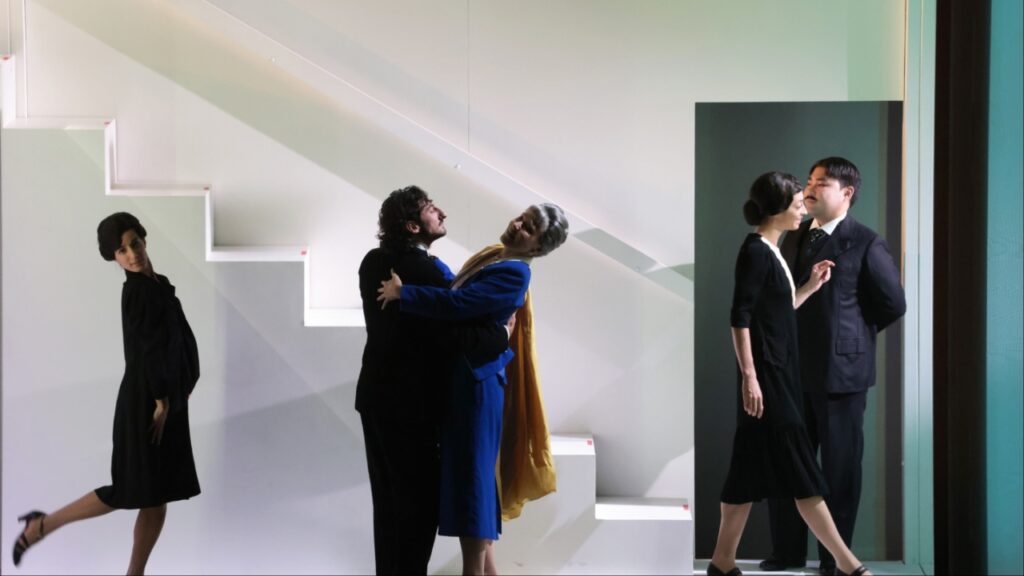
The stage direction by Giulia Giammona is discreet yet highly effective. Her minimalist approach suits the work’s introspective nature and gains vitality through the use of multimedia, integrating singing and acting within the same space. The set design by Lisa Behensky frames the action within a white geometric structure divided by translucent veils, onto which Martin Mallon’s videos are projected: archival footage, poetic imagery, and dreamlike visions. The costumes by Giada Masi, especially those of the three “Annas”–child, young woman, and elder–all dressed identically in blue and yellow, subtly evoke the colors of the Ukrainian and/or European Union flags, suggesting continuity between past and present struggles.
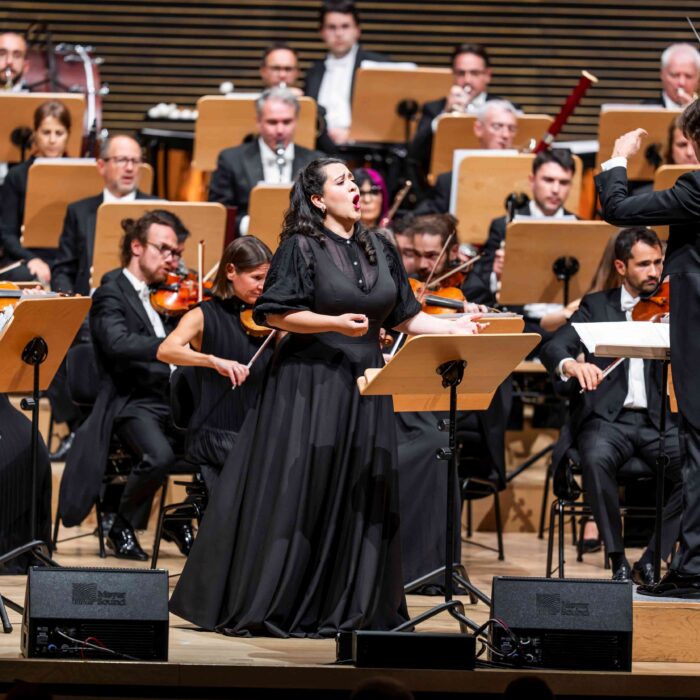
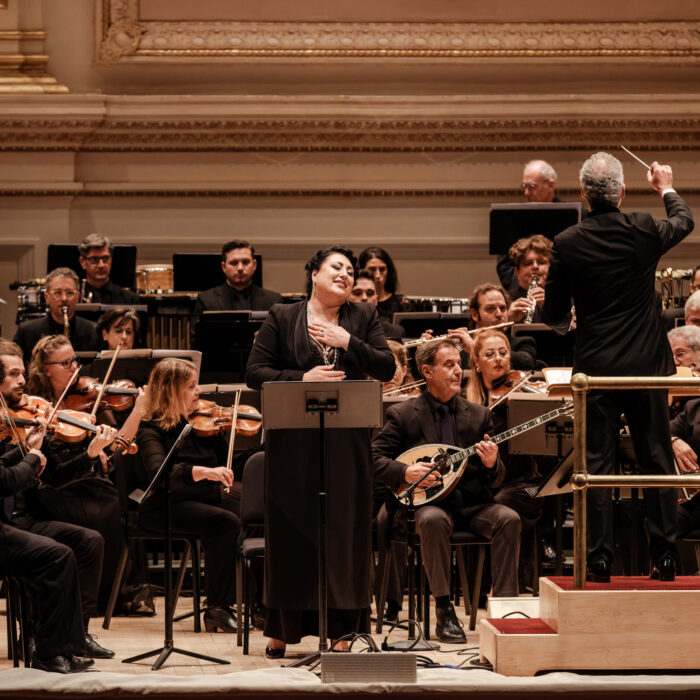
The Orchestra of the Accademia Teatro alla Scala, conducted by Anna Skryleva (who will share the podium in future performances with Bruno Nicoli and Paolo Spadaro), played with discipline and sensitivity, shaping Colasanti’s textures with luminous precision. Skryleva conducted with firmness and clarity, giving the complex score a natural flow. The Accademia Youth Choir, prepared by Dario Grandini, was particularly impressive in the choral passages, especially in the “Chorus of Mothers” which forms the emotional core of the opera.
(Photo: Brescia e Amisano / Teatro alla Scala)
Stellar Cast
The title role is shared by two performers: actress Elena Ghiaurov as the present-day Anna, and soprano Laura Lolita Perešivana as the Anna of the past. Ghiaurov, a distinguished stage actress, embodies her role with sculptural expressiveness and a dark, polished voice that conveys both fragility and strength. Perešivana, for her part, offers a radiant, fluid voice with luminous high notes that capture the innocence and artistic awakening of youth.
Actress Carlotta Viscovo gives a tender, human portrayal of Anna’s friend, Lidija Chukovskaya, while Aleksandrina Mihaylova (Nina Berberova / Marina Tsvetaeva) impresses with her crystalline tone and emotional clarity. Haiyang Guo as Osip Mandelstam stood out for his palpable political conviction and bright, ringing voice, while mezzo-soprano Valentina Pluzhnikova delivered a warm and flexible interpretation in her roles as Zinaida Gippius and Nadezhda Mandelstam.
Among the men, Wonjun Jo as Gumilyov/Bulgakov, and Geunhwa Lee as Punin/Gorodetsky, were solid and musical, and Xhieldo Hyseni brought depth and dignity to his Boris Pasternak.
(Photo: Brescia e Amisano / Teatro alla Scala)
A special mention goes to Damiano Salerno as Il Potere (The Power/Authority), whose dark, resonant baritone imbued the character with unsettling persuasion, shaped through insinuating phrasing and magnetic intensity.
Colasanti’s opera speaks to the present through the lens of the past about the cost of truth, the necessity of memory, and the fragile courage of art under oppression. This world premiere marks a historic milestone for La Scala and a symbolic step forward for contemporary opera. Through its brilliance and simplicity in addressing such a complex, essential subject–one seemingly distant in time and place from central Europe–”Anna A.” invites one to reflect on whether the world has truly changed.