Pinchgut Opera 2026 Review: The First Murder
By Gordon Williams(Photo credit: Anna Kučera)
Pinchgut Opera’s Artistic Director, Erin Helyard, had long wanted to present “The First Murder” by Alessandro Scarlatti. This production, which premiered on Saturday May 23, was the second by Pinchgut to be presented in the Roslyn Packer Theatre in Sydney’s Walsh Bay, Pinchgut’s normal home being Angel Place recital hall, a concert venue suited to the smaller scale of many of the baroque works they present.
Scarlatti’s opera is based on the Genesis story of Cain’s murder of his brother Abel and the ramifications not just for the brothers but of the devastation felt by the first parents, Adam and Eve, whose own sin in the Garden of Eden “brought death into the world and all our woe” (to quote Milton). The original title of the work was “Caino, overo il primo omicidio.” The libretto by Cardinal Pietro Ottoboni (1667-1740) reflects on the devotional meaning of this crime and its consequences, ending with a promise by God to give Adam a son who “shall never die until the great judgment comes” (quoting from Natalie Shea’s translation of the libretto published in the generously-informative program booklet).
In opera-seria format, “The First Murder” proceeds slowly. “Glacial” was the word used by one audience-member in my vicinity. Da capo aria follows da capo aria occasionally enlivened by instrumental sinfonie in a contrasting format, or, as Helyard points out in his program essay, occasional adjustments of the da capo form to create longer, more emotionally complex numbers.
Just listening to the work there’s an incredible intensity to this stealthy approach to catastrophe and its gradual release from tension. A contemporary expression might be “slow motion car-crash,” and the use of a contemporary expression is apt to this production which is set in a modern Australia.
Firstly, there was much to savor musically in this performance. Principals Kyle Stegall (tenor) as Adam, sopranos Sara Macliver as Eve and Madison Nonoa as Abel, and mezzo-soprano Ashlyn Tymms as Cain dexterously ornamented their da capos, injecting intensified emotion into their parts, such as Sarah Macliver’s elaborate anguished intensifications of initial tenderness in the aria “Caro sposo,” in which Eve counsels her husband “to endure the punishment we have earned.”
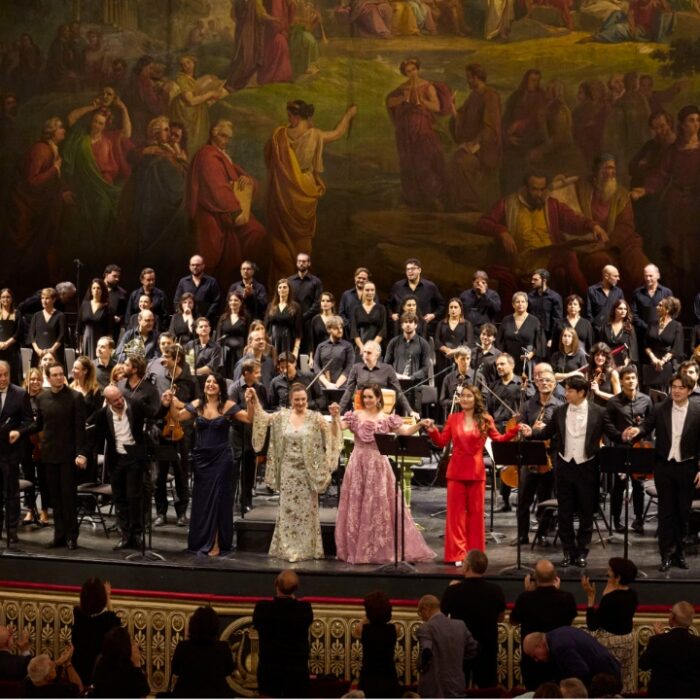
The orchestra conducted by Helyard sustained interest in the work’s inexorable progress, always enlivening the texture with rhythmic precision and wide rhythmic vocabulary. The Orchestra of the Antipodes, Pinchgut’s regular ensemble, comprised mostly strings – incredibly expressive ones as was immediately evident from Lead Violin Matthew Greco’s opening plaint. But one of the most satisfying features of this performance was the at-times large continuo section and its reflection of the varying motivational cross-currents of the plot, with, in Helyard’s podcast-words, “the angelic harp…the brightness of the harpsichord, the smoothness of the organ, the roundness of the theorbo, the brilliance of the guitar.” Additionally, Helyard depicted Lucifer and in fact conflict (Cain and Abel’s fight) with an instrument called the Regal whose acoustic ugliness it has to be said conveyed emotional extremity through the simplest of means.
Though in opera-seria format, the work was originally described as a “sacred entertainment,” what we might call, these days, an oratorio, meant to be religiously instructive, and usually presented these days in concert. But Pinchgut’s “The First Murder” was fully staged – inside an actual theatrical space. How was this handled by director Dean Bryant, Artistic Director/Co-CEO of Melbourne’s Malthouse Theatre, and lyricist and co-writer of the acclaimed recent musical adaptation of Miles Franklin’s “My Brilliant Career”?
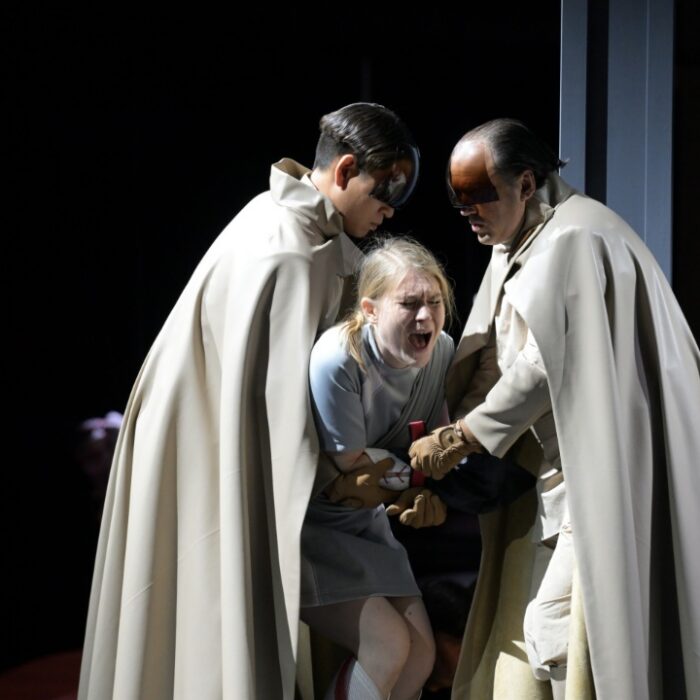
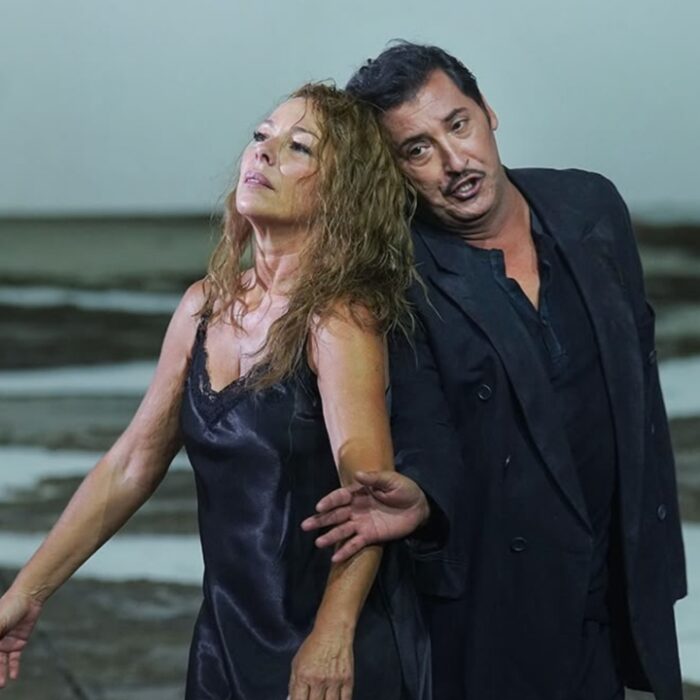
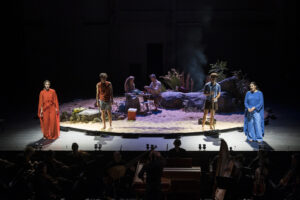
The production is set on the Australian coast featuring a nuclear family (Mom, Dad and the kids) on holiday at the beach, having undergone some undiscussed trauma. So, Jeremy Allen’s set entailed a circular sandpit and rocky outcrop which served convincingly for the scrubby beach environment, but perhaps also, given the sandpit, with connotations of a playground. Thanks to BROCKMAN’s lighting, the production stills for “The First Murder” look fantastic.
But how well did the parallel story work? It was Australian enough. Dad (Adam) at one point took a stubby out of the Esky (for Americans: a 375mL beer bottle out of a cooler).
But I found myself riven by competing reactions, hearing the Bible story on one hand with all its reflective piety, and seeing an Australian beach-holiday scene on the other, but not necessarily feeling that one enhanced the other, or that perhaps the relative weighting was the right way round. A family trauma against a beach-holiday scene can conjure associations for Australians of a certain age – it’s kind of a trope. Bryant acknowledged nostalgic connotations in an interview on the company’s podcast. One question that arose for me was whether the text could have been even more emphasized, beyond what surtitles can achieve, so that it was clearer that this was firstly an ancient sacred drama enhanced with modern iconography?
In fact, the Australian aspect felt inchoate enough to have me puzzling over what might have been extraneous questions and wondering whether to fill in gaps that may or may not have been relevant. Ottoboni’s libretto was pious enough to make me speculate (or want) that these were catholic Australians of a specific time. In the 1950s, Australia’s extremely secular society was so influenced by Catholicism that one of the two principal political parties, the Labor Party, actually split. Could more specifics have paradoxically ruled out such distracting associations, if such associations were not meant to be distracting?
So, one question seems to be whether the theatrical interpretation illuminated the given musical material. The shadowing of two actors Ewan Herdman as Cain and Ty Arnott as Abel by the singers Tymms and Nonoa may be another case in point. Did the transference work?
In Neil Armfield’s 1990s production of “The Makropulos Secret” – for me, a spectacular example – an audience-member could readily believe that Iris Shand was the more than 300 year-old Emilia Marty because the audience was in on the culminating transfer of role-responsibility from singer Marilyn Richardson to the ageing actor Shand. Here, instead, attention still felt bifurcated. Not such a bad thing in itself as we could appreciate the work of Tymms and Nonoa, but there was a chance we would miss Cain killing Abel. “I will kill him,” sang Tymms but where was our focus meant to be – on singer or actor?
Mezzo-soprano Stephanie Dillon and bass-baritone Freddy Shaw appeared as God and Lucifer respectively. We saw them physically on stage and heard them and appreciated, for example, the forceful power of Dillon’s “I sentence you to life” (according to notes taken from the surtitles). But God and Lucifer were also back-projected by an onstage videographer (Video Designer was Morgan Moroney). This shadowing of live actors by a videographer is not an unfamiliar device, but may we have been better off seeing God and Lucifer only ever onscreen, that is: offstage, disembodied? Were they really on the beach with the Family Australian-Suburbia? Cardinal Ottoboni may have said that that was entirely possible. But, for me, it confused the worlds. It would be very interesting to know if others were clearer about this interplay.
In terms of the “relative weighting” referred to above, it was instructive to read that director Bryant once wrote a musical about an Australian family (Mom, Dad and the kids) living in Eden, which is a coastal town six hours’ drive south of Sydney, with the elder brother Kane, being jealous of his younger brother and later bashing him. Bryant raises interesting questions about young men’s anger and brotherly rivalry on that podcast cited above and it’s clearly a fruitful and ever-relevant vein to explore. The morning news as this is written includes a story about a missing Melbourne man allegedly murdered by his brother over a property dispute. But I found myself hovering between fascination with the Ottoboni/Scarlatti conception and, on the other hand, wondering how much clearer the theatrical experience may have been if the production had “actually been a contemporary play,” about a specific family’s compounding tragedies with incidental music/soundtrack and moral dimension from Scarlatti’s reflective work.