Deutsche Oper Berlin 2025-26 Review: Götterdämmerung
By Ossama el Naggar(Photo Credit: Bernd Uhlig)
After a disappointing “Die Walküre” and a terrible “Siegfried,” my hopes for a stimulating ending of Stefan Herheim’s production of Deutsche Oper Berlin’s “Ring” were near non-existent. Fortunately, life is full of surprises; what started as a provocative, irreverent take on Wagner’s tetralogy in a first-rate staging of “Das Rheingold” and deteriorated into tedious attempts at humor marred by an obsession with denuding the entire cast down to their undergarments in the latter two operas, mercifully returned to sanity and even creativity in “Götterdämmerung.”
The production featured a near normal staging, with minimal extravagance. Though Herheim’s trademark suitcases, refugees, grand piano and the opera score (ideas that characterized the previous three works) were still to be found, a higher degree of sanity and coherence predominated. None of these ideas, not even the director’s fetish for undergarments, is a blight per se. The problem is the distortion of the essence of Wagner’s “Ring” to fit into Herheim’s “building blocks.”
It is as if a different Herheim, possibly the one who conceived “Das Rheingold,” was now the one imagining “Götterdämmerung.” Unlike the preceding two operas, characterized by dull, dark, hideous sets composed of the same dark suitcases, this production offered substantially more appealing imagery. Moreover, the transition between scenes was aesthetically and intelligently executed.
Production Details
The opera opens to a replica of the foyer of the Deutsche Oper. The refugees, or at least the same extras who had previously portrayed them, were now dressed in “casual chic,” like typical operagoers of a German city. The Norns go through the crowd prophesying doom. To remain faithful to the undergarment fetish, the operagoing “refugees” do their duty and disrobe. Previously, I attempted to understand the significance of this denuding. Sometimes it meant exposing the truth or possibly shaming a character. As the “refugees” aren’t even characters in the opera, it would be futile to try to understand. It is best seen as part of the required visuals.
A smooth transition into the following scene is accomplished via stage hands wheeling the concert grand into the opera house foyer as the “refugees” exit. Predictably, the piano is Brünnhilde’s rock. The piano is wheeled out and we are in Deutsche Oper again, albeit in another decor. This is the Hall of the Gibichungs; its sparse decor exudes austerity. The predominance of Hagen and the weakness of his step-siblings Gunther and Gutrune is glaring. Gunther resembles Dirk Bogarde, the aging, repressed Gustav von Aschenbach in Visconti’s ”Death in Venice”(1971), bespectacled with jet black dyed hair. It was a smart, though not blatant, innuendo addressing the weakness of this yet unmarried chief of the Gibichungs.
A white bedsheet becomes Herheim’s new tool in “Götterdämmerung.” When used by the Norns in the opening scene, it seemed to signify fate. Here, it implies subterfuge, for Hagen uses it to cover both Gunther and Gutrune while explaining his scheme to obtain their needed spouses. The clean austerity of an opera house foyer is an appropriate choice to depict how alien the “wild” and uncouth Siegfried is in this setting.
The first act’s final scene is one of the best of this entire Ring cycle. In the background, Wotan is seen seated on his divine throne in Walhalla, observing his daughters, Brünnhilde and Waltraute. This Waltraute approaches her sister with such trepidation that it augurs the ensuing horrors. Though unfaithful to the libretto, a magnificent and terrifying abduction of Brünnhilde is imagined by Herheim. Despite that there is only one Tarnhelm (not two) capable of morphing only Siegfried into Gunther, we are presented with Siegfried and Gunther, wearing identical masks, each pulling on the white bedsheet (a metaphor for subterfuge), both apparently addressing Brünnhilde before subjugating and abducting her. This was a truly terrifying scene. Though it runs counter to the libretto, it’s commendable for its intensity, and, though flawed, it’s true to it in spirit.
More terror ensues in the second act, with Alberich’s appearance to Hagen in his sleep. Mercifully, there are neither refugees nor suitcases, and the terror is intensified by the absence of distractions that marred “Die Walküre” and “Siegfried.” When Gunther brings his bride Brünnhilde, and the later recognizes Siegfried and becomes aware of his bride, Gutrune, the Valkyrie flips into boundless rage. Alas, Herheim makes Brünnhilde’s rage over-the-top almost immediately, remaining so until the very end. Nuance and measure would have been more effective and powerful. The act concludes with the chilling “Vengeance trio” sung by Brünnhilde, Gunther and Hagen. It would have been more powerful had Brünnhilde’s fury built up to it.
The white bedsheet is used by the Rhinemaidens in the opening of the third act. It effectively substituted for the river’s water. These sirens’ attempts at seducing Siegfried to retrieve the ring were beautifully choreographed, in part thanks to the clever use of the bedding.
As the Gibichungs‘ hunting party approaches, they appear as chic operagoers in evening attire. A drinking establishment with three young barmen is introduced in the middle of the woods. This made for a striking image, emphasizing the fakeness of the Gibichungs. Hagen transforms into a psychotic monster, savagely killing Siegfried and decapitating him (the latter is not in the libretto and was no doubt added to satisfy the director’s predilection for gore). Siegfried’s head is then tossed to Gunther. This grotesque image was unnecessary and distracted from the inherent intensity of the scene.
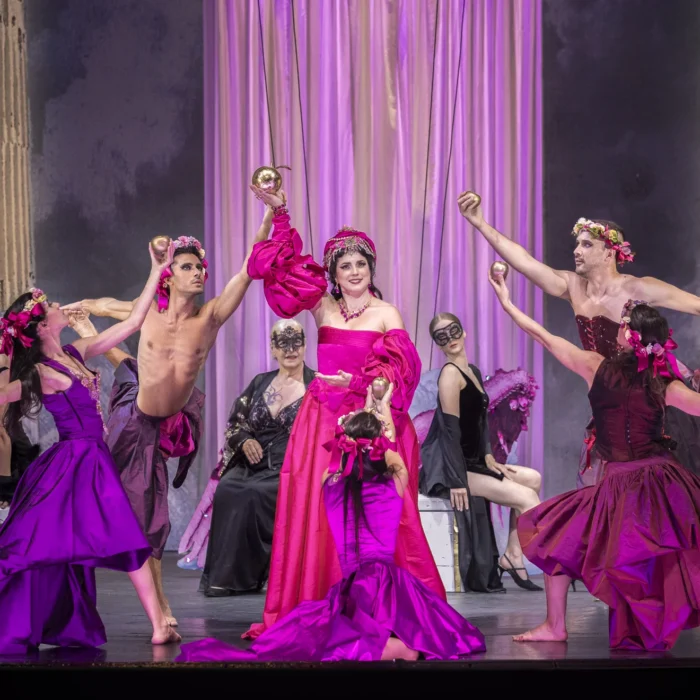
At the moment the hunting party arrives, we are treated to a stunning tableau vivant in the background, a reenactment of Luigi Sabadelli’s fresco “Assembly of the gods on Mount Olympus” (1819-1825). The visually appealing and colourful setting depicts Wotan surrounded by the gods of Walhalla watching the onstage action. This image is not gratuitous, as it was foretold by Waltraute in the first act.
Given Herheim’s propensity for violence, Hagen kills not only Gunther but also Gutrune (truly gratuitous). The gods remain immobile until the end of the opera. The Gibichungs in the hunting party disrobe–de rigueur for this director–and simulate the flickering flames of the burning of Walhalla. The gods descend from the tableau vivant and also disrobe (the more the merrier). As the stage is cleared and the final notes play, the sets change to the opening scene of “Das Rheingold,” the interior of a train station. A cleaning lady sweeps the floor.
Musical & Cast Highlights
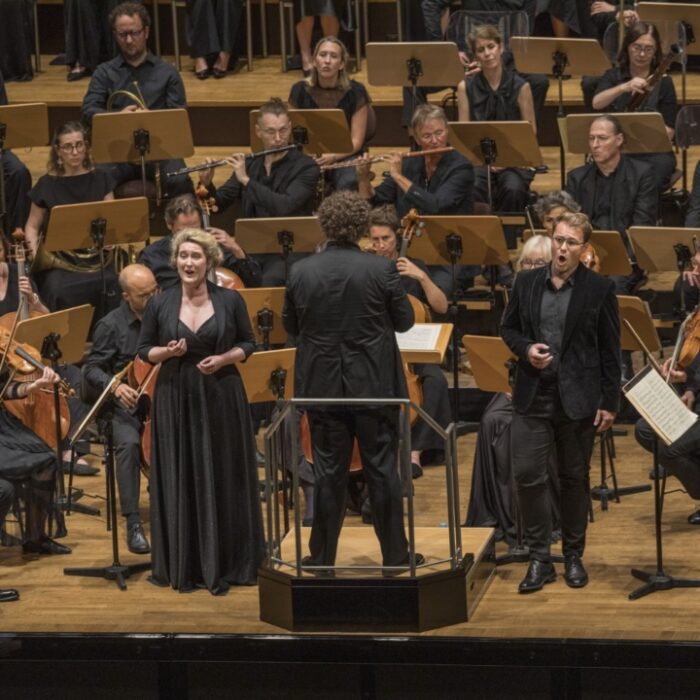
As in the “Ring’s” other three operas, this “Götterdämmerung” was of the highest musical standing thanks to the excellent cast, the ever dependable Donald Runnicles, and the Orchestra of the Deutsche Oper Berlin. Indeed, the anguish in Waltraute’s scene with Brünnhilde, the terror in Brünnhilde’s abduction and in Alberich’s visit to Hagen, Brünnhilde’s rage and finally the fury the “Vengeance trio” were all amplified thanks to the masterful conducting of Runnicles. Appropriately, Brünnhilde’s immolation scene was the orchestral pinnacle of the evening and possibly the entire “Ring,” thanks to Runnicles’ impeccable musicianship. Alternating between softness and vigor, Runnicles made excellent use of Wagner’s massive late‑Romantic orchestration, which includes full percussion, four harps and eight horns, in addition to strings and woodwinds. Collectively, the musicians expertly conjured ominously dark textures or ethereal sweetness, depending on the scene.
American dramatic tenor Clay Hilley impressed even more than in “Siegfried.” It was a delight to hear a fresh lyrical voice able to confront this dramatic tenor role so effortlessly, even at the end of the opera. Siegfried in “Götterdämmerung” is more complex than in “Siegfried.” Hilley was able to nuance his voice, showing different facets of the character. Most impressive was his vocal morphing into Gunther during the abduction of Brünnhilde, where he transformed his voice into a more baritonal one. As both were wearing identical masks, one could not tell who was singing.
Britain’s Catherine Foster is an appealing dramatic soprano endowed with a powerful and incisive voice. Heard last season as Barak’s wife (Die Färberin) in “Die Frau ohne Schatten” in Berlin, she met the vocal and dramatic demands of that challenging role, as she had two days earlier as Brünnhilde in “Siegfried.” Foster is endowed with a powerful and incisive voice. With extreme ease in her upper register, impeccable diction and a powerful stage presence, few Brünnhildes have been as imposing. Equally important, she knows how to express fury, passion and despair, all necessary emotions in this, the most demanding Brünnhilde portrayal of the Ring cycle.
The revelation of this performance was bass Albert Pesendorfer as Hagen. Few Hagens have conveyed the character’s rage and torment as Pesendorfer did. He was indeed one nasty Hagen, perfectly channeling the self‑loathing, resentful underling. His crystal clear diction and attention to wording were essential in personifying this complex character. Indeed, this is a phenomenal singer and actor. It is hard to conceive that this is the same man who portrayed the soft-hearted Fasolt in “Das Rheingold.”
American baritone Thomas Lehman was an outstanding Gunther. This role requires excellent acting, and Lehman perfectly portrayed the weak, wealthy man in over his head, easily manipulated by his conniving stepbrother. His pleasant, warm baritone contrasted well with Hagen’s bass.
Waltraute’s scene with Brünnhilde is one of this opera’s most beautiful and intense moments. Annika Schlicht, an exceptional Fricka in “Das Rheingold” and “Die Walküre,” astonished as Waltraute. Schlicht’s transformation from the imperious Fricka into the anguished Waltraute was indeed astounding, and her beseeching of Brünnhilde was extremely affecting.
Soprano Felicia Moore excelled both vocally and dramatically as Gutrune. Her beautifully youthful voice was a perfect fit here for the tragically insecure rich kid Gutrune; she exuded malaise from the moment she arrived onstage. In the finale, following Siegfried’s murder, she was devastatingly moving in her grief.
Thanks to the excellent singers, to Runnicles and even to Herheim’s less muddled staging, this was a truly satisfactory “Götterdämmerung.” Unfortunately, understanding the relevance of the refugees to the “Ring” was never demystified in the tetralogy’s last installment, as one had hoped. The suitcases and the refugees likely refer to being “on the move,” but what does this have to do with Norse gods? If Herheim’s take on the “Ring” is on a human level, and the gods mere metaphorical figures, it’s still confounding. If human destiny is to be on the move (what a revelation!), what does the symbolism of the “Ring” have to do with it?
All was as obscure by the end of “Götterdämmerung” as it was in the tantalizing beginning in “Das Rheingold,” which is a pity, as this long and musically glorious exercise could also have been intellectually gratifying had there been more attention granted to the clarity of ideas.