ABAO Bilbao Opera 2025-26 Review: Andrea Chénier
By Mauricio VillaThe company ABAO-Bilbao Opera closed its 2025-26 season with Giordano’s masterpiece “Andrea Chénier.” A luxury cast was led by opera star Michael Fabiano, alongside the rising Spanish soprano Saioa Hernández and the extraordinary baritone Juan Jesús Rodríguez.
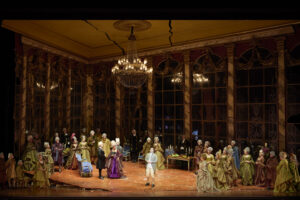
A co-production between ABAO and the Festival de Peralada, it presented beautiful and meaningful sets and costumes designed by Ricardo Sánchez Cuerda and Gabriella Salaverri, respectively. The staging maintained essentially the same structure across all four acts: the corner of a grand hall, with a steeply raked floor and an exaggerated sense of perspective. The first act reveals golden pillars, glass, and a chandelier—though clearly in a state of decay, with a broken ceiling and a section of the floor missing. In the subsequent acts, the walls transform into transparent canvasses revealing scaffolding behind them, or are covered in wooden strips and fencing. The costumes were period pieces with a touch of modernity. This production demonstrated how a staging can be both contemporary and beautiful at the same time.
Production Details
The main weakness was the stage direction by Alfonso Romero. It was functional and respectful of the libretto—he moved the characters according to the action of the opera—but there was little depth in the psychological characterization of the roles. As a result, the performance relied heavily on each artist’s own stagecraft, and it was easy to tell when a singer had received no real direction: they would wander the stage and move their arms randomly, which is what performers tend to do when they don’t know what to do. The final fourth act duet was particularly jarring. Although the opera is considered verista—meaning it aspires to realism—the last duet is a metaphorical climax of love and death that demands a different kind of theatrical language. It was difficult to believe in this outburst of love and mortality, with music so powerful, while the singers were seated on a couch and ultimately left the stage holding hands as though heading out for a stroll rather than to the guillotine. That said, it is something of a relief to see characters behaving in accordance with what they are singing, rather than the absurdities we are so often forced to accept in opera productions. But stage directing is an extraordinarily difficult task. Moving people around the stage according to the action is not enough—there must be a connection with today’s audience, and the staging must illuminate the meaning, ideas, feelings, and even politics that the opera is engaging with.
Michael Fabiano as Andrea Chénier
Andrea Chénier is an opera for tenors—and there are very few works in that category: “Otello,” “Werther,” “Les Contes d’Hoffmann,” “Don Carlo,” “Un ballo in maschera,” “Faust.” The title role carries four arias (one per act) and two long duets. The tenor is the absolute protagonist of the performance, followed by the soprano and baritone. All other roles, including the chorus, are given only spare lines and brief moments.
Michael Fabiano may be one of the very few singers working today who can do true justice to the role of Andrea Chénier. He has always had a large, dark voice, but as his career has evolved, his sound has grown darker and even more substantial. What is truly remarkable is that in moving toward heavier spinto and dramatic repertoire, he has managed to keep his voice light when needed, singing with a beautiful sense of phrase and delivering genuine dynamics and mezza voce. There is a regrettable tradition in verismo opera of resorting to a series of melodramatic clichés to heighten the drama—portamenti everywhere, exaggerated emphases—but Fabiano avoided all of that. Instead he sang with extreme lyricism, making Giordano sound almost like Bellini. His portrayal of Chénier was strong, meaningful, and hypnotic, while his singing was lyrical, heroic, and dramatic all at once.
He had only a few spare lines in the middle register, demonstrating how projected and secure that range is, before singing his first aria of the evening, and probably the opera’s most famous: “Un dì all’azzurro spazio,” with no opportunity to warm up his voice on stage beforehand. He sang the first part of the aria with beautiful lyricism and tenderness, with a strong, secure attack on his first B-flat in “T’amo,” marked forte in the score. What was surprising was how ardent and aggressive he became in the second verse, before returning to tenderness in “ecco la bellezza della vita” with expansive legato lines and another thunderous B-flat. He received the first ovation of the evening, though the conductor seemed more interested in pressing on with the opera than in allowing the tenor to receive his well-deserved applause.
The second act follows the pattern of the first: the tenor has a few spare lines before his second aria, “Io non ho amato ancor.” One of the great challenges of this role is that it lies mostly in the middle register, barely touching the passaggio, before the arias suddenly rise in tessitura and demand high notes in forte. Thanks to the natural projection of Fabiano’s voice, he was able to sing in the middle register without pushing or loading the sound—which could easily compromise the high notes. Indeed, he delivered a beautiful diminuendo to mezza voce on “si chiama amore” just before the aria. He sang it effortlessly, building to a climax with two forte B-flats on “Credi all’amor”—powerful and heroic (a vocal line he repeats in the subsequent scene with Roucher on “Ah, mio bel sogno”). He sang the lyrical line “Ora soave…” in the duet with Maddalena with extreme beauty and dolcezza—sweetness, as marked in the score—delivering a straight, secure attack on the first A-flat, before growing ardent and heroic on “fino alla morte insieme” and finishing the duet with a thunderous B-flat alongside the soprano.
He attacked his single third act intervention, “Sì, fui soldato,” with explosive aggressiveness—a passage written mostly in the middle register within the staff, save for two final A-flats. Fabiano revealed the true nature of his voice here: how powerful and aggressive he can sound in the middle range without pushing or over-darkening the sound. His reaction upon being condemned to death was astonishing—one could see Chénier become weak, defeated, frightened, and incredulous. He sang the fourth-act aria “Come un bel dì di maggio” with a vast palette of vocal colors to express the transition from sadness to desperation, delivering another ringing B-flat toward the end.
The ending of “Andrea Chénier” is quite extraordinary, in that it breaks with the verismo realism that characterizes the rest of the opera and becomes poetic and allegorical—an outburst of emotion and ecstasy centered on the idea of love reunited in death. The music is mostly bombastic and deeply emotional, dwelling in fortissimo for much of its duration. For singers who have spent most of the evening in the middle register, the tessitura suddenly shoots upward into a showcase of forte A-naturals, B-flats, and B-naturals. The chemistry and connection between Hernández and Fabiano was outstanding, and their voices blended beautifully, especially on the high notes. It was the highlight of the evening, as it should be, in terms of power, projection, and sheer commitment from both protagonists.
Saioa Hernández as Maddalena di Coigny
The great Spanish soprano Saioa Hernández sang the role of Maddalena di Coigny. She possesses a genuine spinto/dramatic instrument with a dark timbre, impressive projection, and a fast, marked vibrato in the upper register. The first act is something of a warm-up for the soprano, who is given only a few spare lines, mostly written within the staff. She opened the brief second act duet with Chénier showing the strength and beauty of her middle register—her first lines are written within the staff—but demonstrated her legato and mezza voce in the lyrical line “Ah! Ora soave,” when her voice rose to a high A-flat for the first time in the evening, and delivered a ringing B-flat at the end of the duet on “Viva la morte insieme” alongside the tenor.
She sang the line preceding her famous third act aria “La mamma morta” with a dark, deep chest voice on “se della vita sua tu fai prezzo il mio corpo.” The highlight of her performance was her interpretation of this celebrated aria. The first part remains in the middle-to-low tessitura that characterizes this role, and Hernández made full use of her penetrating chest voice. Having sung at such a low tessitura all evening, however, it is very difficult to keep the voice light enough to execute the high notes that follow. Yet the soprano, investing every line with emotion, managed to deliver strong high notes up to a sustained, ringing B-natural. The audience went wild—one could even hear people calling for an encore!
Juan Jesús Rodríguez as Gérard
Juan Jesús Rodríguez portrayed Gérard. He faced the challenge of opening the opera with the long monologue—difficult to classify as an aria, given its parlato writing mixed with lyrical lines and outbursts of rage—”Compiacente a’collo qui,” and immediately set the standard for what a great evening this would be. His instrument is dark and large, filling the vast Euskalduna auditorium without effort. He was impeccable in style in the lyrical recitative passages, colored with sadness and resignation—until “T’odio casa adorate,” where his singing turned aggressive, crowning the phrase “È l’ora della morte” with a secure, ringing high F-sharp. His great moment came in the third-act aria “Nemico della patria?” He sang the first section, more recitative in character, with doubt and rage, projecting his dark, large sound. He then shifted easily to the legato lines and seamless breath control of “un dì m’era di gioia,” which he sang with expressive sadness and pathos, infusing certain lines with the rage the character requires and conveying the moral weight and deep conflict within Gérard. He was extremely lyrical in “La coscienza nei cuor,” with a fluid, effortless ascent to a high F-sharp on “e in un sol bacio.” He received a strong ovation after the aria. His confrontation with Maddalena was hair-raising, as he traced the full dramatic arc of the character’s emotions—from rage, lust, and love through sorrow and resignation.
More Musical Highlights
Outstanding, too, was the performance of Nancy Fabiola Herrera as Madelon in her brief aria “Son la vecchia Madlon,” which she sang with exceptional depth and emotion, showing off her strong low and middle registers and her powerful high Gs. She had also sung La Contessa di Coigny in the first act, though that role is limited to a few spare lines.
Conductor Guillermo García Calvo seemed more interested in playing as loudly as possible than in finding a balance with the singers—the chorus included—though the voices of Hernández and Fabiano had no difficulty projecting over the exaggerated orchestral volume. Giordano’s orchestration is not simple, and there were moments in the first and third acts where the sound became blurred and muddy. There appeared to be little connection between the conductor and the soloists, who seemed uncomfortable with his tempi at several points. That said, the Bilbao Orkestra Sinfonikoa and the Coro de la Ópera de Bilbao sounded excellent and executed Calvo’s direction with skill.
A beautiful production with straightforward stage direction and three outstanding singers who carried the full weight and success of the evening.