Styriarte Festival 2026 Review: Mozart’s ‘Requiem’
By Mengguang Huang(Photo: Nikola Milatovic)
To speak of Austria as the land of music could be dismissed as a media cliché, a postcard trope engineered for cultural tourism. Yet, experiencing the Styriarte Festival shatters this skepticism entirely. Even in an era where cultural budgets across Europe face systematic contraction, the festival’s curation maintains an outstanding level of detail, immersive hospitality, and uncompromising artistic vision.
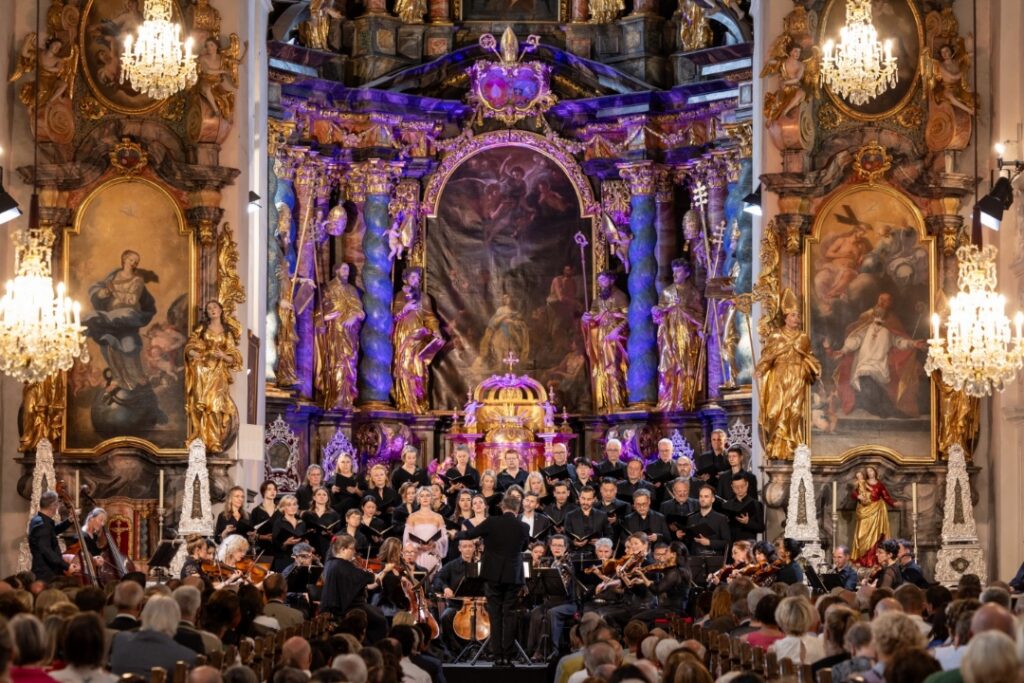
Hearing such a familiar work like Mozart’s “Requiem” (KV 626) inside the Pfarrkirche Stainz—a space intimately bound to the festival’s founder and early music revival icon, Nikolaus Harnoncourt (1929-2016)—transforms the performance into a profound, multi-sensory pilgrimage experience.
The journey started with a festival shuttle bus through the rolling Styrian landscape, culminating in the summer elegance of the Stainzer Schlosshof. Here, an enthusiastic audience, many adorned in traditional Austrian Tracht, wandered through the splendid, blossoming garden.
The Pfarrkirche Stainz boasts an ideal interior layout where the sightlines remain completely unobstructed by heavy pillars, drawing the eye naturally toward the altar. The church’s captivating stucco work and celestial ceiling paintings provide the ultimate visual context for Mozart. Throughout the evening, during moments of deep musical contemplation, one’s gaze could linger on the background of the high altar and the frescoes above, finding a perfect architectural mirror to the late 18th century counterpoint unfolding below. Acoustically, the sanctuary achieves a delicate balance between the rich, rolling reverberation native to baroque churches and the crisp textural clarity necessary for intricate polyphony.
The Liturgical Framework
While sacred music remains a perennial centerpiece of each Styriarte season in Stainz, this year Mozart’s “Requiem” was chosen and coupled with a compelling commitment to reconstructing the original liturgical environment. It achieved a complete theological and liturgical ascension loop for the souls of the departed by integrating the five pristine female voices of the ensemble Schola Resupina at the opening, the close, and immediately preceding the “Offertorium.” They were clearly audible yet completely invisible. These chants succeeded in shaping a deeply imaterialized religious experience. The monophonic texture of the Gregorian lines functioned as an exquisite historical chiaroscuro, a deliberate blank space that refreshed the audience’s ears between the dense orchestral movements.
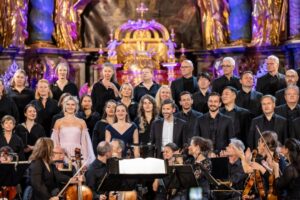
Styriarte Festspiel-Orchester, directed by Michael Hofstetter, delivered a performance as authentic and convincing as their Haydn program days prior. Aside from a slightly unfocused entry in the opening violins of the “Recordare,” the string section masterfully navigated the dual nature of Mozart’s writing. They pivoted effortlessly between an elastic cushion for the soloists and the jagged ferocity required for the score’s darker moments. Nowhere was this more poignant than in the “Lacrimosa.” The weeping, question-like rising theme was rendered with a weightlessness, hovering and descending through the air like a lone feather falling in slow motion. Conversely, the lower strings provided an immovable rock in the “Agnus Dei,” their pulse beating with the quiet precision of a heart facing eternity.
The brass, too, claimed a large share of the evening’s success. They injected a brilliant light into the furious tempests of the “Dies irae,” cutting through the choral textures with a terrifying, radiant glare. Hofstetter’s tempos were expertly judged—deeply attentive to micro-detailed phrasing, yet always tethered to the overarching macro-structure.
(Photo: Nikola Milatovic)
Choral Mastery
The Arnold Schoenberg Chor demonstrated once again why they remain peerless in this repertoire. Showing an intimate familiarity with the acoustic conditions of the Stainz church, their articulation was well-calibrated to prevent the long reverberation from muddying their lines. The choir transitioned seamlessly between the blinding radiance of the “Sanctus,” the suspenseful resolution of the “Domine Jesu Christe” fugue, and the comforting brightness of the “Hostias.”
In the “Rex tremendae,” they displayed an immense emotional range, moving between majestic terror and tender pleading within the span of a heartbeat. Most striking, however, was their registration in the “Confutatis:” the stark contrast between the angelic, floating high female voices and the subterranean, rumbling low male voices produced a timbre so distinct it felt exactly like a pipe organ switching between its principal and celestial stops.
A Quartet Bound by Subservience
The four soloists—Miriam Kutrowatz, Jolana Slavíková, Daniel Johannsen, and Frederic Jost—deserve much praise for their artistic humility before the text: they prioritized the absolute blend of a unified vocal quartet.
In the “Tuba mirum,” their sequential entries from the bass up to the soprano created a breathtaking sensation of slow, spiritual ascension. This collective intelligence carried into the “Recordare,” where the dual pairings of Soprano/Tenor and Alto/Bass offered highly convincing timbral dialogues, while the intricate, internal conversations of the “Benedictus” were executed with hand-in-glove precision.
The final stroke of the liturgy arrived in the “Lux aeterna.” Though utilizing the thematic materials from the work’s opening “Introitus,” Hofstetter opted for a slightly broader tempo, while granting the brass a more dominant presence in the mix. At the end, the performance dissolved seamlessly back into the timeless realm of plainchant with the three concluding peaceful antiphons.
Epilogue: The Living Spirit of Artistic Adventure
Styriarte’s true magic does not rely on a roster of stellar superstars. Its vitality stems from a deep curation vision which is brilliantly demonstrated by this Requiem’s complete liturgical reconstruction.
Fascinatingly, this daring vision extends into entirely different musical genres. A prime example is the festival’s reconstruction of jazz legend Oscar Peterson’s iconic November 9, 1968, concert at the Wiener Konzerthaus, titled “Hymn to Freedom.” Depending on the original ORF radio broadcast tapes number, Kristina Miller Trio transcribed Peterson’s complex improvisations and resurrected a jazz piano wonder right on stage.
By stepping outside the narrow confines of traditional “historical performance,” Styriarte proves it still safeguards the boundless curiosity and spirit of adventure that defined the early music revival: the festival remains an unparalleled bastion of living art.